Wednesday, March 26, 2008

Chicken Updates

Now that it's spring, things to blog about have been piling up. I'll attempt to catch up with everything in the next few posts.

I moved the hens out of the brooder last Monday to make room for the new chicks. One of the bantam cross hens was so freaked out that she flew against the door hard enough to open it. I tried to herd her back into the house, but she was having none of it. After a few times around the yard, she discovered the overgrown forest belt at the bottom of the hill, and then I had no possibility of catching her. I spent about 45 minutes crashing through brambles, trying to head her back up towards the house, but she was too canny to fall for that. Finally, I decided to let her be a wild chicken if that's what she wanted so much. There are coons and foxes out there, so I didn't expect that she'd live very long.
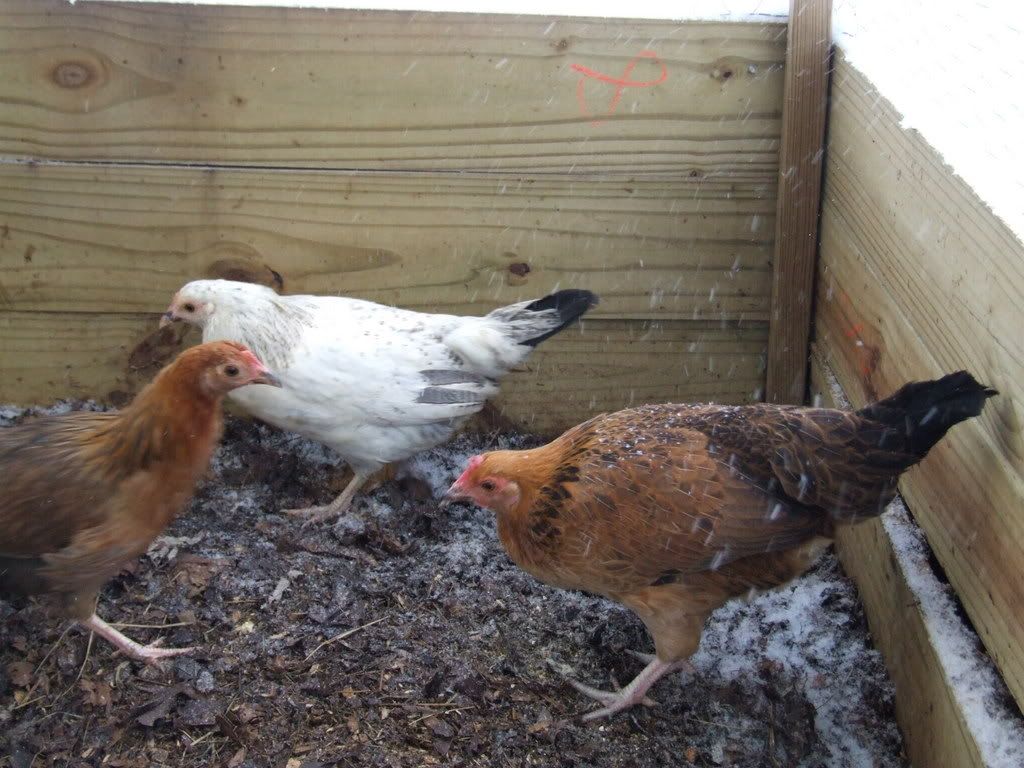
(The hen on the left is the escapee.)


All the other hens have settled in well out at the land. For now, I have them confined to their mobile house, to establish that it is home for them. Also, the pasture growth is too new to let them go scratching it wherever they want. However, most of the grain field is covered with the matted down dead growth from last year, so I'm moving the chicken house over that to tear it up and make it easier for the new grass to grow.

The new chicks arrived last Wednesday. I ordered 50 straight run Silver Laced Wyandottes. The cockerels will be slaughtered as fryers or broilers, and the pullets will be added to the laying flock. They'll look something like this when they're grown.


I had wanted to order ducklings first, but the hatchery was behind on orders since the ducks hadn't even started laying yet! It figures that the ducks would throw a wrench in the plans. It will probably be another month or so before I'm able to get any ducklings. I'm planning to get runner ducks (assorted colors) and Pekins.

A few days ago, in the evening, I saw the wild chicken again. She was poking about the bottom of our yard, although as soon as she saw me she ducked back into the brambles again. I'm surprised that she managed to survive out there. After I saw her a few more times, I decided to set up a live trap for her. We got a Havahart raccoon trap in Arizona, when the badgers destroyed our duck flock. It never caught anything there, but it was worth a shot.

I only opened one end, and set a bowl of corn at the closed end. I sprinkled some of the corn at the entrance to attract her. I wasn't convinced that she would be heavy enough to trip it, but it was worth a try. Last night, the trap was still open and she was wandering around the yard. There was a storm blowing up, so I think she wanted to get back into the brooder. Since it's now full of chicks, I couldn't open it up for her. At one point she walked past the trap and looked in at the bowl of corn, but she didn't enter it.

I guess she decided to go for it, because this morning there she was in the trap, with the door closed behind her. Now I can take her out to rejoin the others at the land.

Saturday, March 08, 2008

Farm Newsletter

Greetings from Foxtail Farm,

As spring quickly approaches, it's time to begin planning for the growing season. We're excited about the new products we will have available this year: pastured poultry (eggs, broilers, and turkeys), grass-fed young goats (cabrito), and fresh produce in season.

Pastured Poultry

Our laying hens are allowed to free-range the pasture in spring, summer, and fall. The large volume of grass and insects they eat greatly increase the omega-3 content of their eggs. They produce large, brown eggs with bright orange yolks that are superior in taste to supermarket eggs.

The broilers are confined to a mobile pasture pen for safety, but it is moved every day to a fresh location. Since their diet is composed of up to 30% grass, these chickens have very lean, flavorful meat. They will be available in mid-June and throughout the summer.

The turkeys are raised the same way as the broilers, but since they are able to fill even more of their diet with grass and insects, the taste improvement over supermarket turkeys is pronounced. They will be available in limited quantities fresh for Thanksgiving.

Cabrito

Cabrito is the Spanish word for young goat. Goats have very lean meat that is mildly flavored when they are young, similar to lamb. A typical way to cook it is to grill a hindquarter over wood coals for several hours, turning every 20 minutes, and then wrap it in foil and cook in a 250° oven for an additional two or three hours. At this point the meat will be tender enough to fall off the bones, and it can be shredded with a fork. We will have a limited number of kid goats for sale this year as cabrito.

Produce

Beginning in May, we will have produce available. All of our produce is grown without pesticides or non-organic fertilizers. Call or stop by to find out what we have available at any given time.

At the back of this newsletter (here) there is an interest form that lists everything we plan to produce this year. Please mark anything that you are interested in and return the form to us so that we can contact you with more information. The form is just to help us gauge interest; you won't be making any commitment to buy at this time.

The newsletter also contains an article by Jo Robinson, titled "You Are What Your Animals Eat." This article may be read online at www.eatwild.com .

Monday, January 21, 2008

Herd Relationships

I saw definite signs of heat in four of the does today (3, 7, 8, and 10). This is the first time I've been able to observe goat breeding behavior in a large herd. The does have paired up (3 & 10, 7 & 8), and in each pair one is docile and loving and the other is aggressive and vicious. I'm not sure what the purpose of this behavior is, but it's been interesting to watch. The does all still beat Bubba up regularly, but at least he has started fighting back. I've been letting him out into the main pasture every day to eat goat feed and hay without being attacked, and this seems to have helped toughen up his attitude a bit. He's also grown quite a bit over the last few months, and he looks much more adult, and less like an adolescent. He'll be a year old in February. I really hope he manages to breed at least a few of these does this year.

Wednesday, January 09, 2008

The Great Chicken Escape

Early this morning, before I'd even had a chance to make some coffee, Paul looked out the window and said, "There's a chicken in our neighbor's yard!" Actually, all six of the new chickens were in the neighbor's yard. It was very windy yesterday and last night, and the greenhouse plastic had been ripped loose from the chicken house roof. Those pullets always perch up near the top of the house, so they were able to just sidle on out into freedom.

To get them back in, first we had to deal with the Reds. The new chickens are skittish enough that they would not go in the door if a person was standing there, but if we stood back the other hens would hop out as well. One piece of plywood later, and all the red hens were crowded into a corner away from the door.

Luckily, my experience working at a dairy had taught me how to herd animals. Chickens are more difficult than cattle, but still easier than goats. I placed Paul strategically to prevent them from breaking for the street, and then carefully worked the chickens closer to the open door of their house. They milled about just outside of it, but a little more pressure got five of them to hop in. The sixth decided to make a run for it.

Several circles of the yard later, I was about ready to give up and go make myself a chicken catcher. However, Paul wanted to try one more time, and he managed to trap her against one side of the house. I snagged her as she tried to dive past and tossed her in. The plastic sheeting has been reattached and battened down, so hopefully there won't be a repeat. When it's time to replace the plastic, I think I'll extend the chicken wire up the roof first to prevent escapes.

Saturday, January 05, 2008

Tame Goats

The goats have become so tame in the last few months. I think it might be because they're eating hay exclusively now, so all of their food comes directly from the humans. Whatever the reason, I was able to deworm all of them in about 15 minutes today. All but one of them let me just walk right up and grab her. Of course Goshen tried to escape, but she was stupid enough to run into their house and was easily caught.

I also had the opportunity to try out the pvc and duct tape solution to goats getting their heads caught in the fence. It probably works better in warm weather, but here in the winter the duct tape didn't hold very well. The pipe only stayed on for a couple of days, and then those goats were right back to getting their heads caught.

I've designed a much sturdier version using pvc and pipe clamps. It's still in field testing, but once I've gotten the bugs worked out I'll post the instructions.

Thursday, December 06, 2007

Hay! Snow!

Sorry for the bad pun. I couldn't resist.

It snowed most of yesterday, and it looks like we got maybe six inches. This is a lot different from last year, where it rained through most of December and the few snow showers did not stick. I had hoped to put off feeding any hay until the end of December or early January, but with the forage under so much snow I figured I had better break it out, at least for a few days.

I constructed the hay feeder by attaching a sixteen-foot cattle panel to about a ten foot length of the fence. That caused it to bow out far enough to put hay in it, but it was narrow enough that the goats could reach hay that was pretty much anywhere in the holder. I plan to attach a tarp on the top to keep the hay dry, but for now I'm just only putting about a day's worth of hay in there at a time. I'll probably also put some branches in the bottom to help keep the hay off the ground.

In reading around a bit, I found a source stating that adult meat goats eat 3-4 lbs of hay per day, not the five that I had found before. So refiguring at eight adults and two babies, that means I need approximately 38 pounds of hay per day, not 50 as I had thought. The only full months that they should need the full ration of hay are January and February. They should only need supplemental hay in December, and new growth should start showing up near the end of March, so I figure I need about 90 days worth of hay. I'll bump it to 100 to allow for unusually bad weather or other circumstances. So 3800 pounds of hay for the winter. There's about 1800 pounds in the haystack that I cut myself, so I need to buy about a ton. We'll be using the money from selling the lawn mower to pay for all that hay. Next year's goal: produce all needed hay on-farm!

Oh, yes. Paul is not getting deployed because of medical issues with his shoulder and neck. It will be good to have him here, but it means that we probably won't be able to complete many, if any, of the big projects next year. Still, we're trusting the Lord to provide for what we really need, and we'll work with that.

Wednesday, December 05, 2007

Chicken Pictures

It's hard to get good pictures of chickens, especially when they are being periodically attacked by other chickens twice their size. However, here are some photos of the new girls.

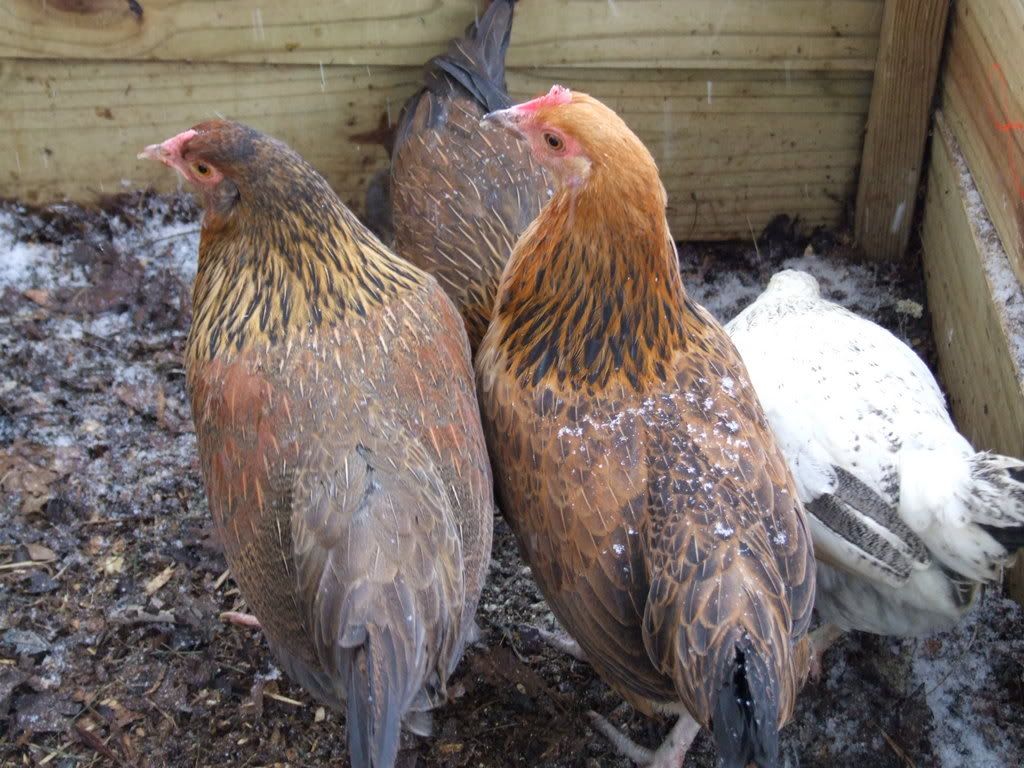
These are the first three. The one in the back has tufts of feathers over her ears, which might get more pronounced as she gets older.


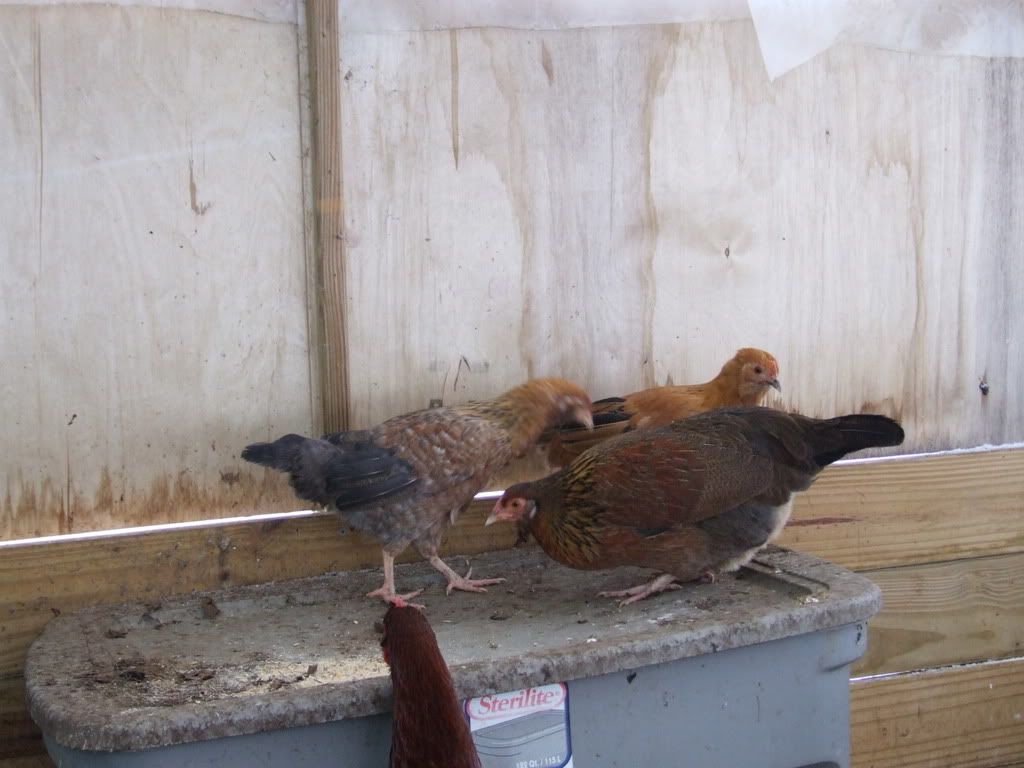
Here are the second three. I'm a sucker for white birds, so I really like the white one in the back. Her neck feathers are lightly barred and are very pretty.


I was trying to get a good picture of the ear-tufted one, but she's even more flighty than the others, so this was the best I could do.


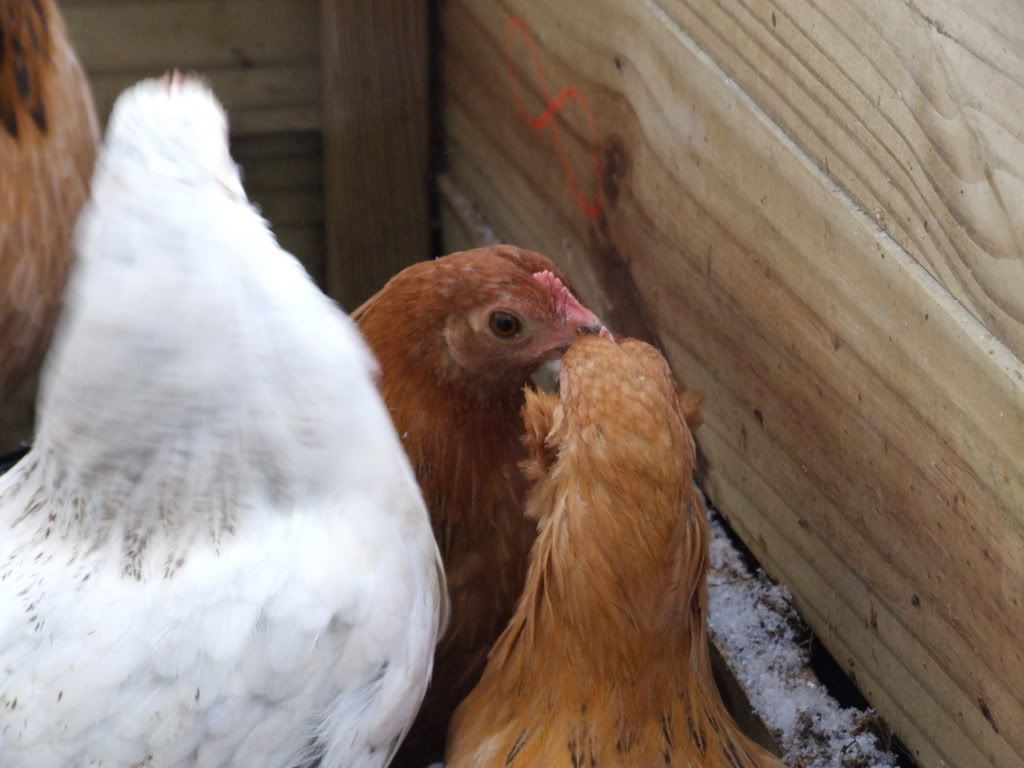
A close-up of multicolored feathers.


If anyone has any ideas what breeds might be in these chickens, let me know. I'm pretty certain that a significant portion of their background is bantam breeds, because they fly very well.

Tuesday, December 04, 2007

Laying Hens: Generation 1.5

We sold our riding lawnmower to a couple in town today, and while I was talking with them I mentioned that I kept a flock of chickens. They immediately wanted to know if I wanted to have any more, because they were reducing their flock. Since they were free, I agreed to look at them.

I guess that several months ago they were given a hen with about ten chicks, all of unknown ancestry. Now that the chicks are a few months old, they wanted to get rid of most of them. I only wanted the pullets, since I don't feel like slaughtering a batch of roosters this winter (and I especially don't want to deal with them if they start crowing before they reach a good slaughter weight). I have no idea what breed(s) they are, but I ended up with six nice-looking little birds. One possibility was Americauna, but their "mother" lays brown eggs, not blue and green. She also looks a lot like them, so she's probably related even if not the actual mother of all of them. It will be interesting to see how they turn out. They seem to have finer frames than I remember the Rhode Island Reds having at that age, so they might end up being some combination of bantam breeds. It was getting dark when I put them in the chicken house, so I'll have to get pictures later.

My flock didn't quite know what to make of these newcomers. They all grew up together, so their social structure was established very easily. It was definitely a vivid demonstration of the "pecking order," as each of the hens seemed to have a goal of eating at least one feather from every new pullet. Hopefully the new girls won't be bald by morning.

With extra chickens in the house, they may not be able to keep the bedding as scratched up as before, so I'll have to watch out for capping. That's the nice thing about starting out with a large amount of space/bird: there's room to take advantage of these sorts of opportunities. Even with adding half again as many birds, they still have 3.5 square feet each. Once I build the new external nest box, it will make things even more roomy.

Since the new pullets are at most three months old, we'll probably start getting eggs from them in early March. This will give us a nice boost in next year's production.

Monday, December 03, 2007

Dairy Goat Deferred

I had said previously that I wanted to get a dairy goat this fall for spring milk (either already bred, or she could be bred to Bubba). It's been so difficult to find dairy goats around here that I would pretty much accept any breed, even though I would prefer a Nubian.

There was a lead at a farm about an hour away. They had goats, and wanted to sell a couple of Nubian/Toggenberg crosses (that were bred to a Boer cross buck). The does were four years old and had never been milked, and were due in February (yikes!). Still, the asking price of $125 each wasn't bad so we went out to take a look.

Well, it turned out that the buck had gotten out a few times, so the does were possibly due to kid at any time. They weren't in bad condition as far as their weight was concerned, but their feet were a mess. One of them had a hoof that was so long that it had turned under and she was walking on the sidewall. I've never had to correct a hoof that long, but my experience with bad hooves is that it takes a long period of frequent trimming to get them anywhere even approaching normal. That doe also had a mismatched udder, and the larger half was nearly dragging on the ground. Oh, and she had at least one extra teat sticking out of the side of the udder. She was such a mess that I wouldn't have taken her even if she had been free (you have to figure that each goat will add at least 500 lbs to your winter hay needs).

The other doe wasn't anywhere near as bad. Her hooves were overgrown, but they looked like they would take less than six months to correct. I think her udder was reasonably high, balanced, and without extra teats, but she was so skittish it was hard to get a good look. Because of the skittishness, hoof neglect, lack of a milk record, and lack of breeding record (as well as her age and crossbredness), I offered $100 for her. I actually think that was even a bit high, but I didn't expect them to go any lower. They hemmed and hawed a bit, but when it was clear that I was serious in my offer, they declined it, saying they could get that much for her kids. It was just as well, because I would rather spend $200-$300 on a decent, non-show purebred from proven milking lines. I just need to keep working the connections to find something like that.

At this point, it's probably too late to get a dairy goat for this year. I would want to keep her in quarantine for two weeks, and with the weather getting bad that would be difficult to manage. Time to start contacting all the goat breeders in the area, to see if I can get a freshened doe in the spring.

Friday, November 16, 2007

Egg Tidbits

During the summer, I fed the laying hens a blend of 18% broiler feed and cracked corn, about 1-1 proportions. They picked up the rest of their protein needs from the insects on pasture, and crushed oyster shells were supplied free choice separately for calcium. In early November I ran out of cracked corn, so they got the straight 18% feed for a few days. The egg production almost immediately jumped from 4-6 eggs per day to 6-8 eggs per day! It makes sense, since there are fewer insects available now. So they will continue to receive the higher protein feed for as long as they continue laying this winter.

Some of the eggs were looking pretty big, so I looked up the weight requirements for the different sizes. According to this USDA publication,


Size or weight classMin net weight/dozenMin weight/egg
Jumbo30 ounces2.5 ounces
Extra Large27 ounces2.25 ounces
Large24 ounces2.0 ounces
Medium21 ounces1.75 ounces
Small18 ounces1.5 ounces
Peewee15 ounces1.25 ounces


The most recent dozen eggs had a net weight of 26 ounces, so they were nearly Extra-Large. I need a more accurate scale to measure the individual eggs, since my kitchen scale only has marks for ounces. Still, if my pullets are laying such large eggs now, just imagine how big they should be after they fully mature.

The hens will be moving into their winter quarters (the brooder house) tomorrow. It's not too cold for them to be out on pasture, but we've now entered the fall rainy season, and it's pretty muddy out there. If I let them stay, they'll cause a lot of damage to the pasture. There's not a whole lot left for them to eat out there, anyway.

Agriculture Resources

After reading some great excerpts from old agriculture books, I've decided to collect as many as I can find that are pre-1940. I found some very promising ones at the Antique Mall in Barnesville.

Agriculture Yearbook, 1924. Topics include hay, poultry, and weather, as well as the agricultural statistics for the year.

Yearbook of Agriculture, 1935. Includes the previous year of agriculture, new developments, and statistics.

Yearbook of Agriculture, 1936. Topic: Genetics and the improvement of plants and animals. No statistics, because this was the first year that they were moved to their own volume.

Pork Production, by William W. Smith. 1937. Extensive information on all phases of pork production, including several chapters on forage and several more on feeding other agricultural by-products (skim milk, whey, etc).

Old McDonald Had A Farm, by Angus McDonald. 1942. This one is actually a biography, but I couldn't resist after reading the author's note at the beginning.

"This book is about my father, James Angus McDonald, and how he labored to make a good farm out of a poor one. I lived on this farm with him and my brother, sister, and mother from 1912 to 1922, near Sallisaw, Oklahoma."

I have no idea if it will be any good, but there might be some agricultural gems hidden in the prose.

There was also a cardboard box filled with herd registry books for the American Jersey Cattle Club from the 1890s. The entire box was $50 and I was really tempted to buy it, just because I like poring over that sort of thing. Plus, if I ever get into full-sized dairy cattle, Jerseys are probably what I would get. I managed to restrain myself, although if the box is still there next time I go down there, I may not be able to resist again. Other than the registry books, I pretty much cleaned them out of agriculture books.

Tuesday, November 06, 2007

Some Musings on Future Endeavors

Potential Projects for 2008

Animals

Cattle: I would like to get a couple of 18-month-old steers next spring to graze our pastures. They would be slaughtered in the fall.

Chickens:
  • Layers: This year's hens should really start producing a lot of eggs in the spring. I would like to build a hoophouse green house for winter poultry keeping, so that I can have more than twelve hens. I'll also be buying another batch of chicks.
  • Broilers: Since I actually have the pasture pen finished now, I'll go ahead and get a batch or two of Cornish cross broilers. I'll also probably get the next batch of layer chicks straight-run, so that the cockerels can also be used as broilers. Perhaps I'll also attempt to caponize a few of them.

Ducks: The ducks will be the advance forces in the war against brain worm. I need to look through the duck breeds and see which are the best foragers. I also plan to get Muscovies to keep the fly population down near the goats.

Goats: We'll continue with the Boers, hopefully getting a good kid crop in the spring. I will be keeping all of the good-quality doelings for future breeding. I'm also looking for a dairy goat this fall to provide milk starting in the spring.

Pigs: While Paul is gone, pigs will be in the garden area tilling the soil and eating weeds. I will be planting oats behind them in the summer for winter forage and to keep weeds to a minimum.

Turkeys: Turkeys have been such a disaster this year that I'm not sure I want to try them again so soon. I'll have to make that decision next summer.

Structures

Fencing: I want to finish the perimeter fence around the forest next year. I also want to divide the forest into paddocks so that I don't have to use the electric netting out there. I'd like to save it for the dairy goat on pasture.

Poultry House: With the addition of ducks to my flock, I'll need more space than the brooder for winter housing. I'll probably get a hoophouse kit to build a combination poultry house for the ducks and layers.

Water: I plan to dig out a very small pond at the base of the spring run-off and put a second storage tank nearby. The tank would provide water to the forest paddocks so that the other tank can be used only for the pastures.

Monday, November 05, 2007

A Few More Goat Notes

I'm beginning to see a pattern here:

The only hitch was that early in the process, Nieuw apparently jumped the fence into the next paddock, although neither of us saw her do it.

One section of fence sagged enough that R6 Nieuw got out.

Yesterday, I caught her in the act. She's been going under the fence, not over. Since the bottom-most strand of the electric netting is neutral, she's discovered that she can flip it up with her nose and scoot under, especially if the fence is "floating" on top of heavy vegetation. So yesterday I had to chase all the goats back into their previous paddock and then use my scythe to cut a fenceline for the netting. Once it was flush with the ground, I staked down each section with tent pegs. It seems to have worked, because everyone was still in their paddock this morning.

Also, Bubba seems to have figured out not to stick his head through the fence, because I haven't had to rescue him since the last time I posted about it. So he got a reprieve from wearing a pvc pipe across his horns.

Thursday, November 01, 2007

Working the Goats

Paul and I spent the morning catching goats, deworming, trimming hooves and determining ages. It was downright relaxing compared to the rodeo of last time. This time, I had a cattle panel bent into a half circle and held in place with T-posts (actually, this was the remains of Bubba's pen.) I had set up their paddock fence so that one end ran flush with the cattle panel, so any goats that ran that way hit a dead end. It worked pretty much flawlessly, and since it was so easy to catch each goat the remaining ones never got too worked up.

The only hitch was that early in the process, Nieuw apparently jumped the fence into the next paddock, although neither of us saw her do it. We just left her for last so that she thought she'd gotten away with it, then snuck up and cornered her. Her "shortcut" turned out to be not so short, since we had to drag her all the way back to the first paddock to be treated, and then all the way back to the new one.

Based on how today went, I have a few ideas for building an actual working pen. It will be made of wire panels and T-posts, so if it needs to be tweaked (or completely changed), it will be easy enough. I did a quick sketch of the plan in Paint, so it's pretty ugly but hopefully it makes sense (click on it to see larger version).


The chute is pointing at the driveway so that a trailer could be backed up to it for easy loading. I estimate that it should cost less than $500 to build, with the majority of the cost coming from the panels. That's a far cry from the multiple thousands you can spend for pre-made working equipment. Since I doubt we would ever have more than 30 breeding does on this property at once, we don't need the fancy equipment.

Sunday, October 28, 2007

Goat Psychology

Bubba is an idiot. When I got there today, he was caught in the fence by his horns. After being freed, he went on to get caught twice more in less than thirty minutes. This article has a solution:

"Goats are creatures of habit. If you have a goat that repeatedly hangs its horns in fencing, that goat will stick its head in the same place time after time until you fit the horns with a PVC pipe secured by duct tape. The grass is always greener on the other side of the fence."

Tomorrow, Bubba will be getting some custom headgear applied.

Saturday, October 27, 2007

Goat Management Software

When we had goats in Arizona, I bought the Goat Breeder's Notebook software to keep track of all of the information. It's been sitting on my computer all this time, so I decided to try using it with my current goats. Oh, my. I can't believe I never noticed before how unintuitive and downright buggy this software is. I spent a fair bit of time putting in goat-related expenses, saved them all, and then none of them showed up in a report! And if you mark an animal as dead, you cannot undo it short of restoring an earlier version of the database. Yet there's no warning that it is a permanent action.

In disgust, I decided to search for some slightly more professional software. Most of what I found was either really low-level, or very expensive, but Ranch Manager: Goat Edition looked like a nice combination of quality software for a decent price. So I requested a trial version and have spent the evening playing with it. The trial version is the full program with a 30 day limit, so if I decide to buy it I'll already have all of my information entered.

So far, it has been reasonably intuitive to use, and there are some very nice features. One of the best things is that you can define different locations on your land (pastures, pens, barns, etc) and can keep track of where any given goat is at any time. The really cool part is as soon as a buck is in the same location as a doe or group of does, the software automatically calculates the earliest due dates for the does. You can also draw maps of your locations, and then add hyperlinks in the maps to the individual records.

I do have a few nitpicks. For the map thing, it would be really nice if you could upload maps as well as draw them. In the individual goat records, the photo uploader always starts in the same spot, one of the data folders for the software, so it takes a good five clicks to navigate to my image folder. It would be sanity-saving if it would remember the last folder it opened and start there instead, the way most programs do.

I've got another 29 days to play with this software, and I'm going to throw everything I can think of at it. If I'm still reasonably happy with it at the end of the trial, I'll probably buy it. This company also has special discounts if you buy more than one species' software together, which would be really nice if I had cattle, sheep, or horses. Too bad they don't have a poultry management edition.

Friday, October 26, 2007

Goat Breeding

Well, I broke down and let Bubba in with the girls tonight. See, I had dismantled his pen so that I could use the panel in the great deworming roundup, and had never put it back together. He's on a tie-out for grazing, so it wasn't a huge priority. But tonight after dusk I heard coyotes up on the ridge, and I didn't want to leave poor Bubba unprotected all night. It was too dark to put the panel back on his pen, so he had to go in with the girls and Balto. It's only about three weeks earlier than I'd planned to start breeding, and honestly, since he's young and unproven, it's probably best to start as early as possible anyhow. So kidding season should start in late March at the earliest.

Bubba was more interested in the new grass than the does. Balto thought that he smelled very interesting. He didn't spend that much time sniffing a new doe when she was first introduced. Bantini (this year's kid) ran up to sniff noses with Bubba when he first came in, but the rest of the herd pretty much ignored him.

Since at this point Bantini is the only doe I don't intend to breed this year, I won't be splitting the herd. She's nowhere near large enough to go into heat yet, so it should be fine.

Thursday, October 25, 2007

Nest Box Free Eggs

At least one of the hens has made a habit of roosting in the nest box instead of in the house, so it was starting to get filthy in there. I dumped it out and put fresh hay in it, but I also decided to leave it out of their yard for a while so that the offending hen could make a habit of sleeping elsewhere. In the meantime, the hens can lay their eggs in the grass.

It was kind of funny, because all of the eggs were together today. It looks like one hen chose a spot and made a nest, and the rest waited in line for their turn to use the same spot. That probably would have been funny to watch. I guess they've just gotten used to taking turns in the nest box.

Wednesday, October 24, 2007

Rendezvous Over a Sagging Fence

There's been a lot of rain over the last several days, so the step-in posts for the electric goat fence loosened a bit. One section of fence sagged enough that R6 Nieuw got out. I'll have to mark her as bred, since she spent as long as eighteen hours loose with Bubba. March 22 is a little bit earlier than I wanted to start kidding, but it's not too bad.

Thursday, October 18, 2007

Rodeo

Today we caught the last of the goats that needed to be dosed with dewormers. Paul and I spent a good hour chasing, cornering, roping, and tackling the recalcitrant goats. They're all done now, but we get to do it again in two weeks. And again a month later, and every month after that. *sigh* I really need to build/buy some working equipment to make this easier. Even a neck crook would probably help.

The good news is that none of these wild goats are showing any symptoms of brain worms. The bad news is that we lost another one, the bottle-baby we bought a few months ago. Also, Tally, the friendliest goat left, definitely has neurological damage. It's too soon to tell if all of the worms have been flushed from her body, but she doesn't seem to have gotten much worse in the last week. So the three tamest goats are the only ones that have been afflicted so far. As we wrestled with the wildest, meanest-tempered doe in the herd (that would be R10, Goshen), I remarked that we'll probably end up with her daughters as our foundation stock. Well, as long as they're healthy and hardy, I don't care about the temperament too much. It's not like they're dairy goats that need to be handled daily.