Showing posts with label ducks. Show all posts

Friday, April 30, 2010

Journal 30 April

Took chicken eggs from hen and replaced with five waterfowl eggs. They all look about the same, so no telling if they are goose or duck. I plan to candle them for viability in eight days, and also add some chicken eggs to the clutch at that time.

Thursday, October 22, 2009

Catch Up

Things that have changed since the last time I blogged:

We bought four started White Embden goslings. One has slipped wings and will be Christmas dinner. Of the remaining three, hopefully both genders are represented so that we can raise more goslings next year. They certainly keep the grass mowed down well!

The female Pekin duck with leg problems has recovered. I'm contemplating hatching a few ducklings next spring, since I have so many broody hens. The final remaining runner duck disappeared. I really liked the runner ducks, but they seem to be entirely too fragile for our farm.

Speaking of fragile, we're getting out of meat goats. All of the kids born this year died. I think it was stomach worms, even though we dewormed them, because with the new baby we weren't able to rotate them through the forest so they were just in the main pasture for most of the summer. There are two does left (because we sold three troublemakers earlier in the summer), and I need to get pictures of them and list them for sale.

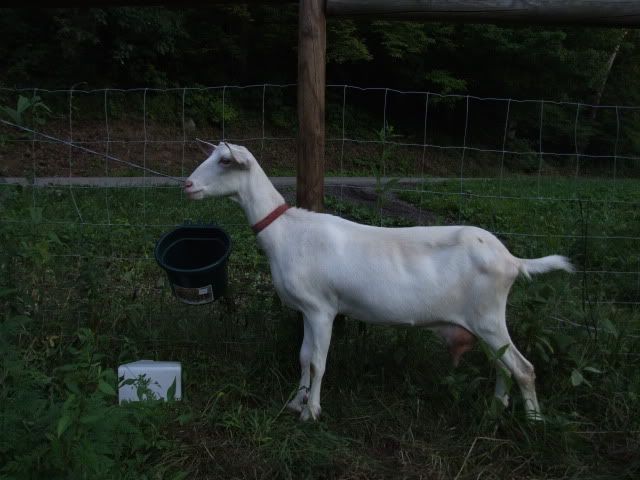
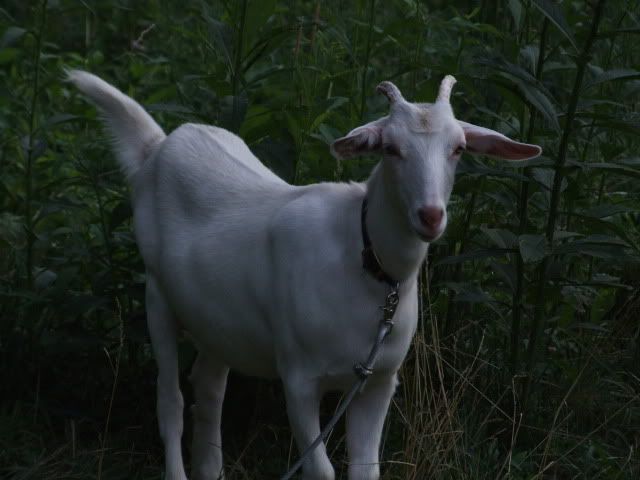
However! In July we bought two Saanen does, with one of them in milk. She's dried off now, because she was producing so little, but during the summer we were getting nearly a gallon a day. The younger one is looking very round, so I'm beginning to wonder if she was bred before we bought her. It's not ideal to have young kids in autumn (although better than the depths of winter!), but if it turns out to be the case it will be nice to have milk through the winter. I still need to find a buck, preferably Saanen but other dairy is acceptable, to breed the other doe this winter. We're going to be focusing on dairy goats, with meat simply as a side product.


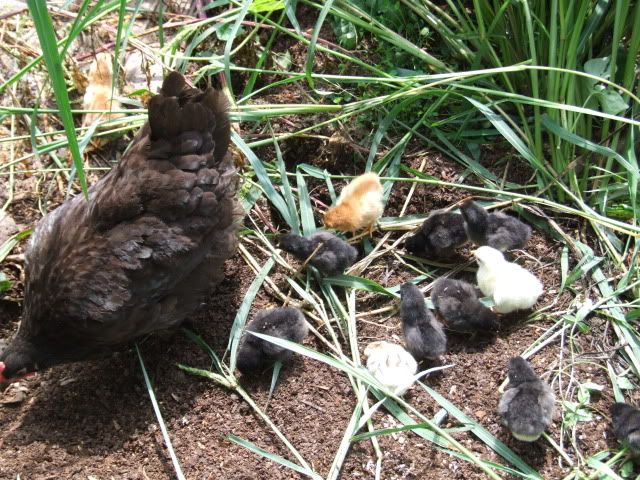
There are a bunch of new chicks. The two broody hens I wrote about before hatched out 14 chicks between them, and we also bought 50 Rhode Island Red pullet chicks from the hatchery. There was still one more broody hen last month, so I let her sit on another dozen eggs. She only hatched four, but is otherwise a good mother. One of the chicks has blue feathers and looks like it will be gorgeous. I'm hoping it's a pullet, but even if it's a cockerel I might still keep it. At this point there aren't any more broodies, which is good because the weather has gotten cold.


We have boarders at our farm. An acquaintance needed space for her animals, so in exchange for lumber and supplies to build shelters, we now have two sheep and a whole bunch of pygmy goats living in our pasture. She also brought her two rabbits and their hutches, but decided to give them to Cerra after Cerra said how much she loved them. So now we have rabbits. I believe that they are male and female, so we'll see about breeding some bunnies here soon. We'll want another hutch first, though, to house the young rabbits while they grow.

I've still got lots of work to do to get ready for winter. I've gotten a good start on the chicken shelter; I can probably finish it in a couple of hours at this point. I've started a shelter for hay for the goats. I'm pretty confidant in my ability to build the frame, but I'm a little bit anxious about the roof. I've never really built a roof before. The ducks and geese are set; they have our old truck shell for a shelter. We've gotten about seven years of use out of it, but it's finally gotten to the point where it's not safe to have on the truck anymore. I don't want the water fowl in with the chickens because they'll eat too much grain and get too fat. Finally, I haven't even started the run-in shed for the goats and sheep. I think I'll need to get the boarders to help me with that one in order to get it done reasonably soon. The weather was cold and wet for several weeks, and Paul was working at the post office, so that left me very little time to work on things at the farm. It's warm and dry now, so I need to take advantage of the weather and get things taken care of.

My garden didn't do all that well, what with the cool weather all summer. The corn was the only thing that really thrived. The tomato was planted much too late, but I was hoping to get at least a few fruits before winter. However, we had an extremely early first frost in September which killed the plant before any of the tomatoes were big enough to pick. The beans would have been great if they had been snap beans, but they're soup beans and I was growing them for seed. Only maybe half of the pods got mature enough to harvest before the weather got really cold. Oh, and the poor okra didn't tolerate the cool weather at all. The one month of hot weather in August got them growing well, but it had cooled off by the time they started setting fruit, and they all just rotted instead of developing.

When I get a chance, I'll post the egg tallies for the latest months and update the farm production in the sidebar.

Wednesday, July 08, 2009

Duck Liquidation

I sold most of our Pekins yesterday. The only ones left are a female with leg problems and an extra male. Duck soup!

We just didn't have time to be dealing with meat ducks with everything else we're doing. They're pretty unforgiving, because if you don't slaughter at seven weeks then you have to wait until after the molt or deal with thousands of pin feathers. Plus, the males were really aggressive to the runner ducks, and had killed several. I'm down to only two runner ducks at this point.

The Pekins went to a small farm up in Jewett. The people that bought them were very nice. I would have liked to spend more time talking with them, but it was getting late and we all had kids that needed to get home to bed.

Thursday, April 02, 2009

Chicken Pictures

Australorps on Pasture


It's a Tough Life, Being a Duck


Compost Pile == Smorgasbord


Jack


New Rooster: Ameraucana?


Check Out Those Spurs!


Tentatively Named Jacques


New Bantam Rooster

Friday, January 23, 2009

Evolution of Design

Several weeks ago, I sketched out my first ideas for the part of our land that we call the Pond Pasture. It doesn't actually have a pond yet, just a low area that is a seep. We're working on directing most of the drainage from that half of the farm into it, and plan to dig out a pond to catch it. Here is a rough map of the area. The pond and the hedge (the hatched part near the top) don't exist yet, the drainage stream and the fence and gate do. Click for a larger, easier to read version.


We want to put the pond, hedge, and fruit trees in this area. It would also be the recreational part of the farm, with picnic tables, a fishing spot, and other enjoyable activities available. In that same vein, I wanted to put in a labyrinth for meditation. I made one out of large rocks in Arizona and really enjoyed using it.


However, even using a small design, I figure that I need a 30' diameter circle for a labyrinth, and the Pond Pasture just isn't large enough to justify using that much space for something mostly decorative. My first design did include a labyrinth, though. Even with a cherry tree in the middle and the outer edge surrounded by blueberries, it was an inefficient use of space.


After creating this first design, I read the book Forest Gardening, by Robert Hart. I realized that I could fit many more plants into the space by using the principles in the book. I also thought deeply about my desire for a labyrinth, and I began to see that a winding path through a forest would offer a similar meditative setting. So I decided that in my next design I would attempt to incorporate the elements of the labyrinth in the entire area, rather than concentrating them into a small part.

To help me organize my thoughts and what I had learned, I made lists of the crops and uses I wanted for each environment on the farm.

Pond
  • fish (food and recreation, duck feed)
  • aquatic plants (food, fish and duck feed)
  • water storage
  • ice production?
Pond Edge/Marsh
  • willow coppice (baskets and other crafts)
  • rushes/reeds (thatching)
  • cattails (edible parts and basket-making)
  • blueberries, cranberries, etc (food)
Open Land (in Pond Pasture)
  • fruit trees (apple, pear, plum, peach, cherry, etc)
  • nut trees
  • bramble bushes (raspberry, blackberry, etc)
  • other fruit shrubs (gooseberry, currant, etc)
  • herbs
  • roots
  • vines (grapes, beans, squash and gourds?)
Current Forest
  • fine timber (black walnut and maple, already established, intermediate crops of nuts and syrup)
  • fruit and nut trees in more open areas
  • shade-loving plants and fungus under maples
Hedgerow
  • construction coppice (osage orange, black locust, cedar?)
  • Bouché-Thomas* pippins** (apple tree hedge, apples for cider and livestock feed)
  • willows? (allowed to grow larger than in marsh)
Taking all of that into consideration, here is my most recent sketch. About the only thing it has in common with the first one is that the foot-bridge over the drainage ditch is in the same place. That's because we normally cross in that spot when walking across the field.


The double line of willows at the south end of the pond are to collect winter snow drifts so that they can melt into the pond in spring. The Rs and Cs in the pond are reeds and cattails, and the boundary between pasture and orchard is made with bricks. There is a whole pile of yellow bricks in the forest that I could salvage for that. I think everything else is labeled. I don't expect this to be the final design, as things will change as we actually start to implement them, but I think it is much closer than my first one.

*Bouché-Thomas is a method of growing apples where the trees are planted slanted so that the branches interlace and form a hedge. It was mentioned and briefly described in Forest Gardening, but I can find very little additional information on the web.

**This is probably just a British usage, but Hart defined a pippin as an apple grown from seed (or pips). I'll need to differentiate between the seedling-apples and grafted apples, and pippin is not a commonly used word in American English, so I have adopted his definition.

Friday, January 16, 2009

Geodesic Chicken House

I've been pondering different building methods for the eventual permanent poultry house. Joel Salatin uses hoop houses, which come in kits and are relatively inexpensive for the amount of space you get. They're still a bit pricey for the amount of chickens and space we have, though. You can build hoop houses out of pvc (which is how I built the roof to the brooder house), but I don't think I can make that strong enough for snow loads and occasional high winds.

So I started thinking about geodesic domes. In Arizona, the woman that we bought our goats from lived in a dome house, and several of her animal shelters were built the same way. I know that these types of structures are very strong and resist being overturned, and don't require a lot of materials. Googling for "geodesic chicken house" brought up this blog, which showed something very similar to what I was imagining. My poultry wouldn't be confined to such a house; it would simply be a place for them to roost and get out of the weather.

One annoyance I see with domes is that there isn't any way to increase floor space without increasing height. Once it's more than about six feet tall, any further height increases are just wasted space. I suppose you can get some extra use by building a storage loft, or you could build multiple smaller domes. Actually, I guess that several domes built next to each other and then connected with a ridge post would be pretty similar to a hoop house.

Because the domes are constructed out of triangles, they can be built with lightweight materials and still be very strong. Many of the domes I've run across on the web have been built with EMT electrical conduit. This is what I used for the roof supports on the current chicken house. I could build a 17-foot diameter dome with 35 lengths of 3/4" EMT, which would cost around $168. 1/2" EMT would cost about half as much, but I don't know if it would be strong enough. Obviously, there are additional costs, such as nuts, bolts, washers, chicken wire, and plastic or tarps for the top. For that cost you get about 225 sq ft of floor space, which is only enough for 45 chickens if that is their only space, but if they have access to an outside yard then it is enough for 150 chickens. That's not bad, for about $250 worth of materials. I could probably house all the poultry that will fit on our land in two or three such domes, although I would only be building one to start. That should be plenty of space for a few years of growth.

I haven't definitely decided to build one of these, but it's something that bears further research.

Monday, January 12, 2009

Morning Sounds

Snow below, clouds above, and the pre-dawn light wavers between them. Only the occasional passing car breaks the stillness.

The Wyandotte roosters are the first animals to notice my approach. First one, and then all of them challenge me with their strident crowing. Then a new voice joins in with a deeper and hoarser crow than the others. That must be Jack, the big, white rooster-of-uncertain-lineage. I have never heard him crow before. Although he is the youngest rooster, he bears himself with a quiet confidence, unlike the strutting, flashy, vocal Wyandottes. Nobody messes with Jack, king of the chicken yard.

Before long the crowing wakes the ducks, and their sleepy quacks echo across the hollow. A few goats bleat greetings, but otherwise prefer to stay bedded down in their warm hay. Balto is silent, because he knows the sound of my car and recognizes my step. He meets me at the goat fence and escorts me to the poultry pen. The ducks panic and run laps around the chicken house, perturbed by the change in their routine. They're not used to seeing people until feeding time in the afternoon.

The nest box opened, and the goat trough cleared of ice, and it's time to go home. Banshee follows me back to my car, trotting at my side like a dog. As soon as I'm safely inside, she heads back to the warm haystack and her kittens, and I head for my warm home.

Monday, December 22, 2008

Full Freezer

Our pig dressed out at 134 pounds, and we got back about 116 pounds of meat and 10 pounds of fat to render into lard. Now that I've seen the cuts of meat, I'll make a few different decisions next time. For example, we had one of the hams cut in half, and one left whole. A whole ham is huge! I'll definitely get them both cut in half next time. So far, we've only tried the bacon, which was amazing. The pig was partly finished on apples, but I'm not sure how much of the sweet flavor is from that and how much is just the difference between real pork and factory pork. Anyhow, the bacon is very sweet and earthy, and it cooks up perfectly. The fat is crispy and the meat is chewy. I can never get store bacon to do that.

Here is the break down:
Hams, 1 whole and 2 halves, 26 lbs 9 oz total
Bacon, 11 lbs 14 oz
Italian sausage, 10 packages, 13 lbs 7 oz total
Sage sausage, 10 packages, 11 lbs 9 oz total
Pork chops, 11 packages of 4, 19 lbs 14 oz total
Country-style ribs, 4 packages, 12 lbs total
Spare ribs, 4 packages, 5 lbs 11 oz total
Shoulder roasts (2), 9 lbs 9 oz total
Sirloin roasts (2), 6 lbs 8 oz total

This was all frozen at the processor, so we didn't overwork our poor freezer.

Paul also shot a deer a few weeks ago, so we have venison again. It was a little guy, only providing 18 pounds of meat, but the processor threw in a complimentary baloney sausage when he found out we have the same last name, so that brought us up to just about 20 pounds of venison.

In addition, there are still ten chickens left from last summer. I thought there were fewer, but when I was rearranging the freezer to make room for all the pork, I found more stashed on different shelves. I kind of lost track, but I think we slaughtered around 40 chickens last year. I got kind of tired of chicken, because for a while it was just about the only meat we had, so I stopped using it as much. Those 10 chickens will probably last us until we slaughter again next summer. Oh, and there's also a duckling in the freezer, which will be our special Epiphany dinner.

Last, and definitely least, we culled one of our problem goats from the herd. There are two more to cull later, probably after Christmas. The meat is tough, of course, but so far it tastes ok in small amounts. We had goat tacos for dinner last night, and they were reasonably tasty. We figure that if we don't want to eat the goat meat, it will still make a good supplement for the dogs so it won't be wasted. Plus, it's good practice at slaughtering and butchering larger animals ourselves.

Wednesday, July 09, 2008

Chicken Chasing

I did a bad thing today. I let all the poultry out of their pen into the main pasture to forage (because I needed to spend my time cutting hay, not moving their pen). I expected that it would be easy to lure them back in with a scoop of grain, but that was not the case. Little heads popped up all over the field when I called them, but they immediately went back to foraging.

The Rhode Island Reds probably would have come back to the house after sunset, but the others are pretty flighty. Besides, I was very tired and didn't want to wait that long. So I stationed Cerra at the gate and told her to open it whenever I herded a chicken her way. The ducks were easy; I got them into the pen in a single flock and they were so traumatized that they didn't try to come out again (ducks are such nervous creatures). Chickens tend to scatter more than flock, so I was pretty resigned to chasing each of them individually.

Paul showed up when I was about halfway through and helped me round up the stragglers. I don't think I'll be letting them all out again any time soon.

Thursday, June 12, 2008

Duck Sorting

Today I sorted the ducks from the drakes, at least among the Pekins. They're still too young to have their sex feathers, but I can tell the difference in their voices. The females have a loud, honking quack, whereas the males make more of a whispery wheezing sound. Out of nine Pekins, there are four females and five males, so I chose the three males I liked best for breeding stock. I really only need one, but I'd rather have some redundancy built in. I would hate to lose my one breeding drake to a raccoon.

The remaining two ducks are now ensconced in the brooder house for the night. I plan to slaughter them on Friday. Now to do a little bit of math and figure out the cost to bring them to market weight.


Purchase$3.65
Shipping$1.00
Feed$7.00*
Total$11.65

*This is a rough estimate, since I didn't actually total up receipts. Actual amount may be slightly lower.

I'll estimate a dressed weight of four lbs, so the cost per pound is $2.91. I'll have more accurate data for that after I actually slaughter them.

Thursday, June 05, 2008

Disoriented Ducks (and Chickens)

Today it was time for the first big paddock move for most of the poultry. The Reds are of course old hands at this, but it was quite the shock for the rest. My normal method is to herd/lure all of the birds into the house, shut the door, and then move it to a fresh spot. While they're still contained in the house, I take down the electric netting and set up a fresh section of pasture.

The ducks were easy enough to herd into the house, and the Reds were easy enough to catch. However, those little Wyandottes were too fast to catch and had no interested in being herded. So I went and made myself a chicken catcher out of brace wire. The wire was not quite stiff enough to be used for the full length, but it got the job done. I plan to find a small sapling to attach just the tip to, so that I'll have more control of it.

After snagging all of the chicks and stuffing them in the house, it was nearly dark. The rest of the move went smoothly, and hopefully they'll all get the hang of it soon enough. If not, I have a chicken catcher and I'm not afraid to use it.

Tuesday, June 03, 2008

Dreaming of Duckling

The ducks turned eight weeks old on Monday, so it's just about time to slaughter the excess Pekin drakes. In Arizona, I had tried dry picking the ducks that I slaughtered, but it never worked well. In every case, I gave up in frustration and skinned them instead. Dry picking is supposed to give you better quality down feathers, but that doesn't mean much if you can't get them off the bird in the first place!

This time I will be scalding them before plucking, just like I learned to do on the chickens last year. The only difficulty is that I don't have any pots big enough to dunk a duck in. Somewhere on the web, I saw a tip for scalding geese: pour boiling water into a metal garbage can until there's enough to dip the bird in, and once the water cools to the right temperature you can scald. I plan to try this with the ducks, but I need to get a clean garbage can first.

The big thing I'm looking forward to is the rendered duck fat. That stuff is delicious, and great for cooking. The cast iron griddle seems to like it even better than bacon grease.

Friday, May 30, 2008

Flock Integration

"And it came to pass that the two great nations of fowl, the Anitadites and the Galluseans, met in battle on the plain. And there was much squawking and gnashing of beaks, for each knew that they would never reign supreme again."


Yes, tonight the ducks and layers were combined into one pen. The hens were offended by the large, boorish creatures in their house, while the ducks were terrified by the very idea of a house.

Tuesday, May 06, 2008

Tragedy

One of the Pekins tried to get through the electric fence, and got its wing stuck. By the time I found it, it had been electrocuted. As I carried it to the compost pile to be buried, Cerra kept yelling, "No! You have to take him back to his friends!" She doesn't understand what death means yet.

Quick Update

Oh, dear. It's been nearly a month since my last post. Here are some of the things I've been working on in that time:

Our ducklings arrived on April 9th (12 Indian Runner Ducks, assorted colors, and 11 White Pekins). Two of the Runners died in the first couple of days, but the rest are doing great. The Pekins should be at market weight in about another month. We'll only be slaughtering enough males to bring us down to two or three, and we'll be keeping all of the females for breeding stock.

Something killed most of the Wyandotte chicks by reaching through the chicken wire and grabbing them. It couldn't get them out to eat, so it just kept killing. In one night, I lost 15 chicks leaving me with only 10. I think it was probably a coon, but I never caught anything in the live trap I set nearby. I surrounded the pasture pen with electric netting, and haven't lost any since.

April 28th, I moved the ducks out to the pasture. Since they require a higher protein feed than chicks, they couldn't share the pasture pen. My solution was to put the ducks within the electric netting surrounding the pen. They've settled in well and have learned to respect the electric wire. This is especially important for the Runners, since they will be one paddock ahead of the goats once they get big enough to be contained by the goat fencing.

I got a good start on the back fence a few weeks ago, but haven't gotten around to stretching it. It's a good thing, too, because there was a storm a few days ago that dropped a large, heavy branch right on my fenceline. I would have been very upset to have to rebuild that fence so soon after putting it up. At this point, all I need to do is to pound in a bunch of staples, stretch the fence, attach it to the T-posts, and hang the two gates. That sounds like a lot, but most of it goes pretty quickly. Hammering the staples is the most time-consuming; once that's finished, the rest should flow together in just a few days.

Tuesday, November 06, 2007

Some Musings on Future Endeavors

Potential Projects for 2008

Animals

Cattle: I would like to get a couple of 18-month-old steers next spring to graze our pastures. They would be slaughtered in the fall.

Chickens:
  • Layers: This year's hens should really start producing a lot of eggs in the spring. I would like to build a hoophouse green house for winter poultry keeping, so that I can have more than twelve hens. I'll also be buying another batch of chicks.
  • Broilers: Since I actually have the pasture pen finished now, I'll go ahead and get a batch or two of Cornish cross broilers. I'll also probably get the next batch of layer chicks straight-run, so that the cockerels can also be used as broilers. Perhaps I'll also attempt to caponize a few of them.

Ducks: The ducks will be the advance forces in the war against brain worm. I need to look through the duck breeds and see which are the best foragers. I also plan to get Muscovies to keep the fly population down near the goats.

Goats: We'll continue with the Boers, hopefully getting a good kid crop in the spring. I will be keeping all of the good-quality doelings for future breeding. I'm also looking for a dairy goat this fall to provide milk starting in the spring.

Pigs: While Paul is gone, pigs will be in the garden area tilling the soil and eating weeds. I will be planting oats behind them in the summer for winter forage and to keep weeds to a minimum.

Turkeys: Turkeys have been such a disaster this year that I'm not sure I want to try them again so soon. I'll have to make that decision next summer.

Structures

Fencing: I want to finish the perimeter fence around the forest next year. I also want to divide the forest into paddocks so that I don't have to use the electric netting out there. I'd like to save it for the dairy goat on pasture.

Poultry House: With the addition of ducks to my flock, I'll need more space than the brooder for winter housing. I'll probably get a hoophouse kit to build a combination poultry house for the ducks and layers.

Water: I plan to dig out a very small pond at the base of the spring run-off and put a second storage tank nearby. The tank would provide water to the forest paddocks so that the other tank can be used only for the pastures.

Tuesday, October 09, 2007

Brain Worm

Monday morning, I found Swellendam lying on the ground, unable to get up, and twitching her legs. I managed to get a vet out to look at her that afternoon. I had tried searching the internet for her symptoms, but the closest thing she matched was enterotoxemia, which didn't make much sense. I don't feed grain, and the goats had been eating pretty much the same forage as ever. Doctor Sparling took one look at her and diagnosed brain worms, which he said came from deer. He recommended fenbendazole (Safe-Guard), but said that her chances of recovery were very low. I had figured as much, since she was pretty far gone. He was unable to tell me the name of the parasite, which I'd never seen mentioned before, so I did some research after I got home.

Paralaphostrongylus tenuis

Called meningeal worm, brain worm, and deer worm, P. tenuis normally completes its life cycle in white-tailed deer. The adult parasite lives in the brains of deer, where it lays its eggs. The eggs travel through the blood to the lungs, where they hatch into larva. The larva travel to the throat, where they are swallowed and passed in the feces of the deer. Here's where things get a little bit strange. The first-stage larva in the feces are not infective until they are consumed by terrestrial snails or slugs. The larva transform into infective third-stage larva within the gastropods, with warm weather allowing them to change more quickly. Then, when a white-tailed deer ingests an infected gastropod while browsing, the larva travel to the brain and mature into adults, starting the cycle over again. The parasites generally cause no harm to white-tailed deer.

Other ruminants can be susceptible to brain worm if they eat infected snails or slugs. However, once the larva migrate into the brain, they are unable to mature into adults. Thus, they swim around in the brain and spinal cord and cause increasing neurological damage. In some cases they will travel from the spinal cord into the skin, causing itching so intense that the animal will chew holes in its hide. The camelids (llamas and alpacas) seem to be more susceptible than goats and sheep.

Since the parasite requires both deer and gastropods to complete its life cycle, only areas with high concentrations of white-tailed deer and a humid climate are at risk. There is some research showing that the instances of the disease peak three to four months after each peak gastropod season. In the Ohio River Valley, the observed peaks of disease are September/October and January/February. This corresponds to the peaks of gastropod prevalence: spring and fall.

Diagnosis

There is no way to definitively diagnose brain worm in a living animal. The only way to know for sure is to find the larva in the nervous symptom. The symptoms include lameness or weakness, paralysis, circling, blindness, and other signs of neurological distress. Some animals may recover without intervention, but even if the brain worms are destroyed, the neurological damage remains.

Treatment

There really isn't a lot of research yet on treatment for acute cases. The most common regimen seems to be dewormers to kill the larva (although there is no reliable information on which, if any, of the dewormers will cross the blood/brain barrier), steroids to reduce the inflammation while the dewormers work, and supportive care.

Prevention

Since the parasite requires gastropods as intermediate hosts, one method of prevention consists of keeping the livestock away from moist areas and woodlands. However, goats much prefer browsing in woodlands and brushy areas to grazing in pastures, and pasture grazing puts goats at much greater risk for stomach worms.

Another possibility for small farms is to put up deer-proof fencing around the property. This is of course extremely expensive, and it wouldn't prevent infected gastropods from entering. Some people spray poisons designed to kill snails and slugs to prevent the disease.

Probably the most common method of prevention is deworming every month, so that the brain worm larva never make it to the nervous system. However, there is no dewormer that is specifically for P. tenuis, so they use the standard dewormers. Deworming on such a frequent basis rapidly leads to resistant strains of parasites, many of which are a greater threat to goats than the brain worm itself.

For now, I will be deworming every month with fenbendazole, but this is only a temporary solution. I can't afford to lose anymore goats right now, but I do want to develop a management system that will not require the use of chemical dewormers on a frequent basis.

Possible Natural Prevention Strategies

The most obvious strategy (to me anyway) would be to choose breeding stock that are naturally resistant to this and other parasites and diseases. I understand that this is how the Kiko breed of goats was developed: a large number of goats were kept with no intervention, and the ones that survived, bred. As a sole strategy, this only works if you have a very large starting breeding pool and don't mind losing a large percentage of the early generations. However, in combination with other management strategies, I think that breeding for animals that require less intervention is a good long term strategy.

There are some natural dewormers out there, although as far as I know there has been no in-depth research as to their effectiveness. Some people swear by diatomaceous earth (DE), which is used as a natural way to kill many kinds of insects/arachnids. The sharp edges of the DE cut open the carapace of the insect, and it dries out and dies. I don't quite understand how DE kills parasites in the moist environment of the digestive track. I suppose that it might kill the larva in the feces once they are exposed to air, which would prevent reinfection. If this is the case, it would not prevent brain worms since they are only passed by infected deer.

There are also herbal dewormers, which often contain wormwood. Again, there is little to no research on the efficacy of these products. However, since the standard chemical dewormers work on brain worms, it's possible that if herbal dewormers work at all, they probably would work on brain worms as well.

Another strategy would be to use natural methods to control the gastropod population. There's a saying, "There's no such thing as a surfeit of snails, only a dearth of ducks." I think that turning ducks into a paddock to clean up the snail and slug population could be a very effective way to control brain worm in livestock. Especially if paddocks are kept small, so that gastropods from neighboring paddocks won't have a chance to migrate in before the animals are moved again.

I had planned to introduce Muscovy ducks next year anyway, to help control the fly population. I'll just add in some mallard-derived breeds as well to help with the gastropods. The original plan was to have the Muscovies follow the goats, but now obviously the Duck Brigade would have to precede the goats into any paddock. It would probably also be a good idea to keep a few of them with the goats as well. I know this will open up new hazards, such as coccidiosis, to the goats. I'll just have to see how it works out in practice.

So, to sum up, this fall I will deworm my goats with fenbendazole monthly until February. As soon as the weather begins to warm up in the spring, I will introduce several breeds of ducks into the paddocks to eat up all the snails and slugs. Under this system, there will still be some risk of brain worm, but it should be greatly mitigated. The long term plan is to select for resistance to all diseases and parasites. I'll probably also introduce some Kiko bloodlines into my herd to help speed that process up.

Poor Swellendam didn't make it, but at least now I know about a significant risk in my area, and can take steps to prevent further problems. RIP Swellendam; you were a good goat.

Sources:
Meningeal Worm, by Susan Shoenian

Parelaphostrongylus tenuis in the Ohio River Valley and Parasitology in Llamas and Alpacas, by Cliff Monahan

Prevention of Meningeal Worm Infection