Showing posts with label goats. Show all posts

Saturday, April 03, 2010

Journal 3 April

Planted three apple trees purchased from Ferda's Nursery. In pond pasture, row starting at road: McIntosh, Honeycrisp, and Gala varieties.

Also built a temporary fence from the corner of the garden (closest to bridge) to the creek bank. Set up electric netting from Forest Gate to creek bank and let goats into the enclosed area.

Thursday, October 22, 2009

Catch Up

Things that have changed since the last time I blogged:

We bought four started White Embden goslings. One has slipped wings and will be Christmas dinner. Of the remaining three, hopefully both genders are represented so that we can raise more goslings next year. They certainly keep the grass mowed down well!

The female Pekin duck with leg problems has recovered. I'm contemplating hatching a few ducklings next spring, since I have so many broody hens. The final remaining runner duck disappeared. I really liked the runner ducks, but they seem to be entirely too fragile for our farm.

Speaking of fragile, we're getting out of meat goats. All of the kids born this year died. I think it was stomach worms, even though we dewormed them, because with the new baby we weren't able to rotate them through the forest so they were just in the main pasture for most of the summer. There are two does left (because we sold three troublemakers earlier in the summer), and I need to get pictures of them and list them for sale.

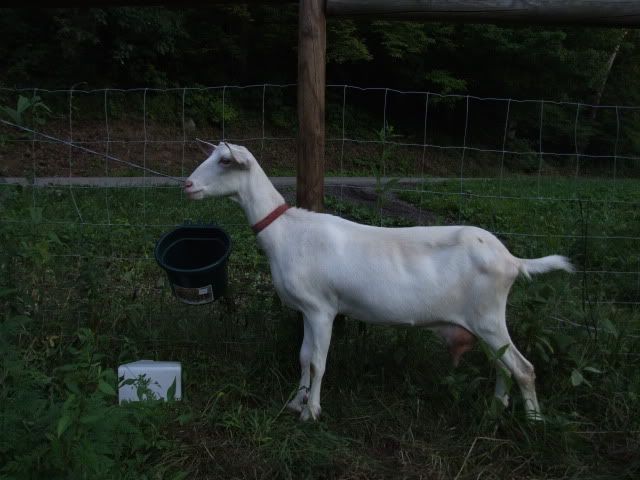
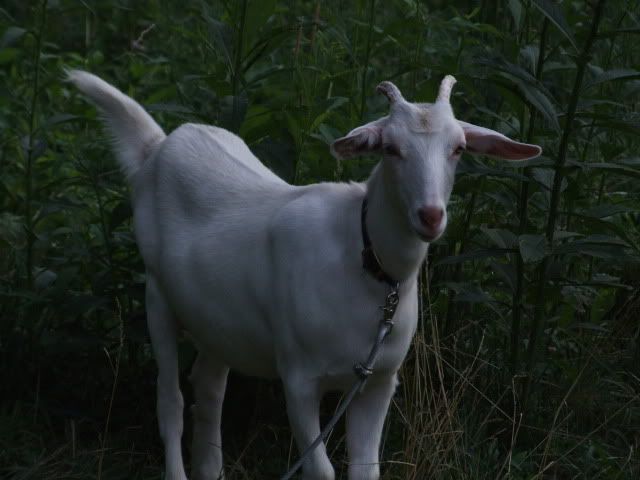
However! In July we bought two Saanen does, with one of them in milk. She's dried off now, because she was producing so little, but during the summer we were getting nearly a gallon a day. The younger one is looking very round, so I'm beginning to wonder if she was bred before we bought her. It's not ideal to have young kids in autumn (although better than the depths of winter!), but if it turns out to be the case it will be nice to have milk through the winter. I still need to find a buck, preferably Saanen but other dairy is acceptable, to breed the other doe this winter. We're going to be focusing on dairy goats, with meat simply as a side product.


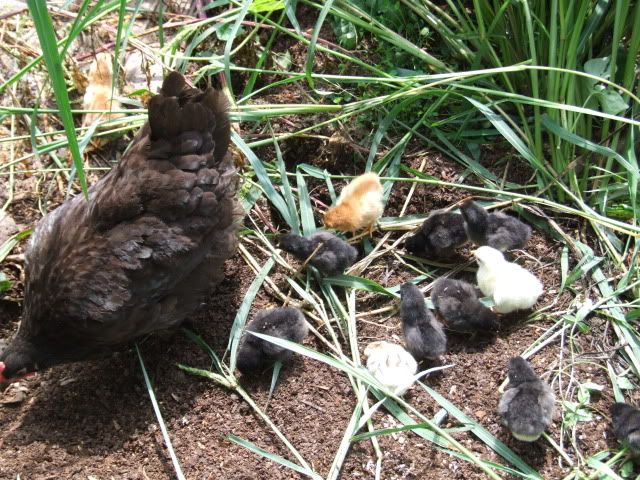
There are a bunch of new chicks. The two broody hens I wrote about before hatched out 14 chicks between them, and we also bought 50 Rhode Island Red pullet chicks from the hatchery. There was still one more broody hen last month, so I let her sit on another dozen eggs. She only hatched four, but is otherwise a good mother. One of the chicks has blue feathers and looks like it will be gorgeous. I'm hoping it's a pullet, but even if it's a cockerel I might still keep it. At this point there aren't any more broodies, which is good because the weather has gotten cold.


We have boarders at our farm. An acquaintance needed space for her animals, so in exchange for lumber and supplies to build shelters, we now have two sheep and a whole bunch of pygmy goats living in our pasture. She also brought her two rabbits and their hutches, but decided to give them to Cerra after Cerra said how much she loved them. So now we have rabbits. I believe that they are male and female, so we'll see about breeding some bunnies here soon. We'll want another hutch first, though, to house the young rabbits while they grow.

I've still got lots of work to do to get ready for winter. I've gotten a good start on the chicken shelter; I can probably finish it in a couple of hours at this point. I've started a shelter for hay for the goats. I'm pretty confidant in my ability to build the frame, but I'm a little bit anxious about the roof. I've never really built a roof before. The ducks and geese are set; they have our old truck shell for a shelter. We've gotten about seven years of use out of it, but it's finally gotten to the point where it's not safe to have on the truck anymore. I don't want the water fowl in with the chickens because they'll eat too much grain and get too fat. Finally, I haven't even started the run-in shed for the goats and sheep. I think I'll need to get the boarders to help me with that one in order to get it done reasonably soon. The weather was cold and wet for several weeks, and Paul was working at the post office, so that left me very little time to work on things at the farm. It's warm and dry now, so I need to take advantage of the weather and get things taken care of.

My garden didn't do all that well, what with the cool weather all summer. The corn was the only thing that really thrived. The tomato was planted much too late, but I was hoping to get at least a few fruits before winter. However, we had an extremely early first frost in September which killed the plant before any of the tomatoes were big enough to pick. The beans would have been great if they had been snap beans, but they're soup beans and I was growing them for seed. Only maybe half of the pods got mature enough to harvest before the weather got really cold. Oh, and the poor okra didn't tolerate the cool weather at all. The one month of hot weather in August got them growing well, but it had cooled off by the time they started setting fruit, and they all just rotted instead of developing.

When I get a chance, I'll post the egg tallies for the latest months and update the farm production in the sidebar.

Tuesday, June 23, 2009

Dewdrop and Max

I should have posted these pictures on May 4th, since that's when I took them, but I never got around to it. Dewdrop and Max are Natalia's kids, the first goats we've bred ourselves.

This is Dewdrop the doeling. We intend to keep her as a breeding doe.


And here is Max the buckling (now a wether).


A good look at their markings.


There are three other kids, all doelings, that I need to get photos of.

Tuesday, April 28, 2009

We're Now Goat Breeders

Natalia had two kids today. These are the first kids that we've actually bred ourselves. They are healthy, although a bit small. The doeling was 3 pounds and the buckling was 3-1/2 pounds. They were a bit confused at first, since they thought Balto (the dog) was their mother. They both tried to nurse from him that first day. We moved Natalia and her kids out to the main pasture so that she could get more to eat than is available right now in the forest. Also, I remember from two years ago that young kids are very difficult to move to a new pen, since they don't know the routine and they will neither follow nor be herded. They'll also be easier to tame out in the main pasture.

The buckling is already promised to the son of one of my friends. He's named him "Max." We'll be keeping the doeling for our own herd. There are at least two more does that look bred, so I'm looking forward to more kids this year.

Saturday, March 14, 2009

An Experiment

I said earlier that I intend to plant corn, beans, and squash in the goats' bedding areas in order to put the extra nitrogen to work. However, I've been doing some reading about gardening, and apparently the uncomposted (well, partially composted) manure will interfere with the growth of plants until it is composted. This is probably true, but I would like to see for myself exactly what happens. So now I will put in an identical patch of corn, beans, and squash in the previous winter's bedding location and in a normal spot in the garden.

Plot 1 is the less composted location. It is sod covered with maybe half an inch of spilled hay and a lot of goat manure and urine. I am working on digging it about a foot deep to mix the hay and manure into the soil and to break up and kill the grass. I will probably plant the corn (the first of the plants) in May in order to give the hay and manure time to begin decomposing.

Plot 2 is the location of the goats' shelter and feeder from two winters ago. Last spring, summer and fall we kept a pig on that location, and she thoroughly mixed the soil, bedding, and manure together, and added more of her own. She was removed last December, and the soil has been untouched since then. It's black, crumbly, and easy to dig. I will prepare that plot the same as the first, and plant the corn at the same time.

Plot 3 will be typical, unimproved garden soil in Paul's garden. All of the garden has received some goat and pig manure and some digging from the pig, but outside of Plot 2 it is scattered and random. This will be the control, to see if planting in a freshly manured spot is more profitable than planting in normal, unimproved soil.

Since planting times for the beans and squash will depend on the size of the corn, it's possible that the different plots will be ready for them at different times. I will keep notes on growth rates, healthiness, and yield for the three plots. I believe that the pre-composted plot will outperform the uncomposted plot, but I am interested to see how big a difference there is, and whether it is even worth it to plant an uncomposted plot.

My science teacher mother would be so proud.

Friday, March 13, 2009

New Garden Plot

Eventually, the pond pasture will be completely converted to a permaculture forest garden, but the first step is removing most of the grass so that it doesn't compete with the new fruit trees. I also need nursery space for the osage orange and apple trees that I intend to grow from seed, and room to experiment with open pollinated varieties away from Paul's garden. I really dislike using motorized equipment, so I am tackling this area with nothing more than shovel, rake, and hoe. I'm finding Steve Solomon's book Gardening When it Counts to be very useful with regards to tool use and maintenance. It's amazing how much easier it is to use a sharpened shovel, compared to a blunt one straight from the store.

I'm not following all of his advice for preparing a garden plot from sod. He says to dig deeply and turn the sod clumps over to expose the roots, and then dig them again in a week to further kill the grass. I'm sure that works, but since the pond pasture is immediately adjacent to the chicken pen, I have been digging shallowly, just underneath the grass roots, and tossing the sod to the birds. It's still too early to allow them out on the pasture, so they are loving the worms, grass, and other goodies in the clumps. I lose a little bit of soil this way, but I will replace it with compost (and the chicken bedding will eventually go to make more compost as well), so I think I come out ahead. Once the sod is removed, I'll go back and dig more deeply to prepare the seedbed.

Since I'm out of shape from a long winter of inactivity (and, oh yes, seven months pregnant), I've been doing my digging at a slow, steady pace and only a little bit at a time. With a sharpened shovel it's really no strain at all, and I feel great. Honestly, I think it would be more dangerous for me to operate the tiller than to dig with a shovel.

In addition to the tree seedlings, I also intend to plant some sort of bush beans, sweet potatoes (more on that in the next post), bushel gourds to make containers out of, and the first of the grafted apple trees and blackberries. I also want to transplant a young oak to one corner of the pond pasture to eventually provide shade to the chicken pen.

I have a couple more little plots I want to work on. There are several spots in the main pasture where the goats spent a lot of time this winter, so there's way too much nitrogen and compaction for the grass to come back easily. I intend to dig those areas up and experiment with "three sisters" planting: corn, vine beans, and squash all grown together. The beans grow up the corn stalks and the squash shades out weeds and helps keep raccoons away from the ripening corn, or so I've read. I look forward to trying it out in practice. After the three sisters are harvested, I'll let those spots go back to grass for the following year.

Sunday, March 01, 2009

Work Day

We spent the afternoon and evening working at the farm. My main plan was to add some more bars to the goat feeder, since one of the goats has been getting her head caught. This would mean taking all of the bars out and drilling new holes for the new placements. However, the goats thought that a human messing around with their feeder meant that they were going to get a treat, and they were mobbing me so much that I just took the bars out and called it a day. There will be somewhat more waste now that they can really get their heads in there, but fresh pasture is only about a month away so I'm not too worried. Once they're transitioned back to eating forage, I'll reattach the bars on the feeder.

I also attached the mineral feeder to the side of the hay feeder, so now that has a permanent location. When they were in the forest I had been hanging it on a new tree in each paddock, but that was not very stable. Now I can just pull the feeder along with the goats wherever they go on the property.

We'll be closing out last year's compost pile at the end of the month, so Paul and I worked on preparing the next location. We add to a pile for a year, and then let it sit for a year, so this spring we can finally start using compost that we started two years ago. Anyhow, there was a lot of wood on the ground from an old haystack where I wanted to put the next compost pile, so we gathered that all up and made a bonfire. There was a cold wind, so that fire was nice. I also began picking up garbage and debris, and gathering things that had gotten lost under the grass and then the snow.

Finally, I started dismantling what was left of this year's haystack. Much of the hay that is left will be the base of the new compost pile, and the rest will go into the chicken pen. I'm leaving most of it alone for now, though, because the farm cats live under there and I don't want to take their shelter while it's still cold. I also need to come up with a new shelter for them so that they don't leave when I finish taking the hay away.

Friday, January 30, 2009

#5 Build Hay Feeder For Goats

This is something I've been meaning to build since two autumns ago. Last winter, since I hadn't built a feeder yet, I protected the hay with a cattle panel. It worked, but several of the goats would get their horns caught in it and have to be removed every day, so I decided not to use that plan this year. This year, we've just been putting the day's hay in a pile in the pen, but anyone who's ever had goats would know how well that works. They think that their dinner makes a wonderful bed, and a lot of the hay gets soiled and wasted that way.

So, I got to work planning out the feeder. I already had plenty of lumber lying around, from the time I attempted to build a Salatin-style poultry pen. The only things I needed to buy were two 10' lengths of electrical conduit, conduit straps to attach them to the wood, and a 6'X8' tarp. I wanted it to be big enough to put a full bale in at a time, although for the number of goats we have right now, half a bale is all that's necessary. The feeder itself is four feet long, two feet wide, and three feet tall. The roof adds another three feet or so to the height, so that hay can be easily added. I spent about five hours yesterday on it, and about another hour or two today to finish it up.


Once it has been transported out to the farm, I will be adding 2x4 runners to make it easier to move and also to help prevent the goats from tipping it over. I also intend to bolt their mineral feeder onto one of the short sides, to make it a complete mobile feeding station.

98 things to go.

Thursday, January 29, 2009

Ice is Heavy

It rained and then snowed most of yesterday, and all that ice and snow was heavy enough to collapse the goat house. It was a hoop structure, with a wooden base and two cattle panels making the hoops. It might have been ok, except that last winter the goats managed to get on top of it and bent up the panels so that the top is a bit flatter than it should be. One of the goats was trapped under the house, but we got her out and she doesn't seem to be injured. Even once we scraped all the ice and snow off of the roof, it still didn't want to go back to something even resembling the right shape. Fortunately, there was a pile of fence posts out there that we hadn't done anything with yet, and we used those to brace one side so that it's mostly upright.

Given that the panels are so bent up, and the wooden base needs to be repaired as well, I plan to retire this house after this winter is over. The panels can go towards making a corral and the lumber will go into other projects.

Monday, January 12, 2009

Morning Sounds

Snow below, clouds above, and the pre-dawn light wavers between them. Only the occasional passing car breaks the stillness.

The Wyandotte roosters are the first animals to notice my approach. First one, and then all of them challenge me with their strident crowing. Then a new voice joins in with a deeper and hoarser crow than the others. That must be Jack, the big, white rooster-of-uncertain-lineage. I have never heard him crow before. Although he is the youngest rooster, he bears himself with a quiet confidence, unlike the strutting, flashy, vocal Wyandottes. Nobody messes with Jack, king of the chicken yard.

Before long the crowing wakes the ducks, and their sleepy quacks echo across the hollow. A few goats bleat greetings, but otherwise prefer to stay bedded down in their warm hay. Balto is silent, because he knows the sound of my car and recognizes my step. He meets me at the goat fence and escorts me to the poultry pen. The ducks panic and run laps around the chicken house, perturbed by the change in their routine. They're not used to seeing people until feeding time in the afternoon.

The nest box opened, and the goat trough cleared of ice, and it's time to go home. Banshee follows me back to my car, trotting at my side like a dog. As soon as I'm safely inside, she heads back to the warm haystack and her kittens, and I head for my warm home.

Thursday, January 08, 2009

More Goat Containment

I've written before about goat #6, not-so-affectionately named Liver Neck by Paul. Last fall, she learned how to flip the bottom wire of electric netting up and scoot under the fence without getting shocked. Goats never forget a way to escape, and she's been a real problem this winter now that they are on hay. She doesn't care about the hay they get fed every day, no, she wants to go stick her head in the hay stack and munch on hay unsullied by human hands. Her friend, goat #3, also gets out, but I haven't determined yet whether she goes over or under the fence. Last night I staked down the bottom wire of the entire fence line, so hopefully Liver Neck will get a thorough shock next time she tries to get out. Being a goat, I know she'll never stop trying what worked in the past, even if it doesn't work now, so she and #3 are on the cull list. Now that Advent and Christmas are over, I should have a chance to slaughter them some time in the next month. They're both pretty goats, but being older does they wouldn't sell for a high enough price to justify hauling them to auction. According to the auction report, the highest a doe sold for last weekend was $65.

Saturday, January 03, 2009

Work Day

Since Paul has taken over the daily farm chores, I only get out there every few weeks or so to work on occasional projects. Today the plan was to move the goat fences so that their pen no longer surrounds the chicken pen. However, some of the screws on the goat house have come loose and I can't move it anymore. It will have to stay where it is until next spring or summer, when I can repair it. So the only options were to leave things as they were or move all the poultry to a new spot. There are over 50 chickens and around 10 ducks, so it really was not going to be feasible to move them. We would have spent hours rounding up the strays, and they really don't like changes to their routine, anyhow. So I just tidied up and tensioned the goat fences to keep them better contained. We worked with Balto a little bit today by tossing one of the Australorps out into the goat pen and growling at him any time he made a move towards it. It didn't take long for him to start turning his back on the loose chicken any time it ran near him, so he was a good boy. I want to try to get out there tomorrow, as well, to reinforce the training. I want it firmly established in his mind that the birds belong to the humans, and are not to be messed with.

I also worked on the chicken house. It has a tarp for a roof, necessary to keep the weight down on a movable building. It worked really well until I got the bantams, which are light enough to fly up and perch on the roof to roost. They taught the Wyandottes to do the same, and probably the Australorps will also join in when they get bigger*. All of those claws don't take long to rip through a tarp, even a heavy duty one. I had just put a brand new tarp on a few weeks ago, since the cold weather and precipitation really made it necessary to have a roof on the house. The ducks and the chicks sleep in there, even if the other chickens don't. Anyhow, several big windstorms came through soon after I put the tarp on, and broke the string holding it to the roof. Those were just supposed to be temporary, until I can put zip ties on to really hold it down. So I tied down the tarp again today, and then I went looking in the woods for a long piece of wood to attach to the apex of the house for the birds to perch on, to protect the tarp. It needed to be about 13 feet long, mostly straight, and not too heavy to lift up. At first I had little luck finding anything like that, but then I remembered that last summer I had cut down a dead walnut sapling, and that turned out to be perfect. It was a little bit on the heavy side, but with Paul's help it was no difficulty to lift it up and attach it. It is just tied on right now, but I'll probably get some long, skinny bolts to attach it more securely.

*The Rhode Island Reds never learned how to perch. One sleeps in the house, the other three insist on sleeping in the nest box. It's not feasible at this point to get out there early every morning to open up the nest box for them, so we just change the bedding in there anytime it starts to get too soiled. One night I was out there, and kicked them out of the nest box and then turned it so that the opening faced the opposite way. Chickens aren't very good at problem-solving, especially after dark, so three very confused hens just stood there looking at where the door used to be. It was pretty funny, and I wish I had thought to take my camera with me that night.

Monday, December 22, 2008

Full Freezer

Our pig dressed out at 134 pounds, and we got back about 116 pounds of meat and 10 pounds of fat to render into lard. Now that I've seen the cuts of meat, I'll make a few different decisions next time. For example, we had one of the hams cut in half, and one left whole. A whole ham is huge! I'll definitely get them both cut in half next time. So far, we've only tried the bacon, which was amazing. The pig was partly finished on apples, but I'm not sure how much of the sweet flavor is from that and how much is just the difference between real pork and factory pork. Anyhow, the bacon is very sweet and earthy, and it cooks up perfectly. The fat is crispy and the meat is chewy. I can never get store bacon to do that.

Here is the break down:
Hams, 1 whole and 2 halves, 26 lbs 9 oz total
Bacon, 11 lbs 14 oz
Italian sausage, 10 packages, 13 lbs 7 oz total
Sage sausage, 10 packages, 11 lbs 9 oz total
Pork chops, 11 packages of 4, 19 lbs 14 oz total
Country-style ribs, 4 packages, 12 lbs total
Spare ribs, 4 packages, 5 lbs 11 oz total
Shoulder roasts (2), 9 lbs 9 oz total
Sirloin roasts (2), 6 lbs 8 oz total

This was all frozen at the processor, so we didn't overwork our poor freezer.

Paul also shot a deer a few weeks ago, so we have venison again. It was a little guy, only providing 18 pounds of meat, but the processor threw in a complimentary baloney sausage when he found out we have the same last name, so that brought us up to just about 20 pounds of venison.

In addition, there are still ten chickens left from last summer. I thought there were fewer, but when I was rearranging the freezer to make room for all the pork, I found more stashed on different shelves. I kind of lost track, but I think we slaughtered around 40 chickens last year. I got kind of tired of chicken, because for a while it was just about the only meat we had, so I stopped using it as much. Those 10 chickens will probably last us until we slaughter again next summer. Oh, and there's also a duckling in the freezer, which will be our special Epiphany dinner.

Last, and definitely least, we culled one of our problem goats from the herd. There are two more to cull later, probably after Christmas. The meat is tough, of course, but so far it tastes ok in small amounts. We had goat tacos for dinner last night, and they were reasonably tasty. We figure that if we don't want to eat the goat meat, it will still make a good supplement for the dogs so it won't be wasted. Plus, it's good practice at slaughtering and butchering larger animals ourselves.

Saturday, June 21, 2008

Worthless Crook

I recently bought a crook from Premier Supplies based on their glowing description.
Most functional and satisfying neck crook we've used. Lightweight, strong and quick in the hand. Top is molded from very tough plastic--so it will never lose its original shape and almost never breaks. Shaft is coated fiberglass. We love everything about it. When given a choice, we always grab this one.

At $39, it was also the most expensive crook that they carried, but I wanted one that would last.

I decided to try it out and do some hoof trimming today. Things were going great, but on the third goat I caught, the top broke right off! I was so disgusted. I've had nothing but good experiences with Premier and their products, so I hope that they will give me a refund when I call them on Monday. I might try out the leg crook instead, which is made of solid aluminum. Presumably that will hold up better with strong goats.

Speaking of hoof trimming, this time I used a homemade rope halter (based on this design) to tie each goat to a tree while I trimmed her hooves. Tally decided to take a nap and enjoy her pedicure. She was stretched flat out on the ground, completely relaxed. I was actually a little bit worried, because that is not normal behavior for a goat, but she got right up once I untied her and gave a little tug on the halter. None of the rest were as cooperative.

Saturday, June 14, 2008

Maybe It's Wishful Thinking...

...but some of the goats are looking a bit bulgy at the sides. I think they might actually be pregnant. I noticed this just before turning them in to a new paddock, so I don't think I was seeing full rumens. I remember that last fall they all looked pregant because their rumens were so big, even though none of them were.

Number 7 looked particularly round, and was one of the ones that I saw in heat in January. If she got bred then, she would be due around June 19th! None of them look quite that far along (comparing to the one that kidded last year), but I understand that it can be hard to tell with goats.

Wednesday, May 07, 2008

Problem Goats

I know I've mentioned them before, but I have two problem goats in the herd. Number 10 has a lot of Spanish influence in her, which makes her a good jumper. She can jump the electric fence from a stand. Mostly, she stays put, but she knows she can jump out any time she wants. She's also one of the most skittish of our goats, and these two things make it very difficult to catch her for deworming and hoof trimming.

Number 6 has learned how to get her nose under the bottom wire of fence (which isn't hot) and then scoots her way under it. She gets zapped a little bit, but not enough to stop her. A lot of times Bantini squirts through with her. I could probably stop her by staking down the bottom strand of fence all around the paddock, but that kind of defeats the purpose of movable fencing.

These two goats have an ultimatum. If they don't produce kids this year, they're going to auction. I might be willing to put up with their escape habits if they were good producers, but otherwise they have no place in our flock.

Friday, April 04, 2008

Pastures and Greedy Goats

The grass on the pastures is growing just fast enough to keep the goats fed. I have to move them every day, even with the huge paddocks created by using both permanent fences and the movable fences. That size of paddock lasts the better part of a week in summer. Still, they're keeping fed.

I nearly had a jailbreak today, though. I needed to get the goats from the garden to their new paddock near the water tank. In between those two places are the compost piles and assorted equipment that I don't want the dog and goats to be messing with. The only way I could do this was to set up the movable fences as a big lane, and then after they were in move part of the section to block off the compost pile. It all went according to plan at first, with the goats following me to the far end of the paddock (I was carrying hay, so it was no surprise). I thought for sure they would stay eating the hay while I set up the other end, but I guess they thought I still had food for them. They wandered back over to me after I'd opened up the end of the paddock, but before I could get it set back up properly. It took some agility, but I managed to scare most of them away so that I could get the fence set up. Bubba and Balto were the only ones to get out (it figures that the males would wander), but I knew I could catch both of them easily. Actually, as soon as Bubba realized that he was on the wrong side of the fence from his does, he found his way back in as quickly as he could. He's going to be really upset in a few days when I separate him for good. Balto of couse was no problem to catch, because he was too busy sniffing the compost pile to get too far.

Monday, January 21, 2008

Herd Relationships

I saw definite signs of heat in four of the does today (3, 7, 8, and 10). This is the first time I've been able to observe goat breeding behavior in a large herd. The does have paired up (3 & 10, 7 & 8), and in each pair one is docile and loving and the other is aggressive and vicious. I'm not sure what the purpose of this behavior is, but it's been interesting to watch. The does all still beat Bubba up regularly, but at least he has started fighting back. I've been letting him out into the main pasture every day to eat goat feed and hay without being attacked, and this seems to have helped toughen up his attitude a bit. He's also grown quite a bit over the last few months, and he looks much more adult, and less like an adolescent. He'll be a year old in February. I really hope he manages to breed at least a few of these does this year.

Saturday, January 05, 2008

Tame Goats

The goats have become so tame in the last few months. I think it might be because they're eating hay exclusively now, so all of their food comes directly from the humans. Whatever the reason, I was able to deworm all of them in about 15 minutes today. All but one of them let me just walk right up and grab her. Of course Goshen tried to escape, but she was stupid enough to run into their house and was easily caught.

I also had the opportunity to try out the pvc and duct tape solution to goats getting their heads caught in the fence. It probably works better in warm weather, but here in the winter the duct tape didn't hold very well. The pipe only stayed on for a couple of days, and then those goats were right back to getting their heads caught.

I've designed a much sturdier version using pvc and pipe clamps. It's still in field testing, but once I've gotten the bugs worked out I'll post the instructions.

Thursday, December 06, 2007

Hay! Snow!

Sorry for the bad pun. I couldn't resist.

It snowed most of yesterday, and it looks like we got maybe six inches. This is a lot different from last year, where it rained through most of December and the few snow showers did not stick. I had hoped to put off feeding any hay until the end of December or early January, but with the forage under so much snow I figured I had better break it out, at least for a few days.

I constructed the hay feeder by attaching a sixteen-foot cattle panel to about a ten foot length of the fence. That caused it to bow out far enough to put hay in it, but it was narrow enough that the goats could reach hay that was pretty much anywhere in the holder. I plan to attach a tarp on the top to keep the hay dry, but for now I'm just only putting about a day's worth of hay in there at a time. I'll probably also put some branches in the bottom to help keep the hay off the ground.

In reading around a bit, I found a source stating that adult meat goats eat 3-4 lbs of hay per day, not the five that I had found before. So refiguring at eight adults and two babies, that means I need approximately 38 pounds of hay per day, not 50 as I had thought. The only full months that they should need the full ration of hay are January and February. They should only need supplemental hay in December, and new growth should start showing up near the end of March, so I figure I need about 90 days worth of hay. I'll bump it to 100 to allow for unusually bad weather or other circumstances. So 3800 pounds of hay for the winter. There's about 1800 pounds in the haystack that I cut myself, so I need to buy about a ton. We'll be using the money from selling the lawn mower to pay for all that hay. Next year's goal: produce all needed hay on-farm!

Oh, yes. Paul is not getting deployed because of medical issues with his shoulder and neck. It will be good to have him here, but it means that we probably won't be able to complete many, if any, of the big projects next year. Still, we're trusting the Lord to provide for what we really need, and we'll work with that.