Tuesday, May 06, 2008

An Update That Deserves Its Own Post

On April 21st, Paul and I were both working out at the farm when a brown dog came trotting down the road. We noticed her because a passing car had to slow way down to avoid hitting her. She was friendly, so we lured her down into the pasture to get her out of the road. We decided to take her back to the house and make some found dog posters, which we later posted in the post offices and feed stores of both Adena and Cadiz. The dog was a little bit thin, but otherwise seemed to be in good condition. Even though she'd clearly been on the move for a while, the pads of her feet were not abraded and didn't seem to be sore. Here she is that first night.


It looks like she has at least a little Black Mouth Cur in her. Compare to this photo from a breeder:


After a week with no calls, we decided to name her. Cerra has grown very attached to her, so we decided to let her choose the name. She came up with "Netta," which has a nice sound to it.

Last Sunday, we started seeing a male dog that looks a lot like Netta hanging around our house. We'd never seen him around town before, so we speculate that they both had escaped/been dumped from the same place. They might even be littermates. He was very wary of people and disappeared down the alley way any time one of us tried to approach him. Even though he was thin enough that I could see his ribs, he was very mistrustful of the food I tried to lure him with. However, as long as I kept my distance, he was content to lie down and watch me work on training Netta. He seemed very interested in our activities.

Today he finally approached me of his own volition. I took Lily out (on leash, luckily) and he was right there waiting. He came right up to me and let me pet him, and after that he let me handle him. The poor guy has gotten really skinny in the week since I first saw him, but I think he'll be a nice looking dog once I get the weight back on him. I'll put up another set of signs for him, but I doubt that anyone will respond. In a couple of weeks, I'll get him neutered (Netta has her appointment to be spayed in just over a week). We're leaning towards keeping him, too, although I may look for a good home for him after he's had some training. The tentative name for him is Bibb, after William Wyatt Bibb, the first governor of Alabama. Paul chose that name, since Black Mouth Curs are a southern breed, and from what we've seen online, the red-colored ones seemed to mostly be located in Alabama.

Here he is. Doesn't he have a cute face?

Quick Update

Oh, dear. It's been nearly a month since my last post. Here are some of the things I've been working on in that time:

Our ducklings arrived on April 9th (12 Indian Runner Ducks, assorted colors, and 11 White Pekins). Two of the Runners died in the first couple of days, but the rest are doing great. The Pekins should be at market weight in about another month. We'll only be slaughtering enough males to bring us down to two or three, and we'll be keeping all of the females for breeding stock.

Something killed most of the Wyandotte chicks by reaching through the chicken wire and grabbing them. It couldn't get them out to eat, so it just kept killing. In one night, I lost 15 chicks leaving me with only 10. I think it was probably a coon, but I never caught anything in the live trap I set nearby. I surrounded the pasture pen with electric netting, and haven't lost any since.

April 28th, I moved the ducks out to the pasture. Since they require a higher protein feed than chicks, they couldn't share the pasture pen. My solution was to put the ducks within the electric netting surrounding the pen. They've settled in well and have learned to respect the electric wire. This is especially important for the Runners, since they will be one paddock ahead of the goats once they get big enough to be contained by the goat fencing.

I got a good start on the back fence a few weeks ago, but haven't gotten around to stretching it. It's a good thing, too, because there was a storm a few days ago that dropped a large, heavy branch right on my fenceline. I would have been very upset to have to rebuild that fence so soon after putting it up. At this point, all I need to do is to pound in a bunch of staples, stretch the fence, attach it to the T-posts, and hang the two gates. That sounds like a lot, but most of it goes pretty quickly. Hammering the staples is the most time-consuming; once that's finished, the rest should flow together in just a few days.

Tuesday, April 08, 2008

Garden Preparation

Yesterday, Paul went out to the garden to start preparing the soil and plant a few seeds. He quickly decided that a shovel just wasn't going to work. If he kept at it, he might have the garden ready to plant by October.

We came up with a Plan B, which was to rent a rototiller, and a Plan C, which was to buy one. I was opposed to Plan C, because it didn't seem very cost effective to buy a machine that would only be used a few times a year. Paul didn't like Plan B because it's a pain to haul a rototiller to and from the land, and to get all of the tilling done during the rental period. We finally came up with Plan D, which was hiring a neighboring farmer to bring his tractor down and till it for us, which he did this evening.

It really was the best plan. It cost about what renting a tiller for a day would be, and he did a much better job than the rental. I know this because the rental is what we did last year. So now two-thirds of the garden is tilled and ready for planting. The other third is mine to play with, and I'm going to experiment with pig plowing and corn growing (not at the same time).

Speaking of corn, due to the high prices I've decided to grow as much of my feed grain as possible this year. I want an open-pollinated corn variety, so that I don't have to buy seed every year. This guy had really good prices, and I decided to order the blue corn since I don't need a full bushel of seed (that would plant about five acres, and I'm only planting maybe an acre this year). Unfortunately, I just got my order form returned, with a note saying that the blue corn failed the germination tests so it's not for sale this year. At this point, I may just plant whatever hybrid variety the feed store is selling, and worry about sustainability next year.

Pasture Chicks

I moved the chicks out to pasture yesterday to make room in the brooder for ducklings this week. They were unhappy about the chicken crate and the travel, but it didn't take long for them to settle into their new home. Speaking of which, I don't think I ever blogged about the construction of my pasture pen.

Joel Salatin builds his out of lumber, chicken wire, and aluminum roofing. Each pen is 10' X 12' and holds approximately 90 broilers. I tried to build one of these, but I didn't get very far. In order to get 12' long boards to our property, we would have to have them delivered, which is far too expensive. I tried putting together half-length sections, but it just wasn't sturdy enough. Plus, the thing is very heavy and requires a special handcart to help move it. So I started looking for other options.

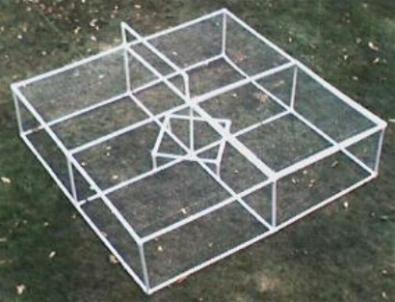
I found plans for a pasture pen built out of PVC pipe and specialized fittings (warning: the fittings are the most expensive part of the pen). With some modifications, I used this plan.


First of all, the plans don't really say what that smaller square in the middle is supposed to be. Supposedly it's a "feeder support," but it's completely useless for the feeders and waterers I use, so I just omitted it. I shrunk the dimensions from 10' X 10' to 8' X 8', giving me approximately half the area of Salatin's pens. For the time being, batches of 50 broilers are more manageable than 90 broilers, so that's fine. I wanted the height to be more than 2' to accomodate turkeys as well as chickens. It turned out that 26" was the most cost effective, because that's what was left in a 10' pipe after cutting out two 47" sections. So the turkeys get an extra 2" of headroom.

The instructions say not to glue any joints, but I found that it was absolutely necessary to glue them. Just be sure that everything is set up properly, first. I also found that simply gluing the hinges and latches was not enough given the amount of stress on them, so I further attached them with small screws (I just noticed on re-reading the instructions that it says to do that as needed. I'm observant).

I used 4' poultry fence to cover it. First I wrapped around the sides, bending the excess in on the top and bottom. Once that was secure, I covered the top and door. Be sure you do the gluing before putting the fence on, because it's a pain afterwards.

My watering system is the same as Salatin's, with an automatic bell waterer attached to a five gallon bucket resevoir. The chicken wire roof alone is not strong enough to support a full bucket, so I angled a 1X6 board across a corner next to the tarp peak for support. I used wire to attach the bucket to the peak so that it won't fall off during moves. The tarp goes over both the peak and the bucket, to protect the water from debris that could clog the tubing.

The pen is light enough to be moved by one person, but with the waterer installed and a full bucket, too heavy to blow away. I still stake down the edges with guy lines, just in case some unusual wind comes through.

I'll probably continue to make small modifications, but I intend to use this plan for the rest of the pasture pens that I make. Somewhere, I should still have the notes I scrawled to myself about quantities, prices, and lengths. If I find it, I'll post more detailed instructions.

Saturday, April 05, 2008

Perimeter Fencing

For our pastures and garden, we have woven wire fencing, with wooden corner assemblies and T-posts in between. Actually, I still have one last length of fencing to put up before the main pasture is completely fenced. Woven wire won't work for the rest of our perimeter fencing, though. The pond pasture is low enough that you hit water about two feet down. The rest of the perimeter is in the forest, where the ground is very rocky and it's impossible to go in a straight line because there are trees in the way. Also, if a tree or branch falls on a section of woven wire, that can mean that the whole section needs to be re-stretched.

My next thought was to use livestock panels. They have the extreme disadvantage of being very expensive, but they have numerous advantages. They can be bent around trees, they only need T-posts to hold them up, they can be used as gates, damaged sections can be replaced without affecting the rest of the fence, and they can be taken up and moved to another property if necessary. Granted, that last one requires renting or hiring a truck that's capable of hauling 16-foot long fence sections, but it is doable.

However, livestock panels are far beyond our fencing budget, so I've had to think further. The next possibilty I thought of was heavy duty electric netting, which is meant to stay in one place for months or years. This would be less than half the cost of the panels, with most of the advantages. An extra advantage is that these fences can be hauled in a normal pickup truck, so there would be no need to use specialized hauling. The only disadvantage is that if the power fails, the fence fails. However, that's already an issue with the movable fences we already use.

Thinking further, there's also the option of using T-posts and multiple strands of electric wire (actually, I would use Intelli-Twine). My initial calculations show that this option would be approximately an eighth of the cost of the netting. The disadvantages are that it is no longer movable (less of an issue with such a low cost), and it is more complicated to design and more work to implement.

After looking at all the options, I think that I will use the last option for most of the remaining perimeter. However, the sections near the creek are prone to flooding, so I think that in those areas I want to use the netting. That way I can remove them each winter and whenever flooding is an issue. Also, in the coming years I plan to rent additional pasture, so I'll want at least some reasonably portable fencing. I'll probably also use the netting for any internal fencing, since I'll want to be able to change the size of paddocks to fit the grazing requirements.

Friday, April 04, 2008

Pastures and Greedy Goats

The grass on the pastures is growing just fast enough to keep the goats fed. I have to move them every day, even with the huge paddocks created by using both permanent fences and the movable fences. That size of paddock lasts the better part of a week in summer. Still, they're keeping fed.

I nearly had a jailbreak today, though. I needed to get the goats from the garden to their new paddock near the water tank. In between those two places are the compost piles and assorted equipment that I don't want the dog and goats to be messing with. The only way I could do this was to set up the movable fences as a big lane, and then after they were in move part of the section to block off the compost pile. It all went according to plan at first, with the goats following me to the far end of the paddock (I was carrying hay, so it was no surprise). I thought for sure they would stay eating the hay while I set up the other end, but I guess they thought I still had food for them. They wandered back over to me after I'd opened up the end of the paddock, but before I could get it set back up properly. It took some agility, but I managed to scare most of them away so that I could get the fence set up. Bubba and Balto were the only ones to get out (it figures that the males would wander), but I knew I could catch both of them easily. Actually, as soon as Bubba realized that he was on the wrong side of the fence from his does, he found his way back in as quickly as he could. He's going to be really upset in a few days when I separate him for good. Balto of couse was no problem to catch, because he was too busy sniffing the compost pile to get too far.

Wednesday, March 26, 2008

Chicken Updates

Now that it's spring, things to blog about have been piling up. I'll attempt to catch up with everything in the next few posts.

I moved the hens out of the brooder last Monday to make room for the new chicks. One of the bantam cross hens was so freaked out that she flew against the door hard enough to open it. I tried to herd her back into the house, but she was having none of it. After a few times around the yard, she discovered the overgrown forest belt at the bottom of the hill, and then I had no possibility of catching her. I spent about 45 minutes crashing through brambles, trying to head her back up towards the house, but she was too canny to fall for that. Finally, I decided to let her be a wild chicken if that's what she wanted so much. There are coons and foxes out there, so I didn't expect that she'd live very long.

(The hen on the left is the escapee.)


All the other hens have settled in well out at the land. For now, I have them confined to their mobile house, to establish that it is home for them. Also, the pasture growth is too new to let them go scratching it wherever they want. However, most of the grain field is covered with the matted down dead growth from last year, so I'm moving the chicken house over that to tear it up and make it easier for the new grass to grow.

The new chicks arrived last Wednesday. I ordered 50 straight run Silver Laced Wyandottes. The cockerels will be slaughtered as fryers or broilers, and the pullets will be added to the laying flock. They'll look something like this when they're grown.


I had wanted to order ducklings first, but the hatchery was behind on orders since the ducks hadn't even started laying yet! It figures that the ducks would throw a wrench in the plans. It will probably be another month or so before I'm able to get any ducklings. I'm planning to get runner ducks (assorted colors) and Pekins.

A few days ago, in the evening, I saw the wild chicken again. She was poking about the bottom of our yard, although as soon as she saw me she ducked back into the brambles again. I'm surprised that she managed to survive out there. After I saw her a few more times, I decided to set up a live trap for her. We got a Havahart raccoon trap in Arizona, when the badgers destroyed our duck flock. It never caught anything there, but it was worth a shot.

I only opened one end, and set a bowl of corn at the closed end. I sprinkled some of the corn at the entrance to attract her. I wasn't convinced that she would be heavy enough to trip it, but it was worth a try. Last night, the trap was still open and she was wandering around the yard. There was a storm blowing up, so I think she wanted to get back into the brooder. Since it's now full of chicks, I couldn't open it up for her. At one point she walked past the trap and looked in at the bowl of corn, but she didn't enter it.

I guess she decided to go for it, because this morning there she was in the trap, with the door closed behind her. Now I can take her out to rejoin the others at the land.

Saturday, March 08, 2008

Farm Newsletter

Greetings from Foxtail Farm,

As spring quickly approaches, it's time to begin planning for the growing season. We're excited about the new products we will have available this year: pastured poultry (eggs, broilers, and turkeys), grass-fed young goats (cabrito), and fresh produce in season.

Pastured Poultry

Our laying hens are allowed to free-range the pasture in spring, summer, and fall. The large volume of grass and insects they eat greatly increase the omega-3 content of their eggs. They produce large, brown eggs with bright orange yolks that are superior in taste to supermarket eggs.

The broilers are confined to a mobile pasture pen for safety, but it is moved every day to a fresh location. Since their diet is composed of up to 30% grass, these chickens have very lean, flavorful meat. They will be available in mid-June and throughout the summer.

The turkeys are raised the same way as the broilers, but since they are able to fill even more of their diet with grass and insects, the taste improvement over supermarket turkeys is pronounced. They will be available in limited quantities fresh for Thanksgiving.

Cabrito

Cabrito is the Spanish word for young goat. Goats have very lean meat that is mildly flavored when they are young, similar to lamb. A typical way to cook it is to grill a hindquarter over wood coals for several hours, turning every 20 minutes, and then wrap it in foil and cook in a 250° oven for an additional two or three hours. At this point the meat will be tender enough to fall off the bones, and it can be shredded with a fork. We will have a limited number of kid goats for sale this year as cabrito.

Produce

Beginning in May, we will have produce available. All of our produce is grown without pesticides or non-organic fertilizers. Call or stop by to find out what we have available at any given time.

At the back of this newsletter (here) there is an interest form that lists everything we plan to produce this year. Please mark anything that you are interested in and return the form to us so that we can contact you with more information. The form is just to help us gauge interest; you won't be making any commitment to buy at this time.

The newsletter also contains an article by Jo Robinson, titled "You Are What Your Animals Eat." This article may be read online at www.eatwild.com .

Monday, January 21, 2008

Herd Relationships

I saw definite signs of heat in four of the does today (3, 7, 8, and 10). This is the first time I've been able to observe goat breeding behavior in a large herd. The does have paired up (3 & 10, 7 & 8), and in each pair one is docile and loving and the other is aggressive and vicious. I'm not sure what the purpose of this behavior is, but it's been interesting to watch. The does all still beat Bubba up regularly, but at least he has started fighting back. I've been letting him out into the main pasture every day to eat goat feed and hay without being attacked, and this seems to have helped toughen up his attitude a bit. He's also grown quite a bit over the last few months, and he looks much more adult, and less like an adolescent. He'll be a year old in February. I really hope he manages to breed at least a few of these does this year.

Wednesday, January 09, 2008

The Great Chicken Escape

Early this morning, before I'd even had a chance to make some coffee, Paul looked out the window and said, "There's a chicken in our neighbor's yard!" Actually, all six of the new chickens were in the neighbor's yard. It was very windy yesterday and last night, and the greenhouse plastic had been ripped loose from the chicken house roof. Those pullets always perch up near the top of the house, so they were able to just sidle on out into freedom.

To get them back in, first we had to deal with the Reds. The new chickens are skittish enough that they would not go in the door if a person was standing there, but if we stood back the other hens would hop out as well. One piece of plywood later, and all the red hens were crowded into a corner away from the door.

Luckily, my experience working at a dairy had taught me how to herd animals. Chickens are more difficult than cattle, but still easier than goats. I placed Paul strategically to prevent them from breaking for the street, and then carefully worked the chickens closer to the open door of their house. They milled about just outside of it, but a little more pressure got five of them to hop in. The sixth decided to make a run for it.

Several circles of the yard later, I was about ready to give up and go make myself a chicken catcher. However, Paul wanted to try one more time, and he managed to trap her against one side of the house. I snagged her as she tried to dive past and tossed her in. The plastic sheeting has been reattached and battened down, so hopefully there won't be a repeat. When it's time to replace the plastic, I think I'll extend the chicken wire up the roof first to prevent escapes.

Saturday, January 05, 2008

Tame Goats

The goats have become so tame in the last few months. I think it might be because they're eating hay exclusively now, so all of their food comes directly from the humans. Whatever the reason, I was able to deworm all of them in about 15 minutes today. All but one of them let me just walk right up and grab her. Of course Goshen tried to escape, but she was stupid enough to run into their house and was easily caught.

I also had the opportunity to try out the pvc and duct tape solution to goats getting their heads caught in the fence. It probably works better in warm weather, but here in the winter the duct tape didn't hold very well. The pipe only stayed on for a couple of days, and then those goats were right back to getting their heads caught.

I've designed a much sturdier version using pvc and pipe clamps. It's still in field testing, but once I've gotten the bugs worked out I'll post the instructions.

Thursday, December 06, 2007

Hay! Snow!

Sorry for the bad pun. I couldn't resist.

It snowed most of yesterday, and it looks like we got maybe six inches. This is a lot different from last year, where it rained through most of December and the few snow showers did not stick. I had hoped to put off feeding any hay until the end of December or early January, but with the forage under so much snow I figured I had better break it out, at least for a few days.

I constructed the hay feeder by attaching a sixteen-foot cattle panel to about a ten foot length of the fence. That caused it to bow out far enough to put hay in it, but it was narrow enough that the goats could reach hay that was pretty much anywhere in the holder. I plan to attach a tarp on the top to keep the hay dry, but for now I'm just only putting about a day's worth of hay in there at a time. I'll probably also put some branches in the bottom to help keep the hay off the ground.

In reading around a bit, I found a source stating that adult meat goats eat 3-4 lbs of hay per day, not the five that I had found before. So refiguring at eight adults and two babies, that means I need approximately 38 pounds of hay per day, not 50 as I had thought. The only full months that they should need the full ration of hay are January and February. They should only need supplemental hay in December, and new growth should start showing up near the end of March, so I figure I need about 90 days worth of hay. I'll bump it to 100 to allow for unusually bad weather or other circumstances. So 3800 pounds of hay for the winter. There's about 1800 pounds in the haystack that I cut myself, so I need to buy about a ton. We'll be using the money from selling the lawn mower to pay for all that hay. Next year's goal: produce all needed hay on-farm!

Oh, yes. Paul is not getting deployed because of medical issues with his shoulder and neck. It will be good to have him here, but it means that we probably won't be able to complete many, if any, of the big projects next year. Still, we're trusting the Lord to provide for what we really need, and we'll work with that.

Wednesday, December 05, 2007

Chicken Pictures

It's hard to get good pictures of chickens, especially when they are being periodically attacked by other chickens twice their size. However, here are some photos of the new girls.

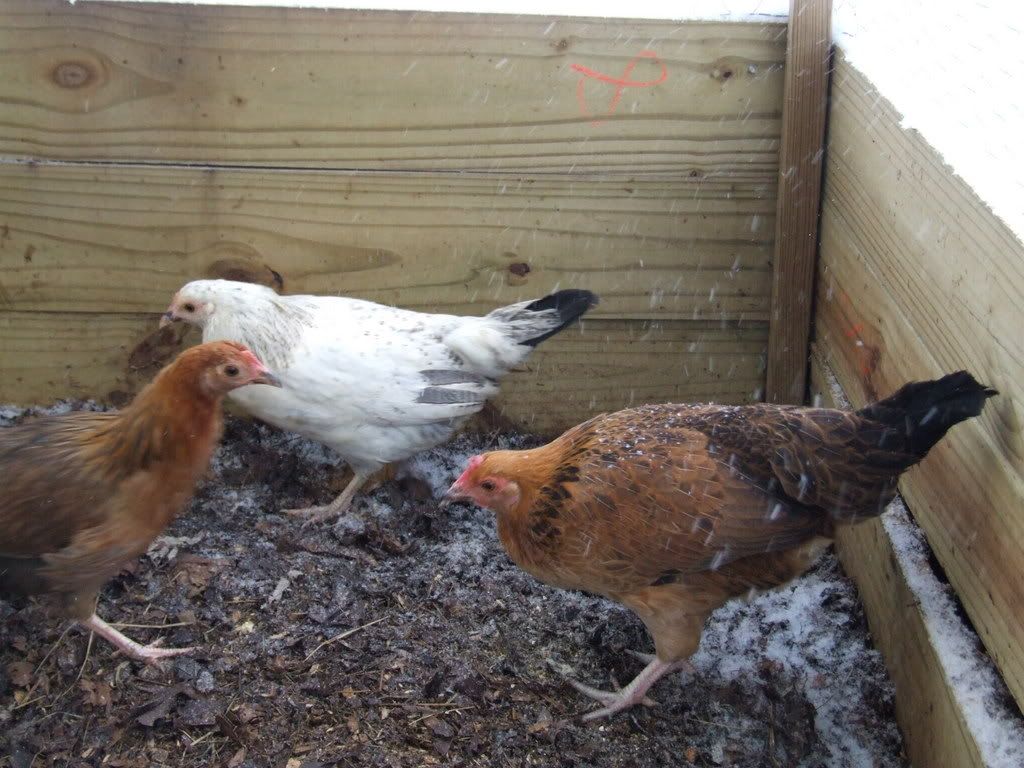
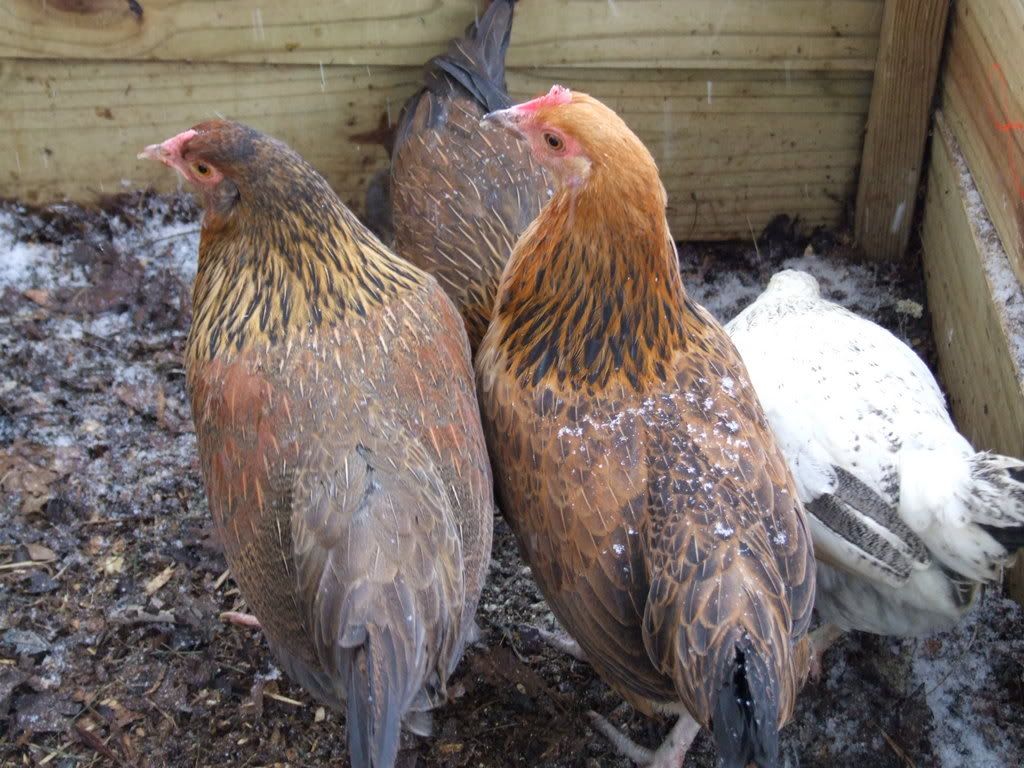
These are the first three. The one in the back has tufts of feathers over her ears, which might get more pronounced as she gets older.


Here are the second three. I'm a sucker for white birds, so I really like the white one in the back. Her neck feathers are lightly barred and are very pretty.


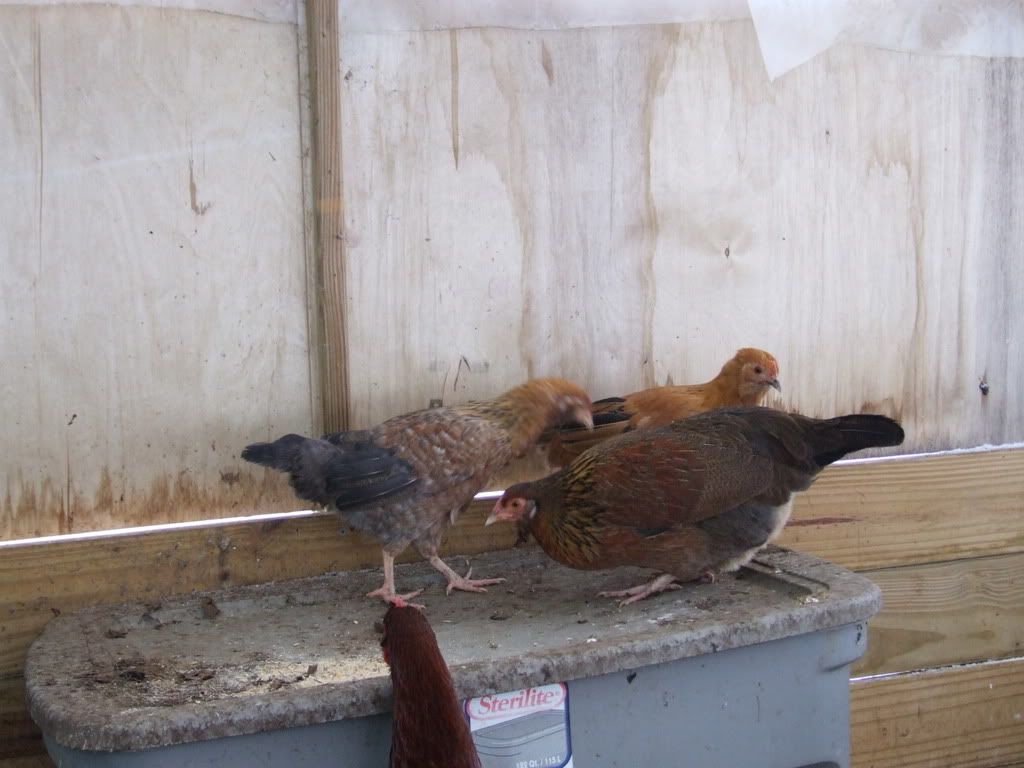
I was trying to get a good picture of the ear-tufted one, but she's even more flighty than the others, so this was the best I could do.


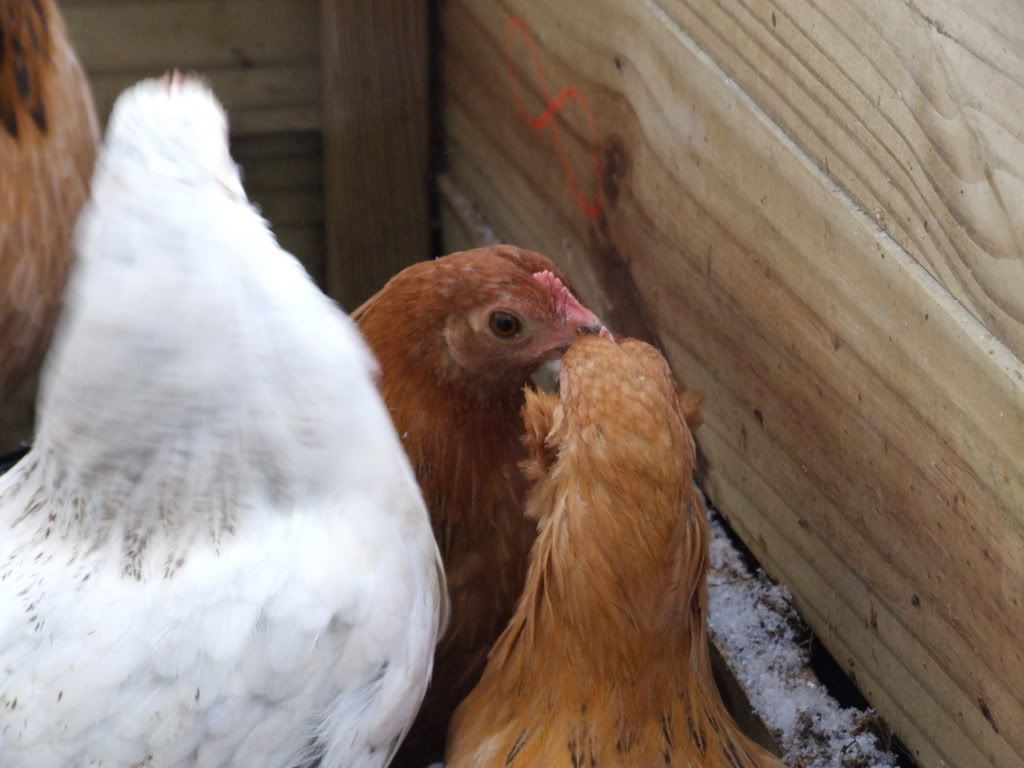
A close-up of multicolored feathers.


If anyone has any ideas what breeds might be in these chickens, let me know. I'm pretty certain that a significant portion of their background is bantam breeds, because they fly very well.

Tuesday, December 04, 2007

Laying Hens: Generation 1.5

We sold our riding lawnmower to a couple in town today, and while I was talking with them I mentioned that I kept a flock of chickens. They immediately wanted to know if I wanted to have any more, because they were reducing their flock. Since they were free, I agreed to look at them.

I guess that several months ago they were given a hen with about ten chicks, all of unknown ancestry. Now that the chicks are a few months old, they wanted to get rid of most of them. I only wanted the pullets, since I don't feel like slaughtering a batch of roosters this winter (and I especially don't want to deal with them if they start crowing before they reach a good slaughter weight). I have no idea what breed(s) they are, but I ended up with six nice-looking little birds. One possibility was Americauna, but their "mother" lays brown eggs, not blue and green. She also looks a lot like them, so she's probably related even if not the actual mother of all of them. It will be interesting to see how they turn out. They seem to have finer frames than I remember the Rhode Island Reds having at that age, so they might end up being some combination of bantam breeds. It was getting dark when I put them in the chicken house, so I'll have to get pictures later.

My flock didn't quite know what to make of these newcomers. They all grew up together, so their social structure was established very easily. It was definitely a vivid demonstration of the "pecking order," as each of the hens seemed to have a goal of eating at least one feather from every new pullet. Hopefully the new girls won't be bald by morning.

With extra chickens in the house, they may not be able to keep the bedding as scratched up as before, so I'll have to watch out for capping. That's the nice thing about starting out with a large amount of space/bird: there's room to take advantage of these sorts of opportunities. Even with adding half again as many birds, they still have 3.5 square feet each. Once I build the new external nest box, it will make things even more roomy.

Since the new pullets are at most three months old, we'll probably start getting eggs from them in early March. This will give us a nice boost in next year's production.

Monday, December 03, 2007

Dairy Goat Deferred

I had said previously that I wanted to get a dairy goat this fall for spring milk (either already bred, or she could be bred to Bubba). It's been so difficult to find dairy goats around here that I would pretty much accept any breed, even though I would prefer a Nubian.

There was a lead at a farm about an hour away. They had goats, and wanted to sell a couple of Nubian/Toggenberg crosses (that were bred to a Boer cross buck). The does were four years old and had never been milked, and were due in February (yikes!). Still, the asking price of $125 each wasn't bad so we went out to take a look.

Well, it turned out that the buck had gotten out a few times, so the does were possibly due to kid at any time. They weren't in bad condition as far as their weight was concerned, but their feet were a mess. One of them had a hoof that was so long that it had turned under and she was walking on the sidewall. I've never had to correct a hoof that long, but my experience with bad hooves is that it takes a long period of frequent trimming to get them anywhere even approaching normal. That doe also had a mismatched udder, and the larger half was nearly dragging on the ground. Oh, and she had at least one extra teat sticking out of the side of the udder. She was such a mess that I wouldn't have taken her even if she had been free (you have to figure that each goat will add at least 500 lbs to your winter hay needs).

The other doe wasn't anywhere near as bad. Her hooves were overgrown, but they looked like they would take less than six months to correct. I think her udder was reasonably high, balanced, and without extra teats, but she was so skittish it was hard to get a good look. Because of the skittishness, hoof neglect, lack of a milk record, and lack of breeding record (as well as her age and crossbredness), I offered $100 for her. I actually think that was even a bit high, but I didn't expect them to go any lower. They hemmed and hawed a bit, but when it was clear that I was serious in my offer, they declined it, saying they could get that much for her kids. It was just as well, because I would rather spend $200-$300 on a decent, non-show purebred from proven milking lines. I just need to keep working the connections to find something like that.

At this point, it's probably too late to get a dairy goat for this year. I would want to keep her in quarantine for two weeks, and with the weather getting bad that would be difficult to manage. Time to start contacting all the goat breeders in the area, to see if I can get a freshened doe in the spring.

Friday, November 16, 2007

Egg Tidbits

During the summer, I fed the laying hens a blend of 18% broiler feed and cracked corn, about 1-1 proportions. They picked up the rest of their protein needs from the insects on pasture, and crushed oyster shells were supplied free choice separately for calcium. In early November I ran out of cracked corn, so they got the straight 18% feed for a few days. The egg production almost immediately jumped from 4-6 eggs per day to 6-8 eggs per day! It makes sense, since there are fewer insects available now. So they will continue to receive the higher protein feed for as long as they continue laying this winter.

Some of the eggs were looking pretty big, so I looked up the weight requirements for the different sizes. According to this USDA publication,


Size or weight classMin net weight/dozenMin weight/egg
Jumbo30 ounces2.5 ounces
Extra Large27 ounces2.25 ounces
Large24 ounces2.0 ounces
Medium21 ounces1.75 ounces
Small18 ounces1.5 ounces
Peewee15 ounces1.25 ounces


The most recent dozen eggs had a net weight of 26 ounces, so they were nearly Extra-Large. I need a more accurate scale to measure the individual eggs, since my kitchen scale only has marks for ounces. Still, if my pullets are laying such large eggs now, just imagine how big they should be after they fully mature.

The hens will be moving into their winter quarters (the brooder house) tomorrow. It's not too cold for them to be out on pasture, but we've now entered the fall rainy season, and it's pretty muddy out there. If I let them stay, they'll cause a lot of damage to the pasture. There's not a whole lot left for them to eat out there, anyway.

Agriculture Resources

After reading some great excerpts from old agriculture books, I've decided to collect as many as I can find that are pre-1940. I found some very promising ones at the Antique Mall in Barnesville.

Agriculture Yearbook, 1924. Topics include hay, poultry, and weather, as well as the agricultural statistics for the year.

Yearbook of Agriculture, 1935. Includes the previous year of agriculture, new developments, and statistics.

Yearbook of Agriculture, 1936. Topic: Genetics and the improvement of plants and animals. No statistics, because this was the first year that they were moved to their own volume.

Pork Production, by William W. Smith. 1937. Extensive information on all phases of pork production, including several chapters on forage and several more on feeding other agricultural by-products (skim milk, whey, etc).

Old McDonald Had A Farm, by Angus McDonald. 1942. This one is actually a biography, but I couldn't resist after reading the author's note at the beginning.

"This book is about my father, James Angus McDonald, and how he labored to make a good farm out of a poor one. I lived on this farm with him and my brother, sister, and mother from 1912 to 1922, near Sallisaw, Oklahoma."

I have no idea if it will be any good, but there might be some agricultural gems hidden in the prose.

There was also a cardboard box filled with herd registry books for the American Jersey Cattle Club from the 1890s. The entire box was $50 and I was really tempted to buy it, just because I like poring over that sort of thing. Plus, if I ever get into full-sized dairy cattle, Jerseys are probably what I would get. I managed to restrain myself, although if the box is still there next time I go down there, I may not be able to resist again. Other than the registry books, I pretty much cleaned them out of agriculture books.

Tuesday, November 06, 2007

Some Musings on Future Endeavors

Potential Projects for 2008

Animals

Cattle: I would like to get a couple of 18-month-old steers next spring to graze our pastures. They would be slaughtered in the fall.

Chickens:
  • Layers: This year's hens should really start producing a lot of eggs in the spring. I would like to build a hoophouse green house for winter poultry keeping, so that I can have more than twelve hens. I'll also be buying another batch of chicks.
  • Broilers: Since I actually have the pasture pen finished now, I'll go ahead and get a batch or two of Cornish cross broilers. I'll also probably get the next batch of layer chicks straight-run, so that the cockerels can also be used as broilers. Perhaps I'll also attempt to caponize a few of them.

Ducks: The ducks will be the advance forces in the war against brain worm. I need to look through the duck breeds and see which are the best foragers. I also plan to get Muscovies to keep the fly population down near the goats.

Goats: We'll continue with the Boers, hopefully getting a good kid crop in the spring. I will be keeping all of the good-quality doelings for future breeding. I'm also looking for a dairy goat this fall to provide milk starting in the spring.

Pigs: While Paul is gone, pigs will be in the garden area tilling the soil and eating weeds. I will be planting oats behind them in the summer for winter forage and to keep weeds to a minimum.

Turkeys: Turkeys have been such a disaster this year that I'm not sure I want to try them again so soon. I'll have to make that decision next summer.

Structures

Fencing: I want to finish the perimeter fence around the forest next year. I also want to divide the forest into paddocks so that I don't have to use the electric netting out there. I'd like to save it for the dairy goat on pasture.

Poultry House: With the addition of ducks to my flock, I'll need more space than the brooder for winter housing. I'll probably get a hoophouse kit to build a combination poultry house for the ducks and layers.

Water: I plan to dig out a very small pond at the base of the spring run-off and put a second storage tank nearby. The tank would provide water to the forest paddocks so that the other tank can be used only for the pastures.

Monday, November 05, 2007

A Few More Goat Notes

I'm beginning to see a pattern here:

The only hitch was that early in the process, Nieuw apparently jumped the fence into the next paddock, although neither of us saw her do it.

One section of fence sagged enough that R6 Nieuw got out.

Yesterday, I caught her in the act. She's been going under the fence, not over. Since the bottom-most strand of the electric netting is neutral, she's discovered that she can flip it up with her nose and scoot under, especially if the fence is "floating" on top of heavy vegetation. So yesterday I had to chase all the goats back into their previous paddock and then use my scythe to cut a fenceline for the netting. Once it was flush with the ground, I staked down each section with tent pegs. It seems to have worked, because everyone was still in their paddock this morning.

Also, Bubba seems to have figured out not to stick his head through the fence, because I haven't had to rescue him since the last time I posted about it. So he got a reprieve from wearing a pvc pipe across his horns.

Thursday, November 01, 2007

Working the Goats

Paul and I spent the morning catching goats, deworming, trimming hooves and determining ages. It was downright relaxing compared to the rodeo of last time. This time, I had a cattle panel bent into a half circle and held in place with T-posts (actually, this was the remains of Bubba's pen.) I had set up their paddock fence so that one end ran flush with the cattle panel, so any goats that ran that way hit a dead end. It worked pretty much flawlessly, and since it was so easy to catch each goat the remaining ones never got too worked up.

The only hitch was that early in the process, Nieuw apparently jumped the fence into the next paddock, although neither of us saw her do it. We just left her for last so that she thought she'd gotten away with it, then snuck up and cornered her. Her "shortcut" turned out to be not so short, since we had to drag her all the way back to the first paddock to be treated, and then all the way back to the new one.

Based on how today went, I have a few ideas for building an actual working pen. It will be made of wire panels and T-posts, so if it needs to be tweaked (or completely changed), it will be easy enough. I did a quick sketch of the plan in Paint, so it's pretty ugly but hopefully it makes sense (click on it to see larger version).


The chute is pointing at the driveway so that a trailer could be backed up to it for easy loading. I estimate that it should cost less than $500 to build, with the majority of the cost coming from the panels. That's a far cry from the multiple thousands you can spend for pre-made working equipment. Since I doubt we would ever have more than 30 breeding does on this property at once, we don't need the fancy equipment.

Sunday, October 28, 2007

Goat Psychology

Bubba is an idiot. When I got there today, he was caught in the fence by his horns. After being freed, he went on to get caught twice more in less than thirty minutes. This article has a solution:

"Goats are creatures of habit. If you have a goat that repeatedly hangs its horns in fencing, that goat will stick its head in the same place time after time until you fit the horns with a PVC pipe secured by duct tape. The grass is always greener on the other side of the fence."

Tomorrow, Bubba will be getting some custom headgear applied.

Saturday, October 27, 2007

Goat Management Software

When we had goats in Arizona, I bought the Goat Breeder's Notebook software to keep track of all of the information. It's been sitting on my computer all this time, so I decided to try using it with my current goats. Oh, my. I can't believe I never noticed before how unintuitive and downright buggy this software is. I spent a fair bit of time putting in goat-related expenses, saved them all, and then none of them showed up in a report! And if you mark an animal as dead, you cannot undo it short of restoring an earlier version of the database. Yet there's no warning that it is a permanent action.

In disgust, I decided to search for some slightly more professional software. Most of what I found was either really low-level, or very expensive, but Ranch Manager: Goat Edition looked like a nice combination of quality software for a decent price. So I requested a trial version and have spent the evening playing with it. The trial version is the full program with a 30 day limit, so if I decide to buy it I'll already have all of my information entered.

So far, it has been reasonably intuitive to use, and there are some very nice features. One of the best things is that you can define different locations on your land (pastures, pens, barns, etc) and can keep track of where any given goat is at any time. The really cool part is as soon as a buck is in the same location as a doe or group of does, the software automatically calculates the earliest due dates for the does. You can also draw maps of your locations, and then add hyperlinks in the maps to the individual records.

I do have a few nitpicks. For the map thing, it would be really nice if you could upload maps as well as draw them. In the individual goat records, the photo uploader always starts in the same spot, one of the data folders for the software, so it takes a good five clicks to navigate to my image folder. It would be sanity-saving if it would remember the last folder it opened and start there instead, the way most programs do.

I've got another 29 days to play with this software, and I'm going to throw everything I can think of at it. If I'm still reasonably happy with it at the end of the trial, I'll probably buy it. This company also has special discounts if you buy more than one species' software together, which would be really nice if I had cattle, sheep, or horses. Too bad they don't have a poultry management edition.

Friday, October 26, 2007

Goat Breeding

Well, I broke down and let Bubba in with the girls tonight. See, I had dismantled his pen so that I could use the panel in the great deworming roundup, and had never put it back together. He's on a tie-out for grazing, so it wasn't a huge priority. But tonight after dusk I heard coyotes up on the ridge, and I didn't want to leave poor Bubba unprotected all night. It was too dark to put the panel back on his pen, so he had to go in with the girls and Balto. It's only about three weeks earlier than I'd planned to start breeding, and honestly, since he's young and unproven, it's probably best to start as early as possible anyhow. So kidding season should start in late March at the earliest.

Bubba was more interested in the new grass than the does. Balto thought that he smelled very interesting. He didn't spend that much time sniffing a new doe when she was first introduced. Bantini (this year's kid) ran up to sniff noses with Bubba when he first came in, but the rest of the herd pretty much ignored him.

Since at this point Bantini is the only doe I don't intend to breed this year, I won't be splitting the herd. She's nowhere near large enough to go into heat yet, so it should be fine.

Thursday, October 25, 2007

Nest Box Free Eggs

At least one of the hens has made a habit of roosting in the nest box instead of in the house, so it was starting to get filthy in there. I dumped it out and put fresh hay in it, but I also decided to leave it out of their yard for a while so that the offending hen could make a habit of sleeping elsewhere. In the meantime, the hens can lay their eggs in the grass.

It was kind of funny, because all of the eggs were together today. It looks like one hen chose a spot and made a nest, and the rest waited in line for their turn to use the same spot. That probably would have been funny to watch. I guess they've just gotten used to taking turns in the nest box.

Wednesday, October 24, 2007

Rendezvous Over a Sagging Fence

There's been a lot of rain over the last several days, so the step-in posts for the electric goat fence loosened a bit. One section of fence sagged enough that R6 Nieuw got out. I'll have to mark her as bred, since she spent as long as eighteen hours loose with Bubba. March 22 is a little bit earlier than I wanted to start kidding, but it's not too bad.

Thursday, October 18, 2007

Rodeo

Today we caught the last of the goats that needed to be dosed with dewormers. Paul and I spent a good hour chasing, cornering, roping, and tackling the recalcitrant goats. They're all done now, but we get to do it again in two weeks. And again a month later, and every month after that. *sigh* I really need to build/buy some working equipment to make this easier. Even a neck crook would probably help.

The good news is that none of these wild goats are showing any symptoms of brain worms. The bad news is that we lost another one, the bottle-baby we bought a few months ago. Also, Tally, the friendliest goat left, definitely has neurological damage. It's too soon to tell if all of the worms have been flushed from her body, but she doesn't seem to have gotten much worse in the last week. So the three tamest goats are the only ones that have been afflicted so far. As we wrestled with the wildest, meanest-tempered doe in the herd (that would be R10, Goshen), I remarked that we'll probably end up with her daughters as our foundation stock. Well, as long as they're healthy and hardy, I don't care about the temperament too much. It's not like they're dairy goats that need to be handled daily.

Tuesday, October 09, 2007

Brain Worm

Monday morning, I found Swellendam lying on the ground, unable to get up, and twitching her legs. I managed to get a vet out to look at her that afternoon. I had tried searching the internet for her symptoms, but the closest thing she matched was enterotoxemia, which didn't make much sense. I don't feed grain, and the goats had been eating pretty much the same forage as ever. Doctor Sparling took one look at her and diagnosed brain worms, which he said came from deer. He recommended fenbendazole (Safe-Guard), but said that her chances of recovery were very low. I had figured as much, since she was pretty far gone. He was unable to tell me the name of the parasite, which I'd never seen mentioned before, so I did some research after I got home.

Paralaphostrongylus tenuis

Called meningeal worm, brain worm, and deer worm, P. tenuis normally completes its life cycle in white-tailed deer. The adult parasite lives in the brains of deer, where it lays its eggs. The eggs travel through the blood to the lungs, where they hatch into larva. The larva travel to the throat, where they are swallowed and passed in the feces of the deer. Here's where things get a little bit strange. The first-stage larva in the feces are not infective until they are consumed by terrestrial snails or slugs. The larva transform into infective third-stage larva within the gastropods, with warm weather allowing them to change more quickly. Then, when a white-tailed deer ingests an infected gastropod while browsing, the larva travel to the brain and mature into adults, starting the cycle over again. The parasites generally cause no harm to white-tailed deer.

Other ruminants can be susceptible to brain worm if they eat infected snails or slugs. However, once the larva migrate into the brain, they are unable to mature into adults. Thus, they swim around in the brain and spinal cord and cause increasing neurological damage. In some cases they will travel from the spinal cord into the skin, causing itching so intense that the animal will chew holes in its hide. The camelids (llamas and alpacas) seem to be more susceptible than goats and sheep.

Since the parasite requires both deer and gastropods to complete its life cycle, only areas with high concentrations of white-tailed deer and a humid climate are at risk. There is some research showing that the instances of the disease peak three to four months after each peak gastropod season. In the Ohio River Valley, the observed peaks of disease are September/October and January/February. This corresponds to the peaks of gastropod prevalence: spring and fall.

Diagnosis

There is no way to definitively diagnose brain worm in a living animal. The only way to know for sure is to find the larva in the nervous symptom. The symptoms include lameness or weakness, paralysis, circling, blindness, and other signs of neurological distress. Some animals may recover without intervention, but even if the brain worms are destroyed, the neurological damage remains.

Treatment

There really isn't a lot of research yet on treatment for acute cases. The most common regimen seems to be dewormers to kill the larva (although there is no reliable information on which, if any, of the dewormers will cross the blood/brain barrier), steroids to reduce the inflammation while the dewormers work, and supportive care.

Prevention

Since the parasite requires gastropods as intermediate hosts, one method of prevention consists of keeping the livestock away from moist areas and woodlands. However, goats much prefer browsing in woodlands and brushy areas to grazing in pastures, and pasture grazing puts goats at much greater risk for stomach worms.

Another possibility for small farms is to put up deer-proof fencing around the property. This is of course extremely expensive, and it wouldn't prevent infected gastropods from entering. Some people spray poisons designed to kill snails and slugs to prevent the disease.

Probably the most common method of prevention is deworming every month, so that the brain worm larva never make it to the nervous system. However, there is no dewormer that is specifically for P. tenuis, so they use the standard dewormers. Deworming on such a frequent basis rapidly leads to resistant strains of parasites, many of which are a greater threat to goats than the brain worm itself.

For now, I will be deworming every month with fenbendazole, but this is only a temporary solution. I can't afford to lose anymore goats right now, but I do want to develop a management system that will not require the use of chemical dewormers on a frequent basis.

Possible Natural Prevention Strategies

The most obvious strategy (to me anyway) would be to choose breeding stock that are naturally resistant to this and other parasites and diseases. I understand that this is how the Kiko breed of goats was developed: a large number of goats were kept with no intervention, and the ones that survived, bred. As a sole strategy, this only works if you have a very large starting breeding pool and don't mind losing a large percentage of the early generations. However, in combination with other management strategies, I think that breeding for animals that require less intervention is a good long term strategy.

There are some natural dewormers out there, although as far as I know there has been no in-depth research as to their effectiveness. Some people swear by diatomaceous earth (DE), which is used as a natural way to kill many kinds of insects/arachnids. The sharp edges of the DE cut open the carapace of the insect, and it dries out and dies. I don't quite understand how DE kills parasites in the moist environment of the digestive track. I suppose that it might kill the larva in the feces once they are exposed to air, which would prevent reinfection. If this is the case, it would not prevent brain worms since they are only passed by infected deer.

There are also herbal dewormers, which often contain wormwood. Again, there is little to no research on the efficacy of these products. However, since the standard chemical dewormers work on brain worms, it's possible that if herbal dewormers work at all, they probably would work on brain worms as well.

Another strategy would be to use natural methods to control the gastropod population. There's a saying, "There's no such thing as a surfeit of snails, only a dearth of ducks." I think that turning ducks into a paddock to clean up the snail and slug population could be a very effective way to control brain worm in livestock. Especially if paddocks are kept small, so that gastropods from neighboring paddocks won't have a chance to migrate in before the animals are moved again.

I had planned to introduce Muscovy ducks next year anyway, to help control the fly population. I'll just add in some mallard-derived breeds as well to help with the gastropods. The original plan was to have the Muscovies follow the goats, but now obviously the Duck Brigade would have to precede the goats into any paddock. It would probably also be a good idea to keep a few of them with the goats as well. I know this will open up new hazards, such as coccidiosis, to the goats. I'll just have to see how it works out in practice.

So, to sum up, this fall I will deworm my goats with fenbendazole monthly until February. As soon as the weather begins to warm up in the spring, I will introduce several breeds of ducks into the paddocks to eat up all the snails and slugs. Under this system, there will still be some risk of brain worm, but it should be greatly mitigated. The long term plan is to select for resistance to all diseases and parasites. I'll probably also introduce some Kiko bloodlines into my herd to help speed that process up.

Poor Swellendam didn't make it, but at least now I know about a significant risk in my area, and can take steps to prevent further problems. RIP Swellendam; you were a good goat.

Sources:
Meningeal Worm, by Susan Shoenian

Parelaphostrongylus tenuis in the Ohio River Valley and Parasitology in Llamas and Alpacas, by Cliff Monahan

Prevention of Meningeal Worm Infection

Monday, October 08, 2007

Chicken Sale

I sold half of my laying flock today, because I only have room to keep twelve of them through the winter. My dad taught me how to tell which ones have started laying (feel how far apart the pelvic bones are), so I was able to set aside the ones that were already laying. I was honest about this with the buyer.

Despite selling eleven pullets, today was a net loss because I had to call the vet for one of the goats. More on that in the next post.

Sunday, September 30, 2007

Meet the Herd

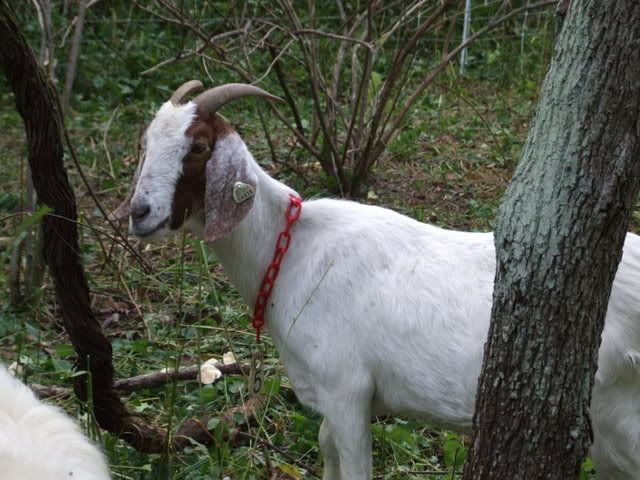
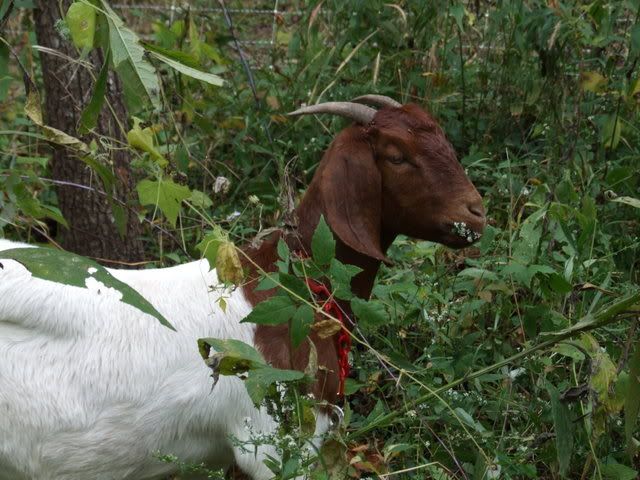
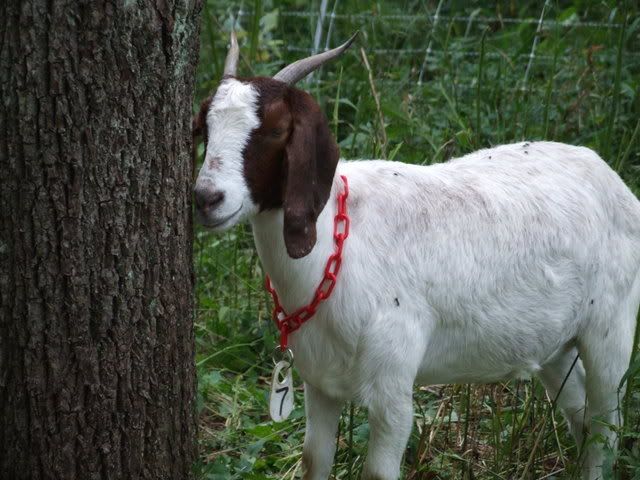
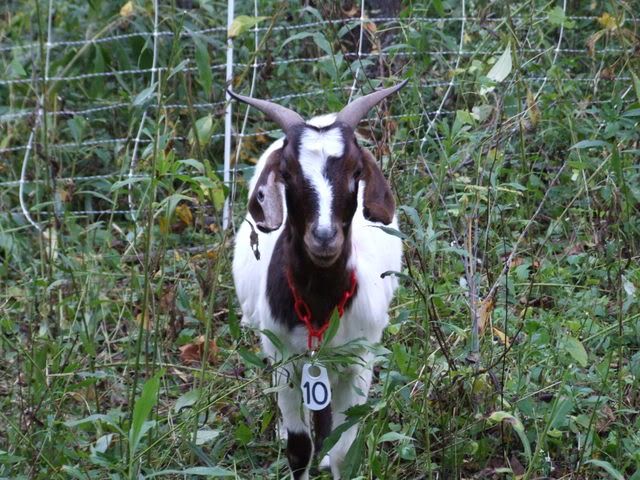
Here are our breeding does. Paul came up with the names, which are all related to the Boers in South Africa.

R1 Natalia "Tally"

R2 Swellendam

R3 Stella

R5 Ciskei

R6 Nieuw

R7 Transkei

R8 Bophuthatswana "Swana"

R9 Lyden

R10 Goshen

Wednesday, September 26, 2007

Preparing for Goat Breeding

This is our buck, Bubba. He's only seven months old, so he's nowhere near his adult size yet.


October 31 is the final kidding date for the goats we bought this summer. At that point, we'll have had them for five months, so any goats that haven't kidded by then, won't. I'll be splitting them into two herds this winter. The first will be all of the adult does except for any that kid in the next month. The second will be the kids and any of the does that kid in October. On November 15, Bubba will be turned into the breeding herd, which could be as small as one doe or as large as nine. He'll stay with them until February 1, giving us a kidding season of April 15 to June 30.

I would also like to get a Nubian doe this fall to breed for milk in the spring. I had no luck finding a currently milking doe this year, so at this point I've given that up as a lost cause. Poor Paul will have to wait another year for fresh goat's milk.

Friday, September 21, 2007

No Turkeys for Thanksgiving

I've been weighing the turkeys every week to chart their progress, and the cold weather last week really took a toll on them. They're now a full week behind schedule, so I've decided to only offer them for Christmas. I don't think there's any point in trying to sell 6-8 lb turkeys.

I've added additional protein to their diet, in the form of roasted soybeans and earthworms, so hopefully they'll start to catch up to their projected weight. I've also decided to delay putting them on pasture for one week to allow them to grow.

Speaking of pasture, I need to get started building their pasture pen. Wood and I don't get along, so I've decided to build a pvc pen with a wooden base for strength and weight. There are a few plans available online, but none of them quite meet my requirements, so I'll probably just design my own. The projected size is 8'X 8', which is a bit more manageable than Salatin's 10' X 12' pens. Next year, I'll be able to re-use the pen for broilers, and should be able to fit about 50 of them in it.

Wednesday, September 19, 2007

First Egg!

One of the Rhode Island Red pullets has laid her first egg. She even managed to put it in the nest box, which made me happy because it's a rather unusual design. I just cut a hole in the side of a large Rubbermaid container and lined it with hay. Since we already had the container, it was much cheaper and easier than trying to build something.

We used the egg to make pancakes, and they were delicious. So richly flavored.

Tuesday, September 04, 2007

The Haystack Grows

There's been a long string of good weather, so I've been frantically cutting hay. I got most of it up on the haystack today, and then decided to actually measure the dimensions rather than estimate them. It's a lot bigger than I thought! There's now just over a ton of hay on the stack, where just last week I thought I only had about 800 lbs. I have nearly a third of the hay that I need, and I haven't even finished the front pasture. After that, there's still the pond pasture, which is about 3/4 of an acre, and the overgrown grain field, which is another acre. As long as I'm able to keep cutting, there's no reason for me to need to buy any hay this winter. That is a wonderful thought.

Hay Progress:
2080 lbs/6750 lbs

Wednesday, August 29, 2007

Early Birds!

Wow, it's a good thing I got everything ready for the turkeys yesterday. I expected them to arrive in Steubenville tonight, but they were at the Adena post office this morning. They all made the trip alive, and none of them look sickly. The hatchery put in an extra one for free (which they've done every time I've ordered from them), so I have seventeen poults in the brooder.

I think I've found the solution to my protein source problem, or actually I remembered the solution. Journey to Forever has an article on how to create high-protein feed out of the air (scroll down). I just need to breed some maggots to feed to the turkeys as a supplement. High protein feed plus cutting down the fly population: a win-win situation.

Tuesday, August 28, 2007

Preparing for Turkeys

Today I finished the last of the preparations for the turkeys, which should arrive tomorrow night. The brooder has fresh bedding, the waterers have been thoroughly cleaned, and the chick feeders are clean and filled with feed.

Speaking of feed, my plan was to take my custom broiler feed (which is about 18% protein) and just add fishmeal to bring it up to 26% for the turkey poults. The only kink in this plan is that the feed store doesn't carry fishmeal, and they looked at me like I was insane when I asked for it. They were supposed to get back to me about if it would be possible to order it, and how much it would cost, but they never did and I haven't had a chance to follow up on it. I've had absolutely no luck finding an internet source, either, unless I want to buy wholesale from the fisheries. Yeah, not so much. At 76% protein, fish meal would have been very useful with these fast growing turkeys.

Apparently, dried earthworms are also 76% protein by weight, so I'll remember that in the future. I don't think I have enough earthworms to spare right now to make enough to make a difference, but I can start harvesting, drying, and storing them for next year's turkeys. In the absence of both fish meal and worm meal, I had to go with roasted soybeans, which only have 37% protein. I had wanted to find something other than soy, since that was already the main protein source in my broiler feed. It will take 8 parts of roasted soybeans to 11 parts of the broiler feed to get 26% protein.

Saturday, August 25, 2007

The Conclusion of the Chicken Marathon

Well, it took two all-day sessions with Paul helping me, but we got all of the broilers processed. Just in time, for the turkey poults arrive next Wednesday. Now that I'm done with the broilers for the year, here is what I learned:

1. It's absolutely imperative to actually get the birds out on pasture, the earlier the better.

2. Bedding was a huge hidden cost that I forgot to take into account when I figured my costs. It takes two bales of shavings (costing $5-$7 each, depending on quality) to cover the floor of the brooder. Those two bales would have easily been enough for the two week minimum that the chicks need to spend in the brooder, however, as the chickens grew they produced more and more waste, and thus needed more and more bedding. Next year I will already have the broiler pen (since I absolutely have to get it built for the turkeys), so it won't be a problem. In the future, I will require myself to have additional field pens completed before the chicks are ordered.

3. They grow incredibly fast, and the next size of feeders and waterers need to be ready to be put into use at mininum notice. This year, I was always scrambling to keep up with the chicks' increasing appetites.

4. Now that I've personally slaughtered 45 chickens, I have a pretty good handle on how to do it. Next time I need to force myself to get them all slaughtered in a timely manner, so that I don't have to keep feeding them for months past the typical 8 weeks. I've also realized that since we have very little space to work, a scalder is useless without an automatic picker. It does no good to scald several chickens at once when there's only room for one person to pluck them. So we'll have to keep doing everything by hand until we can cough up the $600 to buy a basic scalder/picker set (or until we find used ones that we can afford). Until we have that, I don't think it will be possible to raise more than one pen of chickens (75-90) at a time.

5. Cornish cross chickens really can't stand high heat once they're more than about a month old. Most of our 30 losses were due to really hot days where they just keeled over. Getting them out on pasture should help with that.

Hopefully I'm now past the steep part of the learning curve, and next year will run more smoothly.

Tuesday, August 14, 2007

Hay Calculations

I've spent much of the last few months learning how to make hay by hand, starting with a scythe. I've gotten good enough that I think I can harvest the bulk of the hay that my goats will need for the winter. It was hard finding an estimate of how much hay goats will eat, but the number I found was 5 lbs/goat/day. At 15 goats for 90 days, that works out to 6750 lbs of hay.

It was even more difficult to find a formula to estimate the weight of a given volume of loose hay. Finally, I found a Canadian site which said that there were 60 kg/m3. That works out to 3.75 lbs/ft3. Assuming that I did all of the calculations correctly, I need 1800 cubic feet of loose hay.

The weather has been dry this week, so I've been cutting hay every day. This will be the first time cutting the entire pasture by myself (last time the goats helped). I think it's quite likely that I'll have enough hay just from this cutting, but there should be another cutting before winter to give me some surplus.

Friday, August 10, 2007

Jewish Pickles

Up until yesterday, I had no idea that cucumbers could be preserved in a salt brine just like kimchee, but apparently that's the old Jewish way of making dill pickles. So I'll be trying out this recipe with our smaller cucumbers. I'm fascinated with all kinds of fermentation, so this is right up my alley. Plus, if it works, it's so much easier than vinegar pickling!

The large cucumbers are still slated to become dill spears in a vinegar brine.

Processed today:

Jewish Dill Pickles, using all of the small cucumbers (forgot to weigh them).

Thursday, August 09, 2007

More harvest

Harvested today:

Radishes, 6 ounces. These are pretty tough and woody, so they won't be any good for eating raw. They might be okay grated into a soup or something similar.

Potatoes, 3 lbs. Most are pretty small, including a few the size of a large pea, so we'll see how they taste. They're Yukon Gold variety, which is a baking potato.

String beans, assorted, 1 lb. Green, wax, and burgandy beans. These will probably just be cooked up for a side dish one day.

Processed today:
Salsa verde, 3 cups, using 1-1/2 lbs of tomatillos from the house garden.

Wednesday, August 08, 2007

Cucurbita Explosion

Harvested today:

Pickling cucumbers, just under five pounds. The amazing thing is that there were only a few cukezillas in the batch; most of them were a decent size. These are slated to be dill pickles, either whole or spears (depending on size).

Zucchini, two and a half pounds. The bad thing is that they are only two squashes. Zukezilla!

Acorn squash, one at one and a half pounds.

Unknown squash (turns out it's a scallop squash), one at three-eighths of a pound.

I had planned to slaughter a batch of chickens tomorrow, but now I think I'll be pickling instead. The cucumber situation is becoming serious.

Also, we have a ton of mustard greens that I was too busy washing and putting away to weigh. However, the freezer still has nearly all of last year's mustard greens still stored, so it's not like we need anymore. They are apparently good for trading, though, since Paul traded a gallon bag of mustard greens for a hat full of homegrown tomatoes. Our tomatoes are still small and green, so they were a nice treat.

Monday, August 06, 2007

Gobble Gobble

After waffling for a few months, we decided to raise turkeys this year. The poults will be hatched on August 28, and they'll be 12 weeks old just before Thanksgiving. They should be 15-20 lbs dressed weight by then, or maybe a bit less. The minimum order from the hatchery is 15 (we bought 16 because that put us in a lower price bracket), so we'll need to find buyers for most of them. Even if there were nothing else in our freezer, we couldn't fit 16 turkeys in there.

So, if anyone wants a homegrown, pasture-raised turkey for Thanksgiving or Christmas, let us know.

Saturday, July 28, 2007

More goats

We bought two new goats today, both five months old. They're both Boers, one buck and one doe. We needed a buck anyway, and he's a nice looking little guy, so we jumped at the chance. The doe was bottle-fed, so she's very friendly and tame. Between that and looking very good, we couldn't help but get her. I may end up bottle-feeding all of my replacement doe kids next year, or at least some of them, so that my herd will become easier to handle. Once the herd as a whole is tame, I should be able to let the does raise their kids without losing too much tameness.

I'm planning to train the buckling to graze on a tie-out, so that he can clear out areas too small or dense for the doe herd to get into. I'll be keeping an eye out for a cheap wether to be his friend, or if necessary I can save one from a future kidding.

Thursday, July 26, 2007

The Chicken Marathon

Fifteen slaughtered, approximately 35 to go. Two bags of feed left. Will Mel slaughter all of the chickens without having to buy more feed? Tune in next week to find out.

Sunday, July 01, 2007

Pick a Peck of Pickled Peas

Since we have so many peas, I decided to pickle a batch. I used this recipe to pickle five pints of snap peas. There are still a few left over for salads.

For the snow peas, I'll freeze most of the tender ones for stir-fry later, and try pickling some of the others. The really tough, overgrown ones will be evaluated for shelling pea suitability. Anything that's left will be fed to the goats.

The shelling peas will probably find their way into a casserole or two, or maybe a pot pie. I know this will come as a shock to my mother, but I've actually found that I like peas that are fresh from the garden.

In the home garden, the tomatillos are massive with a lot of fruits. Salsa verde! I also picked the first two pickling cucumbers, since they were getting too big. Not enough to make pickles, but perfect sliced thin and marinated in Italian dressing. I know, another shocker. But oddly enough, cucumbers also taste good, fresh from the garden. I'm really looking forward to my slicing cucumbers, which are Lemon Cucumbers.

Saturday, June 30, 2007

Harvested Today

1-1/2 lbs shelling peas (in pods)
1-7/8 lbs snow peas
2-5/16 lbs sugar snap peas

And an unknown number of sun-warmed blackberries, which were promptly eaten.

Sunday, June 24, 2007

Kids!

Our first set of kids were born yesterday. They are twin doelings, and they look like they're doing well. Assuming they still look good in a few months, they will almost certainly be added to our herd. A 20% increase, overnight!


Friday, April 20, 2007

I finished the brooder today, and the chicks will be moving out to it tomorrow afternoon.

I got a good start on the field house. I'm using this design. Cerra helped me put the 2x4 base together: I drilled and she fetched the screws and put them in the holes. Then I screwed them in. I think it actually took less time with her helping than it would have alone. I got a third of the conduit pieces cut, but it was an arduous task because I didn't have the right kind of hacksaw blade. I picked up some better ones at Lowes, so hopefully it will go faster next time. I estimate that this pen will be done by the end of next week, which should give me plenty of time to build a second one for the broilers before they need to go to pasture.

We tried taking Balto out to the land with us today, but it didn't work out too well. Paul thought that Balto could be trusted to roam around the pasture, even without a fence, but he quickly proved that to be wrong by running into the road. We put him in the fenced garden area, but he immediately made a nuisance of himself by standing in the planted spots (probably less than 100 square feet out of a third of an acre) and refusing to move. So he spent the rest of the time tied up in the corner. So much for trustworthiness.

Wednesday, April 18, 2007

The brooder/winter layer house/raised-bed garden/greenhouse is nearly complete. I used 1/2 inch pvc to make a hoophouse-type roof for it, which turned out to be trivially easy to build. I stapled poultry netting around most of the house, leaving room for a nest box and two doors. Putting the plastic over the top ended up being far easier than I expected. There was just enough of a breeze to lift the plastic up, but not enough to send it into orbit. I was able to attach it by myself with two clamps to help me.

Downhill from us, on the other side of the alley, is the neighborhood dump. Near us, it's mostly yard waste: leaves, grass clippings, branches, Christmas trees, etc. However, people have been known to dump garbage further down. At any rate, I raided the big leaf pile for the bottom layer of bedding in the brooder. Since the leaves are already partially composted, they'll give a nice jumpstart of microbes to the bedding. Also, there will be plenty of bugs and spiders (and centipedes!) for the chicks to gobble up. I followed the leaves with a layer of pine shavings. I really need to find a local source for bulk wood shavings, because paying pet store prices is going to get prohibitive.

All that's left to do on the brooder is to build two doors and attach them, cover the nest box hole with plywood, and attach a tarp or two to block cold winds until it warms up some more. The chicks should be able to move in by the end of the week. They'll spend only maybe a week there before going out to pasture, making room for the new batch of broilers.

Speaking of broilers, the last of my supplements arrived today so I was able to put my feed order in at the mill. Even with my customizations, buying in bulk will lower the feed cost from about $0.28/lb to $0.19/lb. This is for the broilers, who are too lethargic to forage much. Once the layers get out on pasture, they should be able to forage most of their own food, especially once the insect populations explode in the summer.

Monday, April 16, 2007

False Spring and Resurgent Winter

As the ground thawed several weeks ago, I began to get excited about my spring plantings. In a short period, I watched my soil temperature go from the mid-30s (19 Mar) to 50 degrees (24 Mar). The warm stretch held until 5 April, when the average daily soil temperature dropped from 52 to 43. Yikes! It hit a low of 39 on 8 April which suspended planting. The only thing in my planting set which can start in soil that cold is garlic, and I had already planted all of my garlic cloves. After several days of temperatures in the low 40s, I was finally able to plant some more lentils today.

So far I have:

- two blocks of garlic (planted 19 and 26 Mar, respectively). Both blocks came up quickly and are thriving nicely. The cloves were from a hardneck variety with a pinkish tinge to the outer paper. I received the bulbs from a neighbor last fall.

- two blocks of lentils (planted 26 Mar and 16 Apr, respectively). The first block (144 seeds) has sprouted and the seedlings are about an inch high. My seed stock is a bag of basic grocery store lentils.

Planted 27 Mar
- one block of lettuce (NK Lawn & Garden: Grand Rapids). Nothing yet. These were 2003 seeds I'm trying to use up.

- one block of arugula (Johnny Seeds: Sprint). Several seedlings have emerged. Majority have not yet come up.

- one block of radish (America's Choice: Sparkler). A good number have sprouted. Growth has been slow due to the cold snap.

- one block of mustard greens (Seeds of Change: Green Wave). Nothing yet.

Planted 29 Mar
- one block of shallots (Seeds of Change: Ed's Red). Nothing yet.

- one block of scallions (Burpee: Evergreen Long White Bunching). Nothing yet.

- one block of quinoa (Seeds of Change: Temuco). Nothing yet.

- one block of spinach (Seeds of Change: America). First seedlings seen today.

- one block of snow pea (Seeds of Change: Oregon Giant). Appears to be just about to break the soil.

- one block of flax (?). Nothing yet.

The weather is supposed to warm up considerably starting tomorrow.

Friday, April 13, 2007

Chicken Feed

Since Paul had to leave for his National Guard Drill weekend today, I wasn't able to go out to the land. So instead I developed the feed recipe I'll be giving to the mill. With around 100 chickens, I'll be using enough feed to be able to order in bulk. This is what I came up with, for 500 lbs (the minimum the mill can mix).


corn250.0
roasted soybeans160.0
crimped oats62.0
feed grade limestone25.0
Thorvin kelp2.5
Fastrack probiotic0.5
Total500.0

The kelp and the probiotic will probably raise some eyebrows at the mill. I had to order them myself, because no one around here uses them. The kelp is a mineral supplement, and probiotics are beneficial bacteria and yeast that help the digestive system.

I've also heard good things about Fertrell Nutri-balancer, but I was unable to find a source for it. The company's website has no indication that they accept direct orders, and none of the dealers are within a two hour drive of here. The only contact information on the website was an email address, so I sent an email asking if they do direct sales or not. This was several days ago, and I haven't heard back yet. At this point I'm just going to give up on Fertrell. I figure this will make a nice control, anyhow. If I ever manage to get some of it, I'll already have a baseline of performance on my regular feed.

I also ordered the broilers today. I should receive 75 Cornish cross chicks on May 10th. I had hoped to start them at the beginning of May, but this was the earliest date the hatchery had available. So I'll probably begin processing them in early or mid July.

Thursday, April 12, 2007

It rained a lot yesterday, so I wasn't able to go out to the land to work on the water system. Instead, I worked hard on the roof to the brooder, which is covered with greenhouse plastic to allow light and warmth in. I got it all done just before sunset during a lull in the rain, which promptly started up again harder than ever.

A few hours later I went out to bring Balto in for the night, and discovered that the roof wasn't sloped nearly as much as I had thought it was. Consequently, the rain had collected instead of running off, and one of the pieces of wood had broken under the weight. *sigh* Back to the drawing board.

I kicked around ideas for putting more of a slant in the roof, but none of them really seemed to work. I was still thinking about it this morning when I drove to St. Clairsville for more plumbing supplies. On the way, there is a nursery with several greenhouses. They look like they use the same kind of plastic, and they are built on a hoophouse model. That got me thinking about how I could implement a similar design for my brooder roof.

Several months ago I ran across a website that had instructions for making a hoop-style greenhouse out of pvc pipe. I figured the measurements for something like that today, and it looks like it will work. Luckily, I have enough of the greenhouse plastic left to cover a second roof. The first plastic, which is full of holes now from being screwed into the wood frame, will be used to cover the ends of the hoops.

At Lowes, I managed to navigate the plumbing department all on my own and figure out how to add in a valve between the tank and the start of the pipe. I had quickly realized, as I was setting the system up two days ago, that it would be very helpful to be able to turn off the water before it got to the pipes.

It sprinkled a bit while I was working, but the threatening clouds held off for a few hours. As soon as I installed the valve on the tank, I set up the pump to begin filling it. I knew that it would take quite a while to pump 300 gallons about ten feet above the creek, so I wanted it to fill while I worked.

While I was at Lowes, I picked up another 100' of pipe, which took the water line almost to the end of the field. I discovered that the best way to uncoil the pipe was to anchor one end to the fence and then stretch it straight on the ground. It took me very little time to set up two more tees and valves on the line. Since there is now a valve at the tank, I can easily add more tees or more pipe at any time.

It took about an hour and a half to completely fill the tank. The water is slightly murky from all of the rain, but it wasn't too bad. The 300 gallons add a good bit of pressure to the water so that it gushes out even at the end of the line. The Foxtail Farm water system is now live!

Tuesday, April 10, 2007

Paul unexpectedly had the day off today, so we went shopping at Lowes for farm stuff. I got most of the rest of what I needed for the water system and all of the supplies for a portable chicken pen. That's enough to keep me busy for a while.

After shopping, I worked on the water system until the sun went down. I'm using a 800-gph bilge pump and pvc pipe to move water from the creek to a 305-gallon storage tank. At the base of the tank there is flexible pipe to take the water down the field. Periodically, there are tees with spigots so that a garden hose can be attached.

I really don't have any experience with plumbing, so I wasn't completely convinced that all of this would work until I got it hooked up tonight. The only difficulty is that the bilge pump's wires are very short, so I had to have the battery perched at the very edge of the creek. I plan to get some alligator clips to act as an extension cord. In the meantime, I tried it with jumper cables and it worked fine. It was such a rush to hear the water start flowing into the tank when I hooked up the battery. I hadn't been sure that the pump would be powerful enough to move the water all the way up the bank and to the top of the tank. I thought I might have to get a second pump and send the water up in two trips, but that turned out to be unneccessary.

The water tank has a 2" outlet, but the pipe is 3/4". I spent about half an hour looking at the different fittings at Lowes, trying to figure out the right combination to make that reduction. Finally, I found a guy who worked in the plumbing department and he was able to find what I needed. I ended up with three different kinds of plastic, and three different kinds of connection (threaded, cement, and compression), but it all works.

The flexible polyethylene pipe is a pain to work with. It comes in 100' coils, and it does not like to uncoil. I finally gave it up for the night because I think that it will be more flexible if the temperature is warmer. I'll try again tomorrow.

The best part about this watering system that I've cobbled together is that it only cost around $600 to provide running water to two acres. Half of that was the cost of the storage tank. Six months ago I had no idea how we were going to get water for livestock short of drilling a well. There was all that water going by in the creek, but I couldn't figure out how to capture it without spending far more money than we have. Luckily, I stumbled across Joel Salatin's books this winter and they taught me about bilge pumps and gravity-powered water systems (among many other things).

This autumn, we want to dig out a pond near the road where there's already a seep. Once the pond is there, I'll move the storage tank and the pipe across the field so that I can pump out of there instead of the creek.

Monday, April 09, 2007

The weather was still pretty cold today, so I didn't do a whole lot out at the land. There is a spot where brambles and trees encroach on the pasture that I had to clear so that the fence can run through that spot. The hardest part was the locust tree that was leaning at 45 degree angle and blocking the way. The only tool I had to work with was a hand saw, but I managed to cut off a big chunk of the tree and haul it out of the way. Then I got to use my brand-new machete to hack down the raspberry and/or multiflora rose brambles in the area. That was fun. Now the area is clear enough to put the fence in.

Jefferson Landmark didn't have any leg bands, so if I want any I'll need to order them online, I guess. Several of the chicks are starting to grow out their tail feathers, and they're so cute with their little wedge-shaped tails. While I was out at the land, I collected a bucket full of fine gravel from the creek bank to give the chicks for grit. They seemed to like it.

The soil temperature has dropped low enough that all garden planting has been suspended for now.

Sunday, April 08, 2007

Chicks

I received my first batch of 26 chicks last week. They are Rhode Island Red pullets for my laying flock. They all survived the mail system and settled in nicely. Since I can only fit 12 chickens in my winter house, I plan to sell the extras as started pullets.

It's interesting to see the different levels of growth in the chicks. They'll be a week old tomorrow, and most of them have grown wing feathers that already reach to their tails. However, there are at least two that hardly have any wing feathers at all. I plan to get some leg bands so I can keep a close watch on these slow growers. Perhaps they're cockerels that were mistaken for pullets.

Spring work and plans

We took advantage of the warm weather the last few weeks to get started on this year's projects. I am fencing out the rest of the cleared land for a pasture, and at this point most of the wood posts are in. Earlier in spring, I was able to plan out where to put a pond. The combination of melting snow, frozen ground, and dormant vegetation made it very easy to see where water likes to collect on our land. The pond site stretches far further into the trees than I had thought, so I had to change some of my fence lines to compensate. The pond will be completely fenced out from livestock, to protect the riparian habitat that will develop.

I've also nearly completed a combination brooder/cold frame/raised-bed garden/winter chicken house in our back yard. This will allow me to keep 12 laying hens through the winter, and brood up to 250 chicks at a time.

The livestock plans for this year include laying hens, broiler chickens, turkeys, and a beef steer. If everything goes well we might add a pig this year, but we aren't definitely planning on it until next year. We will be using a pasture-based forage model. All of the animals will have continual access to fresh grass in an intensive grazing system. My primary goal this year is to produce enough meat to never have to buy any from the grocery store again. The secondary goal is to begin finding customers for direct marketing of our produce, meat, and eggs.

Paul has most of his garden planned out, but I'll let him write about that.

Monday, September 11, 2006

First Harvest

Today I pulled a half dozen radishes. All together they weighed just under a quarter pound, but it is a start. So much for the people who claimed it was to late in the year to grow anything.


There is also some sort of mildew on my quinoa plants. I'm not sure what it is, but they are all affected; so I think I may end up losing all of them.