Friday, September 26, 2008

A Downside to Free Range Chickens

Finding eggs in the haystack.


I've changed the way the chickens are handled. I had been using electric netting to contain them in a section of the pasture, and then moving the pen once or twice a week to a fresh spot. This involved getting all the chickens into the movable house, locking them in, tearing down the fence, moving them to a new spot, setting up the fence, and herding the ducks into the new location. It was just getting to be too much with all the other chores I have out there.

So now I'm going with a modified free range/Balfour method. The Balfour method is basically a pen with a deep layer of straw or other dry vegetable matter. The chickens scratch it up and turn it into compost, and find lots of bugs under it. They spend the night and at least half the day in the pen, in order to confine the eggs to a small area, and then they are let out to free range over the full pasture until evening.

This has been working well, and the birds have learned the routine and are eager to come back to the pen at night. In fact, one day I had choir practice until after dark, and when I came back to the farm to put the birds away, they had all already put themselves to bed. All I had to do was shut the gate.

Now, the bantams can fly over the fence, so that's why I find clutches of eggs in weird spots around the pasture. I don't mind, though. They were free and their eggs are too small to sell, so it's just a happy bonus to find a batch of eggs from them.

Sunday, September 21, 2008

Steam Thresher Reunion Festival

Several weekends ago, we went to the Stumptown Steam Thresher Reunion in New Athens, Ohio. It was fascinating to see the steam powered machinery, including a complete sawmill. I took a bunch of pictures and some video.


Even though it wasn't steam powered, the display I found the most interesting belonged to a washing machine collector. He had a bunch of old gas or hand powered washing machines set up. The most gorgeous one was this hand powered one. The gear action was incredible. Inside the barrel was a wooden arm with spokes that spun and moved the clothes through the water.

The owner said that all of the metal parts on this washing machine were cast, not machined. The craftsman is completely unknown.


Some of the "newer" washing machines came with butter churn or meat grinder attachments, so that the motor could be used for multiple tasks. Most also had a place to attach a belt, so that anything with a drive shaft could be run off of the same motor.


I also took video of the sawmill operating, but uncompressed it is around 200 MB so I'll need to compress it a bit before uploading.

Friday, September 19, 2008

Foraging for Wild Foods...

...in the Sears parking lot.

We found an apple tree planted alongside Sears while walking back to pick up my car after its oil change. It had been pruned in such a way that all of the apples were within the leaves, but I recognized it by the windfalls on the ground. The tree had died some years ago, but four trunks had grown up from the rootstock. We grabbed several apples for dessert, and gathered all of the windfalls for the pig.

Beyond the immediate value of the apples, I was very interested to find this tree because it demonstrates the result of coppicing in apple trees. Coppicing is the practice of cutting a tree down and allowing shoots to grow back from the stump. It is a traditional woodland management tool that has been used for centuries. Trees are harvested every twelve years, and the stumps can produce for hundreds of years.

I had recently read an article about own-root apple tree coppicing, where alternating rows of apple trees are cut down each year to provide additional sun to the remaining trees.

"Coppice-ability is also the basis of our "Coppice Orchard". This consists of OR trees planted in rows running north-south. When the canopy of the orchard closes, a north - south row will be coppiced and the land in the row used for light demanding crops, e.g. vegetables on a no-dig system, while the trees regrow. The trees either side of the glade will have higher light levels on their sides and produce more fruit buds. The next year another north - south row is cut but not the immediate neighbours as these will have the extra buds, so the next row for coppicing will be next-door-but-one. In other words this will be Alternate Row Coppicing. This process is repeated every year, creating a series of parallel , sheltered glades. Eventually the rows of trees forming the avenues between the glades will also be coppiced in turn, but by then the ‘glade’ trees will have regrown to form the avenues. As the trees regrow there will be glades at all stages of regrowth until the cycle repeats itself, and niches for plants suited to full light, semi-shade or heavy shade, creating opportunities for different types of land use."

I'm very interested in the genetic diversity of growing apples from seed, so this was a fascinating concept to me. The tree at Sears gave me a good idea of what to expect from coppicing apple trees.

Now, we don't really have the space to establish the sort of full-sized orchard that is mentioned in the article, but I was thinking of planting apples along some or all of the fence rows. I've been collecting seeds from as many diverse sources as I can, in order to have the greatest genetic diversity amongst my trees. Most of the fruit probably won't be that great for eating, but it will be fine for cider and for feeding to the pig. I understand that apple finished pork is extremely delicious.

Disaster Narrowly Averted

At about midnight I went out to check on the chicks before going to bed. Before I had even gotten out of the garage door, I could tell that something was wrong. There was no orange glow of the heat lamp through the greenhouse plastic roof. I guess the bulb burned out. I don't know how long the heat had been off, but all of the chicks were still alive, huddled against one edge of the draft guard. They're now safe in a cardboard box in the house, with a grow lamp for warmth. If I had been thinking more clearly, I could have put the grow lamp bulb in the brooder, but they're all settled now. The adrenaline is fading, but I'm still a little bit on edge.

Wednesday, September 17, 2008

New Chicks

We're trying out a new system this year. Instead of buying replacement layer chicks in early spring, we've decided to try buying them in late summer. Older birds can forage for much of their feed needs during the growing seasons, but regardless of forage, the chicks need a good growing diet to reach their full potential. So it makes sense to me to have the heavy feeding occur during the fall and winter, when the birds would need to get most of their food provided anyway.

Mid-September is a bit later than I'd like, though. Next year, I will try for early August instead. For this batch of chicks, I decided to try out the Black Australorp, since they are supposed to lay well during hot weather. We had a significant drop in production during the hot months this summer, so they should help even out our production.

I had originally ordered them to ship September 8, but since I ordered 50 of them it was pushed back to September 15. Boy, I'm sure glad they were, since last weekend there was a really bad windstorm that collapsed the roof of the brooder. Hopefully the weather will remain nice at least until they get some feathers on them.

Wednesday, July 09, 2008

Frantically Cutting Hay

It's been a very rainy spring/early summer this year. Since mid-May, there hasn't been more than two or three days of dry weather at a time. I got some hay cut in May, but none since then. The old grain field is very weedy, so I've been cutting that down, but because of the constant rain I've just been composting the cut vegetation.

Finally, I seem to be getting a break. There's not supposed to be any rain until Sunday, so I spent several hours today cutting. Most of it is crownvetch, which gets very tangled, so it's hard work. Luckily, goats love crownvetch, and since it is a legume it probably has a decent protein content. It's not very palatable to cattle or horses, but goats think it's wonderful, especially when it's made into hay.

I plan to try to get out to the farm early tomorrow morning and cut some more before it gets too hot. As the week progresses, I'll transition from cutting to tedding to gathering to storing.

Chicken Chasing

I did a bad thing today. I let all the poultry out of their pen into the main pasture to forage (because I needed to spend my time cutting hay, not moving their pen). I expected that it would be easy to lure them back in with a scoop of grain, but that was not the case. Little heads popped up all over the field when I called them, but they immediately went back to foraging.

The Rhode Island Reds probably would have come back to the house after sunset, but the others are pretty flighty. Besides, I was very tired and didn't want to wait that long. So I stationed Cerra at the gate and told her to open it whenever I herded a chicken her way. The ducks were easy; I got them into the pen in a single flock and they were so traumatized that they didn't try to come out again (ducks are such nervous creatures). Chickens tend to scatter more than flock, so I was pretty resigned to chasing each of them individually.

Paul showed up when I was about halfway through and helped me round up the stragglers. I don't think I'll be letting them all out again any time soon.

Barn Beginnings

Well, really more of a shed. Paul's parents are taking down the wood fence in their yard, and they've given us the panels and posts. The panels are approximately 6' X 8'. I plan to use the first four panels as the walls in a three stall barn. The back of the barn will be hog panels and the front will open out onto three separate paddocks. I plan to put a pole frame around the fence panels to support the roof. This will give me winter housing for up to three flocks of goats (yearling does, breeding does plus buck, and any kids or goats that need special treatment). For the winter, I would stack straw bales against the wire end of the barn to make it three-sided instead of two.

There will be more wood panels coming, so I'll either add more stalls or come up with something else to use them for.

Habits

Gosh, it's easy to lose the habit of blogging (mostly) every day. I lost the use of my computer for one weekend a few weeks ago (dead power supply), and I haven't posted anything since.

I have a few things to write about, but I'll put them in different posts.

Monday, June 23, 2008

Generous Kitty

In the last week I've found a dead field mouse and a dead mole right next to where I park my car. I think Banshee is tithing. Also, I haven't seen any mice skittering about the compost pile since we got her, whereas before I'd usually see them every day. She's doing a great job.

Sunday, June 22, 2008

Silly Pig

Porkchop has an interesting method of getting to her food bowl. She won't be able to pull this off for much longer.


Saturday, June 21, 2008

Worthless Crook

I recently bought a crook from Premier Supplies based on their glowing description.
Most functional and satisfying neck crook we've used. Lightweight, strong and quick in the hand. Top is molded from very tough plastic--so it will never lose its original shape and almost never breaks. Shaft is coated fiberglass. We love everything about it. When given a choice, we always grab this one.

At $39, it was also the most expensive crook that they carried, but I wanted one that would last.

I decided to try it out and do some hoof trimming today. Things were going great, but on the third goat I caught, the top broke right off! I was so disgusted. I've had nothing but good experiences with Premier and their products, so I hope that they will give me a refund when I call them on Monday. I might try out the leg crook instead, which is made of solid aluminum. Presumably that will hold up better with strong goats.

Speaking of hoof trimming, this time I used a homemade rope halter (based on this design) to tie each goat to a tree while I trimmed her hooves. Tally decided to take a nap and enjoy her pedicure. She was stretched flat out on the ground, completely relaxed. I was actually a little bit worried, because that is not normal behavior for a goat, but she got right up once I untied her and gave a little tug on the halter. None of the rest were as cooperative.

Saturday, June 14, 2008

Pork Chop

I was all set to drive to Barnesville today and buy a pig at the auction. However, last night I finally found a source for feeder pigs that was only a few miles away. It was a bit more than I would have paid at the auction, but when you figure in the cost of gas, the waste of an entire day, and the pig's potential exposure to disease at the auction...I was more than willing to pay what they wanted.

They delivered the pig to us this evening, but I still had to hook up the charger for the electric fence. I didn't realize that the opposite end of the fence was touching the woven wire and was grounding out, so the pig escaped into the garden. She was NOT amused at being caught, and squealed like, well, a stuck pig. Paul finally figured out the problem with the fence, and we put her back in the pen. She promptly got zapped on the nose (squeal!), and then she went over to the place where she'd gotten out before. Zap! Squeal! Zap! Squeal! Escape! Wait, that part wasn't supposed to happen. She charged through and was still small enough to fit through the fence, despite being zapped. Again I caught her and put her back in the pen, this time guarding the end that she liked to escape through.

After one final zap and squeal, she sat down and regarded the fence with a thoroughly bewildered expression on her face. Over the next few hours she napped and then rooted around a bit, but did no further escaping. I hope that when I check tomorrow morning, I'll find her still in her pen. Pigs are smart enough that electric fence is supposed to be extremely effective with them, so I hope she's figured it out by now.

The people who brought the pig were very interested in the electric netting. They'd never seen it before, but they could immediately imagine the possibilities.

Maybe It's Wishful Thinking...

...but some of the goats are looking a bit bulgy at the sides. I think they might actually be pregnant. I noticed this just before turning them in to a new paddock, so I don't think I was seeing full rumens. I remember that last fall they all looked pregant because their rumens were so big, even though none of them were.

Number 7 looked particularly round, and was one of the ones that I saw in heat in January. If she got bred then, she would be due around June 19th! None of them look quite that far along (comparing to the one that kidded last year), but I understand that it can be hard to tell with goats.

Friday, June 13, 2008

Kitty Photos/Video

Tentatively named Banshee, since she is very talkative and wails anytime I'm out of sight. It fits with the theme of supernatural names for the other two cats (Spirit and Spook). Also I hope that she will be the omen of death to the field mice.


I wanted video of her talking, to demonstrate how she earned her name. However, she was silent and uncooperative for as long as the camera was out. Typical cat.

Thursday, June 12, 2008

Duck Sorting

Today I sorted the ducks from the drakes, at least among the Pekins. They're still too young to have their sex feathers, but I can tell the difference in their voices. The females have a loud, honking quack, whereas the males make more of a whispery wheezing sound. Out of nine Pekins, there are four females and five males, so I chose the three males I liked best for breeding stock. I really only need one, but I'd rather have some redundancy built in. I would hate to lose my one breeding drake to a raccoon.

The remaining two ducks are now ensconced in the brooder house for the night. I plan to slaughter them on Friday. Now to do a little bit of math and figure out the cost to bring them to market weight.


Purchase$3.65
Shipping$1.00
Feed$7.00*
Total$11.65

*This is a rough estimate, since I didn't actually total up receipts. Actual amount may be slightly lower.

I'll estimate a dressed weight of four lbs, so the cost per pound is $2.91. I'll have more accurate data for that after I actually slaughter them.

Wednesday, June 11, 2008

Volunteer Tomatillos

I spent some time planting beans in my garden (burgundy, green, and wax), and I noticed that there were a bunch of little tomatillo seedlings sprinkled about. There's no room in that plot for even one tomatillo plant this year, let alone a dozen, so when they get a bit bigger I'll see about transplanting them. Mmmm, salsa verde.

Chicken Catcher

I spent some time down in my workshop today and finished up my chicken catcher. It's about six and a half feet tall. To recap, here are the steps I followed to make it.
  1. Cut down a small maple sapling that the goats had girdled.
  2. Stripped off the bark and cut off branches.
  3. Let dry for a couple of days.
  4. Filed off all the rough spots (especially on the handle) and sanded the whole thing.
  5. Bent a piece of brace wire (10 gauge, if I recall correctly) into the right shape.
  6. Drilled a hole the same diameter as the brace wire into the end of the staff.
  7. With the help of some linseed oil, inserted the wire the full length of the hole.
  8. Rubbed a thin covering of linseed oil over the whole staff to slow drying and prevent cracking.
I'll continue adding layers of linseed oil as the wood dries, and eventually it will build up into a nice finish.

Tuesday, June 10, 2008

Potential Barn Cat

We've had a mouse problem near the hay storage and composting area since last fall, so I'd been starting to think about getting a cat for the field. On Saturday, one of my friends tried to talk me into taking one of her kittens, but I really didn't think I was ready to get another cat (we have two that have been housepets their whole lives).

I guess it really was time to get a barn cat. I was at my friend's house (the same one tempting me with the kitten on Saturday), and she mentioned that a skinny calico had shown up and started begging for food. I'm a sucker for calicos/torties (my two pet cats are one of each), and I knew that I was doomed. She opened up the door, and there the cat was, crying. She's actually a tortie and white, not a calico. She was hungry enough to come take some food from me, and it was easy to catch her. It was NOT easy to hold on to her, however, and I got a couple of good scratches on my hand. It's been too long since I've had to handle a stray cat, and I've lost my touch. On the third try, I got her by the scruff and she couldn't scratch me anymore. I had to transport her home in a pillowcase since I hadn't come prepared with a carrier or other box (it was a Pampered Chef party! I didn't expect to bring an animal home from it).

She's not going to be a pet. I'm giving her a chance to live a life that's better than wandering without a home, but it will still be a more dangerous life than she would have as a housepet. On the other hand, it's probably the only chance she'll ever be given. My friend certainly didn't want to support another cat. I'll provide food and water, and as long as I can catch her I'll give her vaccinations.

Right now, she's in the brooder house (empty of poultry, of course) until I can settle her in at the farm. I need to make a few changes to the poultry set up first, so that they'll be safe from her. There's a pile of hay under a shade tarp thing that she can perch on to get out of the rain, at least until there's shelter that's more permanent. Of course it remains to be seen if she chooses to stick around our farm. She may decide that she'd rather move on and try her luck elsewhere.

Saturday, June 07, 2008

Now I Understand Why Goats Love the Stuff

Yesterday I cut down a sugar maple sapling that the goats had girdled. I plan to turn it into the handle for my chicken catcher. When I stripped the bark off it suddenly became clear to me why the goats love maples so much. It was exremely sweet smelling with traces of apple. I almost wanted to eat it myself.

Friday, June 06, 2008

Deerfly Season

Today was the first day this year that the deerflies were out in force. There doesn't seem to be any pattern to when they're around. Last year it was mid-May, the year before it was August. They appear for several weeks and then that's it for the year.

I tend to have a pretty strong reaction to deerfly bites. Nothing major, but the bites swell up and are maddeningly itchy for weeks on end. The first year was the worst, since my immune system was already on overload with all the new viruses, bacteria, fungi, and allergens that didn't exist in Arizona.

Last year I tried out deerfly patches, and they worked wonderfully. I guess there is a pretty small population on our farm, because after I had trapped about 20 of them they were no longer a problem. Those 20 just seem like hundreds because they are so aggresive!

So far I've trapped five, plus there was one that I smashed when it bit me on the leg. It's a little bit odd to walk around with a buzzing hat, but it's better than getting bitten. I highly recommend these patches for anyone dealing with deerflies.

Thursday, June 05, 2008

Disoriented Ducks (and Chickens)

Today it was time for the first big paddock move for most of the poultry. The Reds are of course old hands at this, but it was quite the shock for the rest. My normal method is to herd/lure all of the birds into the house, shut the door, and then move it to a fresh spot. While they're still contained in the house, I take down the electric netting and set up a fresh section of pasture.

The ducks were easy enough to herd into the house, and the Reds were easy enough to catch. However, those little Wyandottes were too fast to catch and had no interested in being herded. So I went and made myself a chicken catcher out of brace wire. The wire was not quite stiff enough to be used for the full length, but it got the job done. I plan to find a small sapling to attach just the tip to, so that I'll have more control of it.

After snagging all of the chicks and stuffing them in the house, it was nearly dark. The rest of the move went smoothly, and hopefully they'll all get the hang of it soon enough. If not, I have a chicken catcher and I'm not afraid to use it.

Wednesday, June 04, 2008

Porkers

I've wanted to get pigs for a while, but since I've never raised them before I was a little bit reluctant to start (mostly subconsciously). However, I spent a few hours researching pigs online, and it looks like feeder pigs, at least, are very easy to keep. There are a few things that they need:

  • Fencing
  • Feed (mostly corn)
  • Water
  • Shade/Shelter
I already have a movable shelter, which the goats spent the winter in. It's more than big enough for a pig, and it should be sturdy enough to withstand being rubbed on.

For the fencing, I will be using electric netting. It's the same kind that I use for the goats, except that it's three feet tall instead of four feet. I understand that pigs can be contained with just two strands of electric wire, but that is more difficult to move around and I'm less familiar with it. The main thing problem with netting is that pigs can cover the lower parts of the mesh with dirt, making it less effective. However, I think as long as I check it every day, it should be fine. The higher wires still work, even if the bottom ones are grounded out.

I don't want to spend over $100 for a special pig feeder when I'm not sure that it's something I'll keep doing, so I ordered some show pig feeders for $20 each. They hang on the fence and have a chain that keeps the pig from flipping them up. Obviously, I can't hang that on the electric netting, but I can leave a short section of the woven wire fence available for that purpose. I'm also going to keep my eye open at auctions and such for used pig feeders for a good price. I've read the high corn prices and low pork prices are driving a lot of pork producers out of business.

At this point, I've ordered everything I need. Now I just need to set it up after it arrives, buy some feed, and buy a feeder pig. First paddock location will be the packed down straw and goat manure from this winter. Once that is all turned up and mixed in, I'll plant corn on it. As a sidenote, I plan to grow open pollinated corn, which has a higher protein content than the hybrid varieties. I've read that open pollinated corn can be used as a complete feed for feeder pigs on pasture, no additional protein needed.

The good thing is, everything that I'm buying for pig keeping can be easily used with other livestock if I decide that I never want to do this again.

Tuesday, June 03, 2008

Dreaming of Duckling

The ducks turned eight weeks old on Monday, so it's just about time to slaughter the excess Pekin drakes. In Arizona, I had tried dry picking the ducks that I slaughtered, but it never worked well. In every case, I gave up in frustration and skinned them instead. Dry picking is supposed to give you better quality down feathers, but that doesn't mean much if you can't get them off the bird in the first place!

This time I will be scalding them before plucking, just like I learned to do on the chickens last year. The only difficulty is that I don't have any pots big enough to dunk a duck in. Somewhere on the web, I saw a tip for scalding geese: pour boiling water into a metal garbage can until there's enough to dip the bird in, and once the water cools to the right temperature you can scald. I plan to try this with the ducks, but I need to get a clean garbage can first.

The big thing I'm looking forward to is the rendered duck fat. That stuff is delicious, and great for cooking. The cast iron griddle seems to like it even better than bacon grease.

Friday, May 30, 2008

Flock Integration

"And it came to pass that the two great nations of fowl, the Anitadites and the Galluseans, met in battle on the plain. And there was much squawking and gnashing of beaks, for each knew that they would never reign supreme again."


Yes, tonight the ducks and layers were combined into one pen. The hens were offended by the large, boorish creatures in their house, while the ducks were terrified by the very idea of a house.

Found It!

I took a closer look at the neighbor's pastures, and found the source of the pond's water. There is a little stream that runs down the hillside and into the old creek bed. It should not be too difficult to pipe that over to a trough for livestock.

There is a lot of wildlife back in there. Yesterday I got a close look at a blue heron in the pond, and tonight I conversed with a screech owl. It called to me, and I whistled the song back. I tried to get a picture, since it was sitting just above me, but it was too dark to turn out very well. After lightening the photo, you can kind of see the owl in the middle of the picture.

Thursday, May 29, 2008

Auxiliary Pastures

Today I took a few minutes to go look at the neighboring pastures that I now have access to. They were a very good example of what happens when a pasture only gets cut once a year. Weeds were nearly choking out the grass for much of it, and brambles were starting to pop up at the edges. It's actually perfect forage for goats, but I don't have enough goats to go clear it, at least not without neglecting my own farm.

I'm thinking that if I get any more goats at auction this year, they can work in those pastures during their quarantine. Then, after they've cleared the weeds and grass has grown up, I'll put cattle in there.

The big issue with those pastures will be water. The creek used to run along the edge of them, but sometime in the last 50 years it was diverted and a causeway was built for the road to run along. Now the creek is on the opposite side of the road from the pastures. It was actually kind of creepy to look through the trees and see the old creek bed, dry and empty. Just before the creek bed hits the causeway, there is a small "pond." This is in quotes because I don't think it gets more than a few feet deep at any point. I could pull water from there, but it's so nasty-looking and choked with algae that I would worry about the water quality. I need to do a more detailed survey and see if there are any other water sources that I could use.

Hay Storage

Since we don't have a barn, I've had to get creative with hay storage. Last year I experimented with several types of haystack, but I didn't have enough skill to make them water resistant. The final stack was made by criss-crossing branches on the ground to keep the hay up, with a large tarp over the top to keep water off. This worked reasonably well, but since the tarp rested on the top of the hay, any moisture would condense and soak the top layer. Also, a number of field mice took up residence underneath.

I have a couple of different things to try this year. According to the book The Lost Country Life, here is how an English haystack was built:

A stack of hay always had some foundation; it could be built upon a level flooring of stones, covered with a deep layer of still-green bracken, which does not seem to have 'risen damp' to the hay... The reasons for this bracken foundation were that through it the air could pass easily (it does not pack close like hay), and that it raised the valuable hay several feet off the damp ground and was rat-proof -- rats will not gnaw through bracken, for it, like horse tail, makes their mouths sore.


I don't know that we have actual bracken around here, but there are several different kinds of ferns. The hillside across the road has quite a few, and I have permission to cut as many as I want. It's very labor intensive to gather the rocks for the foundation, so I'm only building one of these haystacks this year. I calculate that it will hold approximately 1000 lbs of hay, which is 1/5 the amount I need for the goats.

I have also sketched out some ideas for racks that would store hay completely off the ground. I'll describe it more fully and take pictures once I've built them and made sure that they work, but basically there would be a frame to hold my large tarp off of the top of hay, and several smaller frames underneath to hold mounds of hay off of the ground.

Finally, I plan to get large burlap bags and pack some of the hay into them for storage in our garage. If I get the construction rolls (6' X 1500') and cut them down into 3' X 6' bags, each bag would hold approximately 50 lbs of hay, or comparable to a bale. The bags would be for backup, in case anything happens to the hay stored at the field. I would probably also use them on days with heavy snow or ice, where I would be unable or unwilling to get the hay out of the haystacks. Buying the burlap for the bags will be slightly more expensive than just buying that quantity of hay, but the bags would be reusable for many years.

Sunday, May 25, 2008

Old Farm Resources

Back in November, I visited the Barnesville Antique Mall and cleaned them out of old agriculture books. I got a chance to go back today. The box of Jersey cattle registries was still there, but I was far less tempted to buy it this time. There were only a few new agriculture books.

The New Agriculture, by Henry Jackson Waters. 1924. A textbook covering crops, livestock, soil management and bookkeeping, complete with questions at the end of each chapter.

Horticulture Enterprises, edited by Kary C. Davis. 1929. Another textbook, discussing various crops: fruit trees, strawberries, grapes, onions, beets, asparagus, rhubarb, horseradish, celery, and mustard, as well as woodland management. Not only does this one have questions at the end of each chapter, but it also has field and laboratory exercises to complete. The book also came with a USDA Farmer's Bulletin tucked into its pages, titled "The Farm Garden in the North" (1922).

After picking through the book room, I wandered downstairs to the farm implements closet. There were some interesting old tools there, but nothing really caught my eye. I had hoped to find something useful in there, at the very least as a model.

The last section I looked in was the basement, where a lot of the things that weren't nice enough to go upstairs were stored. Boy, what a treasure trove down there. I found a sickle that was only $5. It was a bit rusty, but otherwise in pretty good condition. I didn't think to take a picture of it before I started cleaning it up, but here it is after sanding most of the rust off and applying a few layers of linseed oil. It still needs to be sharpened, although it's already sharp enough to decapitate a burdock plant.


I also found an ox yoke, but it was $65 so I didn't buy it. It was nice to be able to hold one in my hands and really inspect it; I now have more confidence that I can carve one based on instructions I found online. It was very small, so I guess it was for training young cattle. I don't know, if it's still there next time I visit I might go ahead and buy it, now that I've seen some of the prices for yokes and yoke components online. It would cost $200 dollars just to buy the curved bows that hold the yoke onto the oxen's necks! I guess $65 is a steal for a yoke in reasonably good condition.


There was also a hay rake leaning up against one wall. It had been broken and repaired with electrical tape, and there wasn't a price tag on it. I don't know how well it would stand up to actual use, but again, it was nice to be able to see how a hay rake is put together. That's something else I intend to try to make at some point.


All in all, it was a great trip to Barnesville.

Saturday, May 24, 2008

Animal Power

I started thinking last week that maybe we should get a couple of calves this year to train as oxen. It will be several years before they can really work, and I think future-me would appreciate it if I took the initiative and started the project sooner rather than later. The difficulty is that oxen are worked in pairs, and our pastures just aren't big enough to support two oxen and a beef steer, not to mention hay for them plus the goats during the winter. After much thought, I reluctantly tabled the idea of oxen for a later time.

However, just a few days later our downstream neighbor came to visit. His family owns the property, but they mostly just use it for hunting. It's a huge pain for them to keep all the grass mowed down, so he offered free grazing and mowing to me. There are a couple of pastures that are too narrow for tractors, so the local farmers won't cut them for him. All told, they have enough grass that I could raise far more than three cattle at a time, so now I'm seriously looking into starting oxen this year.

From what I've read, dairy breeds (or multi-purpose heritage breeds) are preferred for working cattle. I could easily pick up a couple of Holstein calves for less than $100 each, but I'm leery of that breed. The breeders have focused so much on milk production that I wonder how well they hold up to work. Then again, since I've never trained oxen before, it might be best to start with cheap cattle, knowing that they'll probably have a shorter working life than other breeds.

Up near Tappan Lake I saw a farm with Dutch Belted cattle, which are a little known milking breed. After reading about them, I think they bear looking into. They're probably out of our budget at this time, though.

Monday, May 19, 2008

Back in the Swing

After spending Sunday resting, I cut some more of the pasture tonight. This time my muscles didn't complain at all, and I got a lot done. It's so satisfying to watch the stalks fall with every swing of the blade. I could have kept going, but the sun had gone down and I needed to rake the cut grass out to dry before leaving. Orchard grass is quite lovely in twilight, with luminescent blue-green leaves. I love mowing season.

Saturday, May 17, 2008

First Mowing

This May has been very rainy, so for the last several weeks I've been watching the pasture grass getting higher, and higher, and higher. There haven't been enough dry days in a row to get it cut and dried before the next storm rolled in. It's not so bad for the big farmers, since they use tractors to cut the entire field at once, and they bale it in a day as well. I guess the downside for them is if a surprise rainstorm comes up, it can ruin an entire field's worth of hay.

Here at Foxtail Farm, it's just me and a scythe, so I can only cut a small portion each day. I really needed to get a start on cutting, regardless of the weather, so today I set up a shade gazebo type thing that we got from Paul's aunt. I figured I could pile the cut grass under it to keep it out of the rain, and then spread it out to dry when it's not raining.

I didn't cut much grass today because the necessary muscles had gotten rather weak after some eight months since the last time I did this. I had thought I was in decent shape, what with hauling water buckets all over the farm, but today I discovered that scything uses very different muscles than water hauling. Ouch. I'm taking some ibuprofen and going to bed.

Wednesday, May 07, 2008

Problem Goats

I know I've mentioned them before, but I have two problem goats in the herd. Number 10 has a lot of Spanish influence in her, which makes her a good jumper. She can jump the electric fence from a stand. Mostly, she stays put, but she knows she can jump out any time she wants. She's also one of the most skittish of our goats, and these two things make it very difficult to catch her for deworming and hoof trimming.

Number 6 has learned how to get her nose under the bottom wire of fence (which isn't hot) and then scoots her way under it. She gets zapped a little bit, but not enough to stop her. A lot of times Bantini squirts through with her. I could probably stop her by staking down the bottom strand of fence all around the paddock, but that kind of defeats the purpose of movable fencing.

These two goats have an ultimatum. If they don't produce kids this year, they're going to auction. I might be willing to put up with their escape habits if they were good producers, but otherwise they have no place in our flock.

Tuesday, May 06, 2008

Tragedy

One of the Pekins tried to get through the electric fence, and got its wing stuck. By the time I found it, it had been electrocuted. As I carried it to the compost pile to be buried, Cerra kept yelling, "No! You have to take him back to his friends!" She doesn't understand what death means yet.

An Update That Deserves Its Own Post

On April 21st, Paul and I were both working out at the farm when a brown dog came trotting down the road. We noticed her because a passing car had to slow way down to avoid hitting her. She was friendly, so we lured her down into the pasture to get her out of the road. We decided to take her back to the house and make some found dog posters, which we later posted in the post offices and feed stores of both Adena and Cadiz. The dog was a little bit thin, but otherwise seemed to be in good condition. Even though she'd clearly been on the move for a while, the pads of her feet were not abraded and didn't seem to be sore. Here she is that first night.


It looks like she has at least a little Black Mouth Cur in her. Compare to this photo from a breeder:


After a week with no calls, we decided to name her. Cerra has grown very attached to her, so we decided to let her choose the name. She came up with "Netta," which has a nice sound to it.

Last Sunday, we started seeing a male dog that looks a lot like Netta hanging around our house. We'd never seen him around town before, so we speculate that they both had escaped/been dumped from the same place. They might even be littermates. He was very wary of people and disappeared down the alley way any time one of us tried to approach him. Even though he was thin enough that I could see his ribs, he was very mistrustful of the food I tried to lure him with. However, as long as I kept my distance, he was content to lie down and watch me work on training Netta. He seemed very interested in our activities.

Today he finally approached me of his own volition. I took Lily out (on leash, luckily) and he was right there waiting. He came right up to me and let me pet him, and after that he let me handle him. The poor guy has gotten really skinny in the week since I first saw him, but I think he'll be a nice looking dog once I get the weight back on him. I'll put up another set of signs for him, but I doubt that anyone will respond. In a couple of weeks, I'll get him neutered (Netta has her appointment to be spayed in just over a week). We're leaning towards keeping him, too, although I may look for a good home for him after he's had some training. The tentative name for him is Bibb, after William Wyatt Bibb, the first governor of Alabama. Paul chose that name, since Black Mouth Curs are a southern breed, and from what we've seen online, the red-colored ones seemed to mostly be located in Alabama.

Here he is. Doesn't he have a cute face?

Quick Update

Oh, dear. It's been nearly a month since my last post. Here are some of the things I've been working on in that time:

Our ducklings arrived on April 9th (12 Indian Runner Ducks, assorted colors, and 11 White Pekins). Two of the Runners died in the first couple of days, but the rest are doing great. The Pekins should be at market weight in about another month. We'll only be slaughtering enough males to bring us down to two or three, and we'll be keeping all of the females for breeding stock.

Something killed most of the Wyandotte chicks by reaching through the chicken wire and grabbing them. It couldn't get them out to eat, so it just kept killing. In one night, I lost 15 chicks leaving me with only 10. I think it was probably a coon, but I never caught anything in the live trap I set nearby. I surrounded the pasture pen with electric netting, and haven't lost any since.

April 28th, I moved the ducks out to the pasture. Since they require a higher protein feed than chicks, they couldn't share the pasture pen. My solution was to put the ducks within the electric netting surrounding the pen. They've settled in well and have learned to respect the electric wire. This is especially important for the Runners, since they will be one paddock ahead of the goats once they get big enough to be contained by the goat fencing.

I got a good start on the back fence a few weeks ago, but haven't gotten around to stretching it. It's a good thing, too, because there was a storm a few days ago that dropped a large, heavy branch right on my fenceline. I would have been very upset to have to rebuild that fence so soon after putting it up. At this point, all I need to do is to pound in a bunch of staples, stretch the fence, attach it to the T-posts, and hang the two gates. That sounds like a lot, but most of it goes pretty quickly. Hammering the staples is the most time-consuming; once that's finished, the rest should flow together in just a few days.

Tuesday, April 08, 2008

Garden Preparation

Yesterday, Paul went out to the garden to start preparing the soil and plant a few seeds. He quickly decided that a shovel just wasn't going to work. If he kept at it, he might have the garden ready to plant by October.

We came up with a Plan B, which was to rent a rototiller, and a Plan C, which was to buy one. I was opposed to Plan C, because it didn't seem very cost effective to buy a machine that would only be used a few times a year. Paul didn't like Plan B because it's a pain to haul a rototiller to and from the land, and to get all of the tilling done during the rental period. We finally came up with Plan D, which was hiring a neighboring farmer to bring his tractor down and till it for us, which he did this evening.

It really was the best plan. It cost about what renting a tiller for a day would be, and he did a much better job than the rental. I know this because the rental is what we did last year. So now two-thirds of the garden is tilled and ready for planting. The other third is mine to play with, and I'm going to experiment with pig plowing and corn growing (not at the same time).

Speaking of corn, due to the high prices I've decided to grow as much of my feed grain as possible this year. I want an open-pollinated corn variety, so that I don't have to buy seed every year. This guy had really good prices, and I decided to order the blue corn since I don't need a full bushel of seed (that would plant about five acres, and I'm only planting maybe an acre this year). Unfortunately, I just got my order form returned, with a note saying that the blue corn failed the germination tests so it's not for sale this year. At this point, I may just plant whatever hybrid variety the feed store is selling, and worry about sustainability next year.

Pasture Chicks

I moved the chicks out to pasture yesterday to make room in the brooder for ducklings this week. They were unhappy about the chicken crate and the travel, but it didn't take long for them to settle into their new home. Speaking of which, I don't think I ever blogged about the construction of my pasture pen.

Joel Salatin builds his out of lumber, chicken wire, and aluminum roofing. Each pen is 10' X 12' and holds approximately 90 broilers. I tried to build one of these, but I didn't get very far. In order to get 12' long boards to our property, we would have to have them delivered, which is far too expensive. I tried putting together half-length sections, but it just wasn't sturdy enough. Plus, the thing is very heavy and requires a special handcart to help move it. So I started looking for other options.

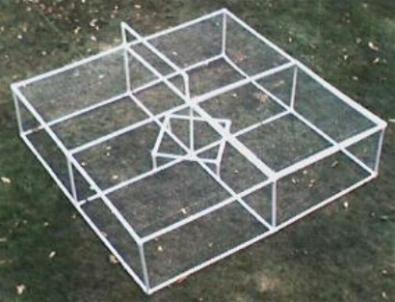
I found plans for a pasture pen built out of PVC pipe and specialized fittings (warning: the fittings are the most expensive part of the pen). With some modifications, I used this plan.


First of all, the plans don't really say what that smaller square in the middle is supposed to be. Supposedly it's a "feeder support," but it's completely useless for the feeders and waterers I use, so I just omitted it. I shrunk the dimensions from 10' X 10' to 8' X 8', giving me approximately half the area of Salatin's pens. For the time being, batches of 50 broilers are more manageable than 90 broilers, so that's fine. I wanted the height to be more than 2' to accomodate turkeys as well as chickens. It turned out that 26" was the most cost effective, because that's what was left in a 10' pipe after cutting out two 47" sections. So the turkeys get an extra 2" of headroom.

The instructions say not to glue any joints, but I found that it was absolutely necessary to glue them. Just be sure that everything is set up properly, first. I also found that simply gluing the hinges and latches was not enough given the amount of stress on them, so I further attached them with small screws (I just noticed on re-reading the instructions that it says to do that as needed. I'm observant).

I used 4' poultry fence to cover it. First I wrapped around the sides, bending the excess in on the top and bottom. Once that was secure, I covered the top and door. Be sure you do the gluing before putting the fence on, because it's a pain afterwards.

My watering system is the same as Salatin's, with an automatic bell waterer attached to a five gallon bucket resevoir. The chicken wire roof alone is not strong enough to support a full bucket, so I angled a 1X6 board across a corner next to the tarp peak for support. I used wire to attach the bucket to the peak so that it won't fall off during moves. The tarp goes over both the peak and the bucket, to protect the water from debris that could clog the tubing.

The pen is light enough to be moved by one person, but with the waterer installed and a full bucket, too heavy to blow away. I still stake down the edges with guy lines, just in case some unusual wind comes through.

I'll probably continue to make small modifications, but I intend to use this plan for the rest of the pasture pens that I make. Somewhere, I should still have the notes I scrawled to myself about quantities, prices, and lengths. If I find it, I'll post more detailed instructions.

Saturday, April 05, 2008

Perimeter Fencing

For our pastures and garden, we have woven wire fencing, with wooden corner assemblies and T-posts in between. Actually, I still have one last length of fencing to put up before the main pasture is completely fenced. Woven wire won't work for the rest of our perimeter fencing, though. The pond pasture is low enough that you hit water about two feet down. The rest of the perimeter is in the forest, where the ground is very rocky and it's impossible to go in a straight line because there are trees in the way. Also, if a tree or branch falls on a section of woven wire, that can mean that the whole section needs to be re-stretched.

My next thought was to use livestock panels. They have the extreme disadvantage of being very expensive, but they have numerous advantages. They can be bent around trees, they only need T-posts to hold them up, they can be used as gates, damaged sections can be replaced without affecting the rest of the fence, and they can be taken up and moved to another property if necessary. Granted, that last one requires renting or hiring a truck that's capable of hauling 16-foot long fence sections, but it is doable.

However, livestock panels are far beyond our fencing budget, so I've had to think further. The next possibilty I thought of was heavy duty electric netting, which is meant to stay in one place for months or years. This would be less than half the cost of the panels, with most of the advantages. An extra advantage is that these fences can be hauled in a normal pickup truck, so there would be no need to use specialized hauling. The only disadvantage is that if the power fails, the fence fails. However, that's already an issue with the movable fences we already use.

Thinking further, there's also the option of using T-posts and multiple strands of electric wire (actually, I would use Intelli-Twine). My initial calculations show that this option would be approximately an eighth of the cost of the netting. The disadvantages are that it is no longer movable (less of an issue with such a low cost), and it is more complicated to design and more work to implement.

After looking at all the options, I think that I will use the last option for most of the remaining perimeter. However, the sections near the creek are prone to flooding, so I think that in those areas I want to use the netting. That way I can remove them each winter and whenever flooding is an issue. Also, in the coming years I plan to rent additional pasture, so I'll want at least some reasonably portable fencing. I'll probably also use the netting for any internal fencing, since I'll want to be able to change the size of paddocks to fit the grazing requirements.

Friday, April 04, 2008

Pastures and Greedy Goats

The grass on the pastures is growing just fast enough to keep the goats fed. I have to move them every day, even with the huge paddocks created by using both permanent fences and the movable fences. That size of paddock lasts the better part of a week in summer. Still, they're keeping fed.

I nearly had a jailbreak today, though. I needed to get the goats from the garden to their new paddock near the water tank. In between those two places are the compost piles and assorted equipment that I don't want the dog and goats to be messing with. The only way I could do this was to set up the movable fences as a big lane, and then after they were in move part of the section to block off the compost pile. It all went according to plan at first, with the goats following me to the far end of the paddock (I was carrying hay, so it was no surprise). I thought for sure they would stay eating the hay while I set up the other end, but I guess they thought I still had food for them. They wandered back over to me after I'd opened up the end of the paddock, but before I could get it set back up properly. It took some agility, but I managed to scare most of them away so that I could get the fence set up. Bubba and Balto were the only ones to get out (it figures that the males would wander), but I knew I could catch both of them easily. Actually, as soon as Bubba realized that he was on the wrong side of the fence from his does, he found his way back in as quickly as he could. He's going to be really upset in a few days when I separate him for good. Balto of couse was no problem to catch, because he was too busy sniffing the compost pile to get too far.

Wednesday, March 26, 2008

Chicken Updates

Now that it's spring, things to blog about have been piling up. I'll attempt to catch up with everything in the next few posts.

I moved the hens out of the brooder last Monday to make room for the new chicks. One of the bantam cross hens was so freaked out that she flew against the door hard enough to open it. I tried to herd her back into the house, but she was having none of it. After a few times around the yard, she discovered the overgrown forest belt at the bottom of the hill, and then I had no possibility of catching her. I spent about 45 minutes crashing through brambles, trying to head her back up towards the house, but she was too canny to fall for that. Finally, I decided to let her be a wild chicken if that's what she wanted so much. There are coons and foxes out there, so I didn't expect that she'd live very long.

(The hen on the left is the escapee.)


All the other hens have settled in well out at the land. For now, I have them confined to their mobile house, to establish that it is home for them. Also, the pasture growth is too new to let them go scratching it wherever they want. However, most of the grain field is covered with the matted down dead growth from last year, so I'm moving the chicken house over that to tear it up and make it easier for the new grass to grow.

The new chicks arrived last Wednesday. I ordered 50 straight run Silver Laced Wyandottes. The cockerels will be slaughtered as fryers or broilers, and the pullets will be added to the laying flock. They'll look something like this when they're grown.


I had wanted to order ducklings first, but the hatchery was behind on orders since the ducks hadn't even started laying yet! It figures that the ducks would throw a wrench in the plans. It will probably be another month or so before I'm able to get any ducklings. I'm planning to get runner ducks (assorted colors) and Pekins.

A few days ago, in the evening, I saw the wild chicken again. She was poking about the bottom of our yard, although as soon as she saw me she ducked back into the brambles again. I'm surprised that she managed to survive out there. After I saw her a few more times, I decided to set up a live trap for her. We got a Havahart raccoon trap in Arizona, when the badgers destroyed our duck flock. It never caught anything there, but it was worth a shot.

I only opened one end, and set a bowl of corn at the closed end. I sprinkled some of the corn at the entrance to attract her. I wasn't convinced that she would be heavy enough to trip it, but it was worth a try. Last night, the trap was still open and she was wandering around the yard. There was a storm blowing up, so I think she wanted to get back into the brooder. Since it's now full of chicks, I couldn't open it up for her. At one point she walked past the trap and looked in at the bowl of corn, but she didn't enter it.

I guess she decided to go for it, because this morning there she was in the trap, with the door closed behind her. Now I can take her out to rejoin the others at the land.

Saturday, March 08, 2008

Farm Newsletter

Greetings from Foxtail Farm,

As spring quickly approaches, it's time to begin planning for the growing season. We're excited about the new products we will have available this year: pastured poultry (eggs, broilers, and turkeys), grass-fed young goats (cabrito), and fresh produce in season.

Pastured Poultry

Our laying hens are allowed to free-range the pasture in spring, summer, and fall. The large volume of grass and insects they eat greatly increase the omega-3 content of their eggs. They produce large, brown eggs with bright orange yolks that are superior in taste to supermarket eggs.

The broilers are confined to a mobile pasture pen for safety, but it is moved every day to a fresh location. Since their diet is composed of up to 30% grass, these chickens have very lean, flavorful meat. They will be available in mid-June and throughout the summer.

The turkeys are raised the same way as the broilers, but since they are able to fill even more of their diet with grass and insects, the taste improvement over supermarket turkeys is pronounced. They will be available in limited quantities fresh for Thanksgiving.

Cabrito

Cabrito is the Spanish word for young goat. Goats have very lean meat that is mildly flavored when they are young, similar to lamb. A typical way to cook it is to grill a hindquarter over wood coals for several hours, turning every 20 minutes, and then wrap it in foil and cook in a 250° oven for an additional two or three hours. At this point the meat will be tender enough to fall off the bones, and it can be shredded with a fork. We will have a limited number of kid goats for sale this year as cabrito.

Produce

Beginning in May, we will have produce available. All of our produce is grown without pesticides or non-organic fertilizers. Call or stop by to find out what we have available at any given time.

At the back of this newsletter (here) there is an interest form that lists everything we plan to produce this year. Please mark anything that you are interested in and return the form to us so that we can contact you with more information. The form is just to help us gauge interest; you won't be making any commitment to buy at this time.

The newsletter also contains an article by Jo Robinson, titled "You Are What Your Animals Eat." This article may be read online at www.eatwild.com .

Monday, January 21, 2008

Herd Relationships

I saw definite signs of heat in four of the does today (3, 7, 8, and 10). This is the first time I've been able to observe goat breeding behavior in a large herd. The does have paired up (3 & 10, 7 & 8), and in each pair one is docile and loving and the other is aggressive and vicious. I'm not sure what the purpose of this behavior is, but it's been interesting to watch. The does all still beat Bubba up regularly, but at least he has started fighting back. I've been letting him out into the main pasture every day to eat goat feed and hay without being attacked, and this seems to have helped toughen up his attitude a bit. He's also grown quite a bit over the last few months, and he looks much more adult, and less like an adolescent. He'll be a year old in February. I really hope he manages to breed at least a few of these does this year.

Wednesday, January 09, 2008

The Great Chicken Escape

Early this morning, before I'd even had a chance to make some coffee, Paul looked out the window and said, "There's a chicken in our neighbor's yard!" Actually, all six of the new chickens were in the neighbor's yard. It was very windy yesterday and last night, and the greenhouse plastic had been ripped loose from the chicken house roof. Those pullets always perch up near the top of the house, so they were able to just sidle on out into freedom.

To get them back in, first we had to deal with the Reds. The new chickens are skittish enough that they would not go in the door if a person was standing there, but if we stood back the other hens would hop out as well. One piece of plywood later, and all the red hens were crowded into a corner away from the door.

Luckily, my experience working at a dairy had taught me how to herd animals. Chickens are more difficult than cattle, but still easier than goats. I placed Paul strategically to prevent them from breaking for the street, and then carefully worked the chickens closer to the open door of their house. They milled about just outside of it, but a little more pressure got five of them to hop in. The sixth decided to make a run for it.

Several circles of the yard later, I was about ready to give up and go make myself a chicken catcher. However, Paul wanted to try one more time, and he managed to trap her against one side of the house. I snagged her as she tried to dive past and tossed her in. The plastic sheeting has been reattached and battened down, so hopefully there won't be a repeat. When it's time to replace the plastic, I think I'll extend the chicken wire up the roof first to prevent escapes.

Saturday, January 05, 2008

Tame Goats

The goats have become so tame in the last few months. I think it might be because they're eating hay exclusively now, so all of their food comes directly from the humans. Whatever the reason, I was able to deworm all of them in about 15 minutes today. All but one of them let me just walk right up and grab her. Of course Goshen tried to escape, but she was stupid enough to run into their house and was easily caught.

I also had the opportunity to try out the pvc and duct tape solution to goats getting their heads caught in the fence. It probably works better in warm weather, but here in the winter the duct tape didn't hold very well. The pipe only stayed on for a couple of days, and then those goats were right back to getting their heads caught.

I've designed a much sturdier version using pvc and pipe clamps. It's still in field testing, but once I've gotten the bugs worked out I'll post the instructions.

Thursday, December 06, 2007

Hay! Snow!

Sorry for the bad pun. I couldn't resist.

It snowed most of yesterday, and it looks like we got maybe six inches. This is a lot different from last year, where it rained through most of December and the few snow showers did not stick. I had hoped to put off feeding any hay until the end of December or early January, but with the forage under so much snow I figured I had better break it out, at least for a few days.

I constructed the hay feeder by attaching a sixteen-foot cattle panel to about a ten foot length of the fence. That caused it to bow out far enough to put hay in it, but it was narrow enough that the goats could reach hay that was pretty much anywhere in the holder. I plan to attach a tarp on the top to keep the hay dry, but for now I'm just only putting about a day's worth of hay in there at a time. I'll probably also put some branches in the bottom to help keep the hay off the ground.

In reading around a bit, I found a source stating that adult meat goats eat 3-4 lbs of hay per day, not the five that I had found before. So refiguring at eight adults and two babies, that means I need approximately 38 pounds of hay per day, not 50 as I had thought. The only full months that they should need the full ration of hay are January and February. They should only need supplemental hay in December, and new growth should start showing up near the end of March, so I figure I need about 90 days worth of hay. I'll bump it to 100 to allow for unusually bad weather or other circumstances. So 3800 pounds of hay for the winter. There's about 1800 pounds in the haystack that I cut myself, so I need to buy about a ton. We'll be using the money from selling the lawn mower to pay for all that hay. Next year's goal: produce all needed hay on-farm!

Oh, yes. Paul is not getting deployed because of medical issues with his shoulder and neck. It will be good to have him here, but it means that we probably won't be able to complete many, if any, of the big projects next year. Still, we're trusting the Lord to provide for what we really need, and we'll work with that.

Wednesday, December 05, 2007

Chicken Pictures

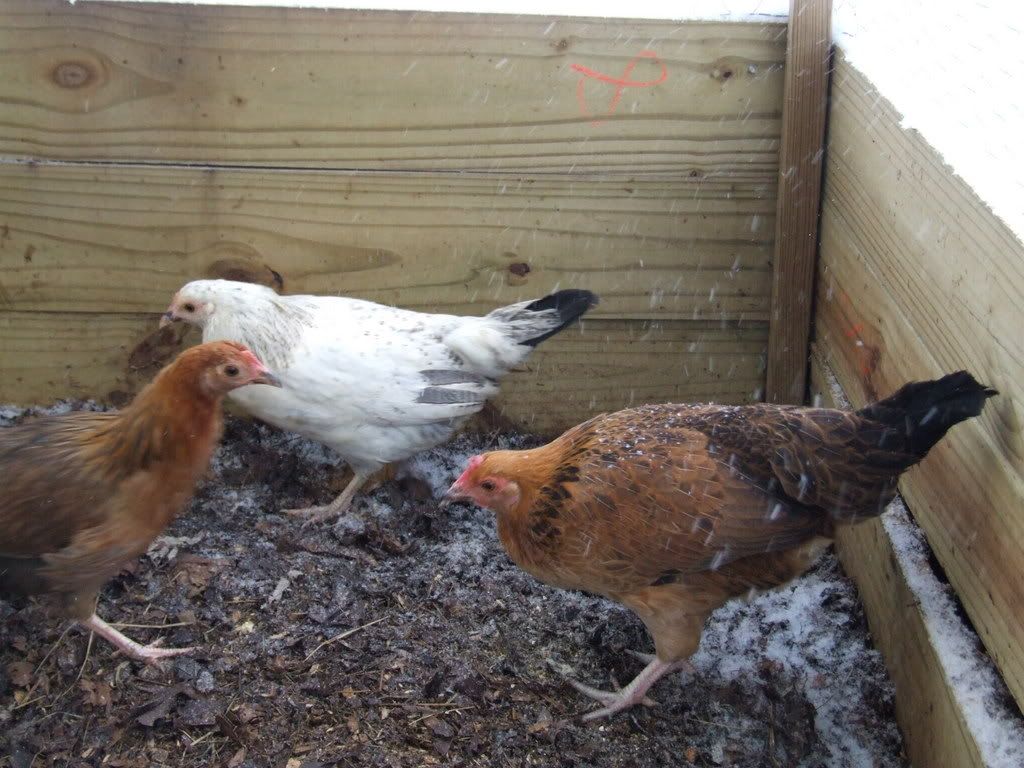
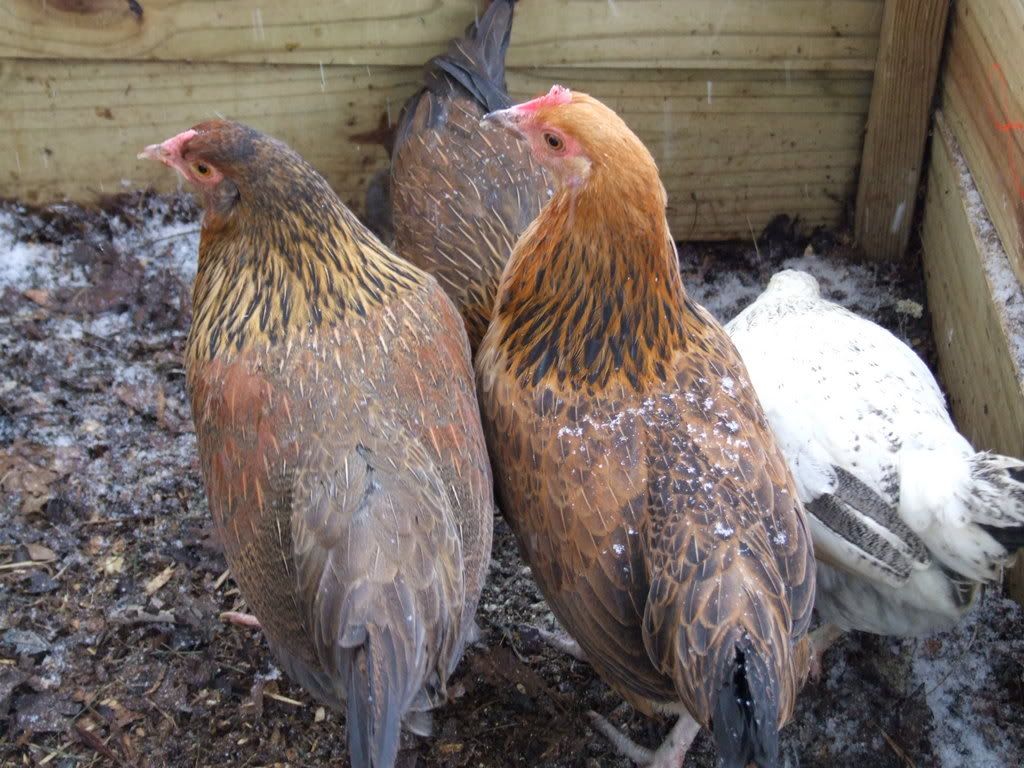
It's hard to get good pictures of chickens, especially when they are being periodically attacked by other chickens twice their size. However, here are some photos of the new girls.

These are the first three. The one in the back has tufts of feathers over her ears, which might get more pronounced as she gets older.


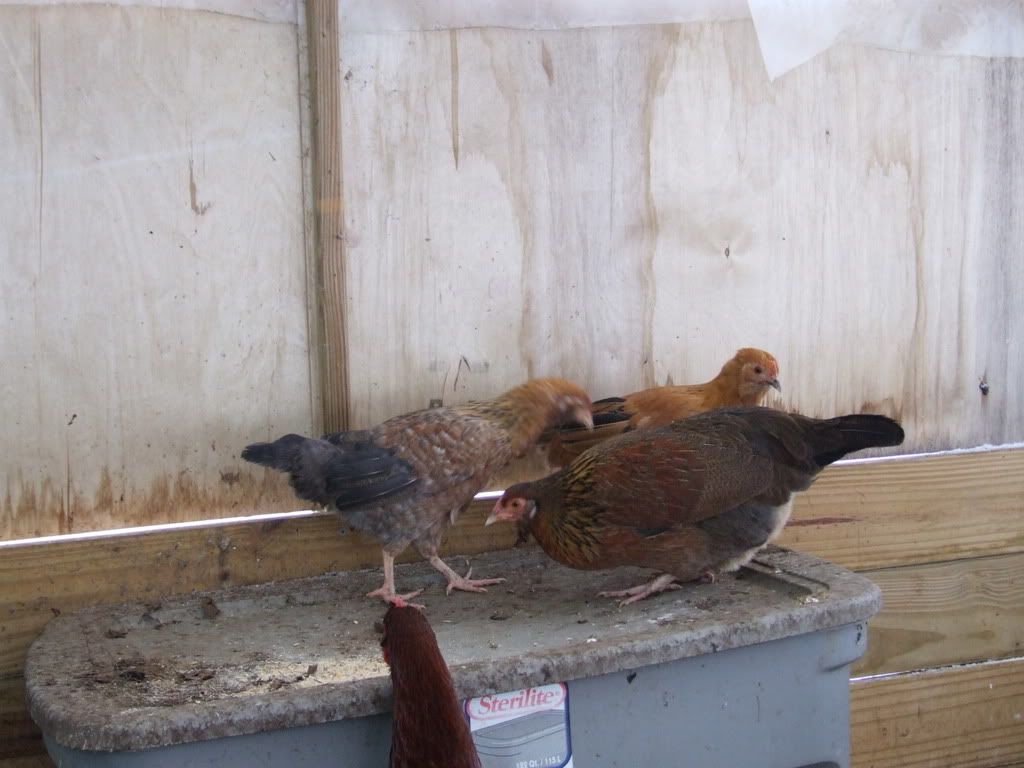
Here are the second three. I'm a sucker for white birds, so I really like the white one in the back. Her neck feathers are lightly barred and are very pretty.


I was trying to get a good picture of the ear-tufted one, but she's even more flighty than the others, so this was the best I could do.


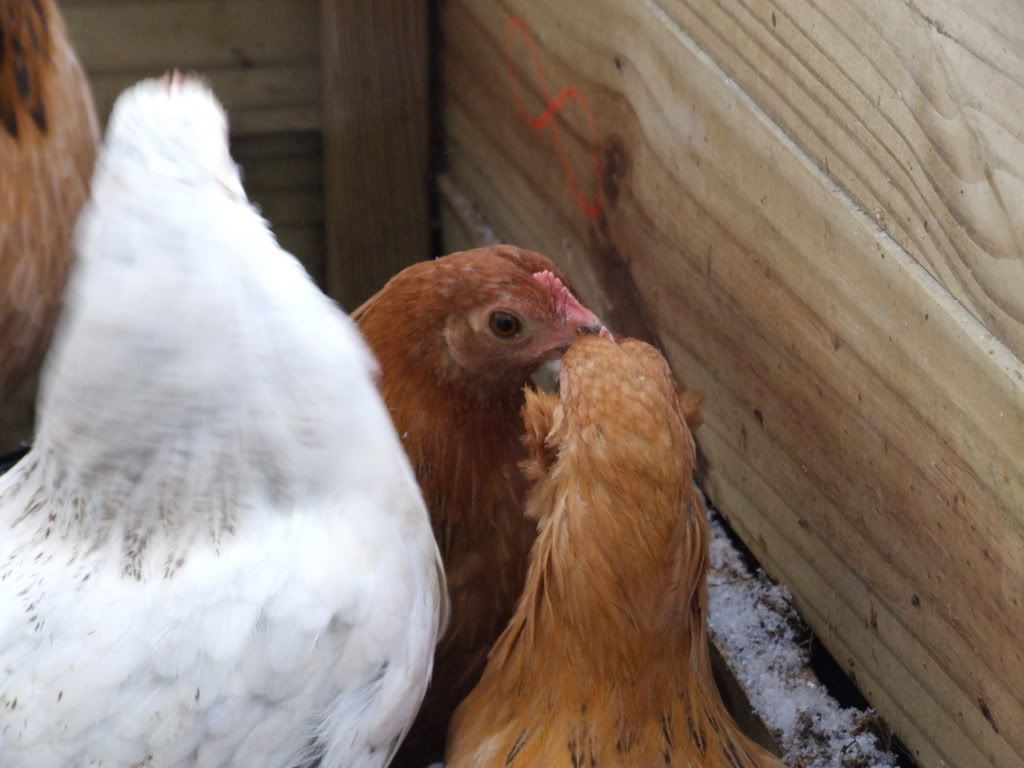
A close-up of multicolored feathers.


If anyone has any ideas what breeds might be in these chickens, let me know. I'm pretty certain that a significant portion of their background is bantam breeds, because they fly very well.

Tuesday, December 04, 2007

Laying Hens: Generation 1.5

We sold our riding lawnmower to a couple in town today, and while I was talking with them I mentioned that I kept a flock of chickens. They immediately wanted to know if I wanted to have any more, because they were reducing their flock. Since they were free, I agreed to look at them.

I guess that several months ago they were given a hen with about ten chicks, all of unknown ancestry. Now that the chicks are a few months old, they wanted to get rid of most of them. I only wanted the pullets, since I don't feel like slaughtering a batch of roosters this winter (and I especially don't want to deal with them if they start crowing before they reach a good slaughter weight). I have no idea what breed(s) they are, but I ended up with six nice-looking little birds. One possibility was Americauna, but their "mother" lays brown eggs, not blue and green. She also looks a lot like them, so she's probably related even if not the actual mother of all of them. It will be interesting to see how they turn out. They seem to have finer frames than I remember the Rhode Island Reds having at that age, so they might end up being some combination of bantam breeds. It was getting dark when I put them in the chicken house, so I'll have to get pictures later.

My flock didn't quite know what to make of these newcomers. They all grew up together, so their social structure was established very easily. It was definitely a vivid demonstration of the "pecking order," as each of the hens seemed to have a goal of eating at least one feather from every new pullet. Hopefully the new girls won't be bald by morning.

With extra chickens in the house, they may not be able to keep the bedding as scratched up as before, so I'll have to watch out for capping. That's the nice thing about starting out with a large amount of space/bird: there's room to take advantage of these sorts of opportunities. Even with adding half again as many birds, they still have 3.5 square feet each. Once I build the new external nest box, it will make things even more roomy.

Since the new pullets are at most three months old, we'll probably start getting eggs from them in early March. This will give us a nice boost in next year's production.

Monday, December 03, 2007

Dairy Goat Deferred

I had said previously that I wanted to get a dairy goat this fall for spring milk (either already bred, or she could be bred to Bubba). It's been so difficult to find dairy goats around here that I would pretty much accept any breed, even though I would prefer a Nubian.

There was a lead at a farm about an hour away. They had goats, and wanted to sell a couple of Nubian/Toggenberg crosses (that were bred to a Boer cross buck). The does were four years old and had never been milked, and were due in February (yikes!). Still, the asking price of $125 each wasn't bad so we went out to take a look.

Well, it turned out that the buck had gotten out a few times, so the does were possibly due to kid at any time. They weren't in bad condition as far as their weight was concerned, but their feet were a mess. One of them had a hoof that was so long that it had turned under and she was walking on the sidewall. I've never had to correct a hoof that long, but my experience with bad hooves is that it takes a long period of frequent trimming to get them anywhere even approaching normal. That doe also had a mismatched udder, and the larger half was nearly dragging on the ground. Oh, and she had at least one extra teat sticking out of the side of the udder. She was such a mess that I wouldn't have taken her even if she had been free (you have to figure that each goat will add at least 500 lbs to your winter hay needs).

The other doe wasn't anywhere near as bad. Her hooves were overgrown, but they looked like they would take less than six months to correct. I think her udder was reasonably high, balanced, and without extra teats, but she was so skittish it was hard to get a good look. Because of the skittishness, hoof neglect, lack of a milk record, and lack of breeding record (as well as her age and crossbredness), I offered $100 for her. I actually think that was even a bit high, but I didn't expect them to go any lower. They hemmed and hawed a bit, but when it was clear that I was serious in my offer, they declined it, saying they could get that much for her kids. It was just as well, because I would rather spend $200-$300 on a decent, non-show purebred from proven milking lines. I just need to keep working the connections to find something like that.

At this point, it's probably too late to get a dairy goat for this year. I would want to keep her in quarantine for two weeks, and with the weather getting bad that would be difficult to manage. Time to start contacting all the goat breeders in the area, to see if I can get a freshened doe in the spring.

Friday, November 16, 2007

Egg Tidbits

During the summer, I fed the laying hens a blend of 18% broiler feed and cracked corn, about 1-1 proportions. They picked up the rest of their protein needs from the insects on pasture, and crushed oyster shells were supplied free choice separately for calcium. In early November I ran out of cracked corn, so they got the straight 18% feed for a few days. The egg production almost immediately jumped from 4-6 eggs per day to 6-8 eggs per day! It makes sense, since there are fewer insects available now. So they will continue to receive the higher protein feed for as long as they continue laying this winter.

Some of the eggs were looking pretty big, so I looked up the weight requirements for the different sizes. According to this USDA publication,


Size or weight classMin net weight/dozenMin weight/egg
Jumbo30 ounces2.5 ounces
Extra Large27 ounces2.25 ounces
Large24 ounces2.0 ounces
Medium21 ounces1.75 ounces
Small18 ounces1.5 ounces
Peewee15 ounces1.25 ounces


The most recent dozen eggs had a net weight of 26 ounces, so they were nearly Extra-Large. I need a more accurate scale to measure the individual eggs, since my kitchen scale only has marks for ounces. Still, if my pullets are laying such large eggs now, just imagine how big they should be after they fully mature.

The hens will be moving into their winter quarters (the brooder house) tomorrow. It's not too cold for them to be out on pasture, but we've now entered the fall rainy season, and it's pretty muddy out there. If I let them stay, they'll cause a lot of damage to the pasture. There's not a whole lot left for them to eat out there, anyway.

Agriculture Resources

After reading some great excerpts from old agriculture books, I've decided to collect as many as I can find that are pre-1940. I found some very promising ones at the Antique Mall in Barnesville.

Agriculture Yearbook, 1924. Topics include hay, poultry, and weather, as well as the agricultural statistics for the year.

Yearbook of Agriculture, 1935. Includes the previous year of agriculture, new developments, and statistics.

Yearbook of Agriculture, 1936. Topic: Genetics and the improvement of plants and animals. No statistics, because this was the first year that they were moved to their own volume.

Pork Production, by William W. Smith. 1937. Extensive information on all phases of pork production, including several chapters on forage and several more on feeding other agricultural by-products (skim milk, whey, etc).

Old McDonald Had A Farm, by Angus McDonald. 1942. This one is actually a biography, but I couldn't resist after reading the author's note at the beginning.

"This book is about my father, James Angus McDonald, and how he labored to make a good farm out of a poor one. I lived on this farm with him and my brother, sister, and mother from 1912 to 1922, near Sallisaw, Oklahoma."

I have no idea if it will be any good, but there might be some agricultural gems hidden in the prose.

There was also a cardboard box filled with herd registry books for the American Jersey Cattle Club from the 1890s. The entire box was $50 and I was really tempted to buy it, just because I like poring over that sort of thing. Plus, if I ever get into full-sized dairy cattle, Jerseys are probably what I would get. I managed to restrain myself, although if the box is still there next time I go down there, I may not be able to resist again. Other than the registry books, I pretty much cleaned them out of agriculture books.

Tuesday, November 06, 2007

Some Musings on Future Endeavors

Potential Projects for 2008

Animals

Cattle: I would like to get a couple of 18-month-old steers next spring to graze our pastures. They would be slaughtered in the fall.

Chickens:
  • Layers: This year's hens should really start producing a lot of eggs in the spring. I would like to build a hoophouse green house for winter poultry keeping, so that I can have more than twelve hens. I'll also be buying another batch of chicks.
  • Broilers: Since I actually have the pasture pen finished now, I'll go ahead and get a batch or two of Cornish cross broilers. I'll also probably get the next batch of layer chicks straight-run, so that the cockerels can also be used as broilers. Perhaps I'll also attempt to caponize a few of them.

Ducks: The ducks will be the advance forces in the war against brain worm. I need to look through the duck breeds and see which are the best foragers. I also plan to get Muscovies to keep the fly population down near the goats.

Goats: We'll continue with the Boers, hopefully getting a good kid crop in the spring. I will be keeping all of the good-quality doelings for future breeding. I'm also looking for a dairy goat this fall to provide milk starting in the spring.

Pigs: While Paul is gone, pigs will be in the garden area tilling the soil and eating weeds. I will be planting oats behind them in the summer for winter forage and to keep weeds to a minimum.

Turkeys: Turkeys have been such a disaster this year that I'm not sure I want to try them again so soon. I'll have to make that decision next summer.

Structures

Fencing: I want to finish the perimeter fence around the forest next year. I also want to divide the forest into paddocks so that I don't have to use the electric netting out there. I'd like to save it for the dairy goat on pasture.

Poultry House: With the addition of ducks to my flock, I'll need more space than the brooder for winter housing. I'll probably get a hoophouse kit to build a combination poultry house for the ducks and layers.

Water: I plan to dig out a very small pond at the base of the spring run-off and put a second storage tank nearby. The tank would provide water to the forest paddocks so that the other tank can be used only for the pastures.

Monday, November 05, 2007

A Few More Goat Notes

I'm beginning to see a pattern here:

The only hitch was that early in the process, Nieuw apparently jumped the fence into the next paddock, although neither of us saw her do it.

One section of fence sagged enough that R6 Nieuw got out.

Yesterday, I caught her in the act. She's been going under the fence, not over. Since the bottom-most strand of the electric netting is neutral, she's discovered that she can flip it up with her nose and scoot under, especially if the fence is "floating" on top of heavy vegetation. So yesterday I had to chase all the goats back into their previous paddock and then use my scythe to cut a fenceline for the netting. Once it was flush with the ground, I staked down each section with tent pegs. It seems to have worked, because everyone was still in their paddock this morning.

Also, Bubba seems to have figured out not to stick his head through the fence, because I haven't had to rescue him since the last time I posted about it. So he got a reprieve from wearing a pvc pipe across his horns.

Thursday, November 01, 2007

Working the Goats

Paul and I spent the morning catching goats, deworming, trimming hooves and determining ages. It was downright relaxing compared to the rodeo of last time. This time, I had a cattle panel bent into a half circle and held in place with T-posts (actually, this was the remains of Bubba's pen.) I had set up their paddock fence so that one end ran flush with the cattle panel, so any goats that ran that way hit a dead end. It worked pretty much flawlessly, and since it was so easy to catch each goat the remaining ones never got too worked up.

The only hitch was that early in the process, Nieuw apparently jumped the fence into the next paddock, although neither of us saw her do it. We just left her for last so that she thought she'd gotten away with it, then snuck up and cornered her. Her "shortcut" turned out to be not so short, since we had to drag her all the way back to the first paddock to be treated, and then all the way back to the new one.

Based on how today went, I have a few ideas for building an actual working pen. It will be made of wire panels and T-posts, so if it needs to be tweaked (or completely changed), it will be easy enough. I did a quick sketch of the plan in Paint, so it's pretty ugly but hopefully it makes sense (click on it to see larger version).


The chute is pointing at the driveway so that a trailer could be backed up to it for easy loading. I estimate that it should cost less than $500 to build, with the majority of the cost coming from the panels. That's a far cry from the multiple thousands you can spend for pre-made working equipment. Since I doubt we would ever have more than 30 breeding does on this property at once, we don't need the fancy equipment.