Friday, June 06, 2008

Deerfly Season

Today was the first day this year that the deerflies were out in force. There doesn't seem to be any pattern to when they're around. Last year it was mid-May, the year before it was August. They appear for several weeks and then that's it for the year.

I tend to have a pretty strong reaction to deerfly bites. Nothing major, but the bites swell up and are maddeningly itchy for weeks on end. The first year was the worst, since my immune system was already on overload with all the new viruses, bacteria, fungi, and allergens that didn't exist in Arizona.

Last year I tried out deerfly patches, and they worked wonderfully. I guess there is a pretty small population on our farm, because after I had trapped about 20 of them they were no longer a problem. Those 20 just seem like hundreds because they are so aggresive!

So far I've trapped five, plus there was one that I smashed when it bit me on the leg. It's a little bit odd to walk around with a buzzing hat, but it's better than getting bitten. I highly recommend these patches for anyone dealing with deerflies.

Thursday, June 05, 2008

Disoriented Ducks (and Chickens)

Today it was time for the first big paddock move for most of the poultry. The Reds are of course old hands at this, but it was quite the shock for the rest. My normal method is to herd/lure all of the birds into the house, shut the door, and then move it to a fresh spot. While they're still contained in the house, I take down the electric netting and set up a fresh section of pasture.

The ducks were easy enough to herd into the house, and the Reds were easy enough to catch. However, those little Wyandottes were too fast to catch and had no interested in being herded. So I went and made myself a chicken catcher out of brace wire. The wire was not quite stiff enough to be used for the full length, but it got the job done. I plan to find a small sapling to attach just the tip to, so that I'll have more control of it.

After snagging all of the chicks and stuffing them in the house, it was nearly dark. The rest of the move went smoothly, and hopefully they'll all get the hang of it soon enough. If not, I have a chicken catcher and I'm not afraid to use it.

Wednesday, June 04, 2008

Porkers

I've wanted to get pigs for a while, but since I've never raised them before I was a little bit reluctant to start (mostly subconsciously). However, I spent a few hours researching pigs online, and it looks like feeder pigs, at least, are very easy to keep. There are a few things that they need:

  • Fencing
  • Feed (mostly corn)
  • Water
  • Shade/Shelter
I already have a movable shelter, which the goats spent the winter in. It's more than big enough for a pig, and it should be sturdy enough to withstand being rubbed on.

For the fencing, I will be using electric netting. It's the same kind that I use for the goats, except that it's three feet tall instead of four feet. I understand that pigs can be contained with just two strands of electric wire, but that is more difficult to move around and I'm less familiar with it. The main thing problem with netting is that pigs can cover the lower parts of the mesh with dirt, making it less effective. However, I think as long as I check it every day, it should be fine. The higher wires still work, even if the bottom ones are grounded out.

I don't want to spend over $100 for a special pig feeder when I'm not sure that it's something I'll keep doing, so I ordered some show pig feeders for $20 each. They hang on the fence and have a chain that keeps the pig from flipping them up. Obviously, I can't hang that on the electric netting, but I can leave a short section of the woven wire fence available for that purpose. I'm also going to keep my eye open at auctions and such for used pig feeders for a good price. I've read the high corn prices and low pork prices are driving a lot of pork producers out of business.

At this point, I've ordered everything I need. Now I just need to set it up after it arrives, buy some feed, and buy a feeder pig. First paddock location will be the packed down straw and goat manure from this winter. Once that is all turned up and mixed in, I'll plant corn on it. As a sidenote, I plan to grow open pollinated corn, which has a higher protein content than the hybrid varieties. I've read that open pollinated corn can be used as a complete feed for feeder pigs on pasture, no additional protein needed.

The good thing is, everything that I'm buying for pig keeping can be easily used with other livestock if I decide that I never want to do this again.

Tuesday, June 03, 2008

Dreaming of Duckling

The ducks turned eight weeks old on Monday, so it's just about time to slaughter the excess Pekin drakes. In Arizona, I had tried dry picking the ducks that I slaughtered, but it never worked well. In every case, I gave up in frustration and skinned them instead. Dry picking is supposed to give you better quality down feathers, but that doesn't mean much if you can't get them off the bird in the first place!

This time I will be scalding them before plucking, just like I learned to do on the chickens last year. The only difficulty is that I don't have any pots big enough to dunk a duck in. Somewhere on the web, I saw a tip for scalding geese: pour boiling water into a metal garbage can until there's enough to dip the bird in, and once the water cools to the right temperature you can scald. I plan to try this with the ducks, but I need to get a clean garbage can first.

The big thing I'm looking forward to is the rendered duck fat. That stuff is delicious, and great for cooking. The cast iron griddle seems to like it even better than bacon grease.

Friday, May 30, 2008

Flock Integration

"And it came to pass that the two great nations of fowl, the Anitadites and the Galluseans, met in battle on the plain. And there was much squawking and gnashing of beaks, for each knew that they would never reign supreme again."


Yes, tonight the ducks and layers were combined into one pen. The hens were offended by the large, boorish creatures in their house, while the ducks were terrified by the very idea of a house.

Found It!

I took a closer look at the neighbor's pastures, and found the source of the pond's water. There is a little stream that runs down the hillside and into the old creek bed. It should not be too difficult to pipe that over to a trough for livestock.

There is a lot of wildlife back in there. Yesterday I got a close look at a blue heron in the pond, and tonight I conversed with a screech owl. It called to me, and I whistled the song back. I tried to get a picture, since it was sitting just above me, but it was too dark to turn out very well. After lightening the photo, you can kind of see the owl in the middle of the picture.

Thursday, May 29, 2008

Auxiliary Pastures

Today I took a few minutes to go look at the neighboring pastures that I now have access to. They were a very good example of what happens when a pasture only gets cut once a year. Weeds were nearly choking out the grass for much of it, and brambles were starting to pop up at the edges. It's actually perfect forage for goats, but I don't have enough goats to go clear it, at least not without neglecting my own farm.

I'm thinking that if I get any more goats at auction this year, they can work in those pastures during their quarantine. Then, after they've cleared the weeds and grass has grown up, I'll put cattle in there.

The big issue with those pastures will be water. The creek used to run along the edge of them, but sometime in the last 50 years it was diverted and a causeway was built for the road to run along. Now the creek is on the opposite side of the road from the pastures. It was actually kind of creepy to look through the trees and see the old creek bed, dry and empty. Just before the creek bed hits the causeway, there is a small "pond." This is in quotes because I don't think it gets more than a few feet deep at any point. I could pull water from there, but it's so nasty-looking and choked with algae that I would worry about the water quality. I need to do a more detailed survey and see if there are any other water sources that I could use.

Hay Storage

Since we don't have a barn, I've had to get creative with hay storage. Last year I experimented with several types of haystack, but I didn't have enough skill to make them water resistant. The final stack was made by criss-crossing branches on the ground to keep the hay up, with a large tarp over the top to keep water off. This worked reasonably well, but since the tarp rested on the top of the hay, any moisture would condense and soak the top layer. Also, a number of field mice took up residence underneath.

I have a couple of different things to try this year. According to the book The Lost Country Life, here is how an English haystack was built:

A stack of hay always had some foundation; it could be built upon a level flooring of stones, covered with a deep layer of still-green bracken, which does not seem to have 'risen damp' to the hay... The reasons for this bracken foundation were that through it the air could pass easily (it does not pack close like hay), and that it raised the valuable hay several feet off the damp ground and was rat-proof -- rats will not gnaw through bracken, for it, like horse tail, makes their mouths sore.


I don't know that we have actual bracken around here, but there are several different kinds of ferns. The hillside across the road has quite a few, and I have permission to cut as many as I want. It's very labor intensive to gather the rocks for the foundation, so I'm only building one of these haystacks this year. I calculate that it will hold approximately 1000 lbs of hay, which is 1/5 the amount I need for the goats.

I have also sketched out some ideas for racks that would store hay completely off the ground. I'll describe it more fully and take pictures once I've built them and made sure that they work, but basically there would be a frame to hold my large tarp off of the top of hay, and several smaller frames underneath to hold mounds of hay off of the ground.

Finally, I plan to get large burlap bags and pack some of the hay into them for storage in our garage. If I get the construction rolls (6' X 1500') and cut them down into 3' X 6' bags, each bag would hold approximately 50 lbs of hay, or comparable to a bale. The bags would be for backup, in case anything happens to the hay stored at the field. I would probably also use them on days with heavy snow or ice, where I would be unable or unwilling to get the hay out of the haystacks. Buying the burlap for the bags will be slightly more expensive than just buying that quantity of hay, but the bags would be reusable for many years.

Sunday, May 25, 2008

Old Farm Resources

Back in November, I visited the Barnesville Antique Mall and cleaned them out of old agriculture books. I got a chance to go back today. The box of Jersey cattle registries was still there, but I was far less tempted to buy it this time. There were only a few new agriculture books.

The New Agriculture, by Henry Jackson Waters. 1924. A textbook covering crops, livestock, soil management and bookkeeping, complete with questions at the end of each chapter.

Horticulture Enterprises, edited by Kary C. Davis. 1929. Another textbook, discussing various crops: fruit trees, strawberries, grapes, onions, beets, asparagus, rhubarb, horseradish, celery, and mustard, as well as woodland management. Not only does this one have questions at the end of each chapter, but it also has field and laboratory exercises to complete. The book also came with a USDA Farmer's Bulletin tucked into its pages, titled "The Farm Garden in the North" (1922).

After picking through the book room, I wandered downstairs to the farm implements closet. There were some interesting old tools there, but nothing really caught my eye. I had hoped to find something useful in there, at the very least as a model.

The last section I looked in was the basement, where a lot of the things that weren't nice enough to go upstairs were stored. Boy, what a treasure trove down there. I found a sickle that was only $5. It was a bit rusty, but otherwise in pretty good condition. I didn't think to take a picture of it before I started cleaning it up, but here it is after sanding most of the rust off and applying a few layers of linseed oil. It still needs to be sharpened, although it's already sharp enough to decapitate a burdock plant.


I also found an ox yoke, but it was $65 so I didn't buy it. It was nice to be able to hold one in my hands and really inspect it; I now have more confidence that I can carve one based on instructions I found online. It was very small, so I guess it was for training young cattle. I don't know, if it's still there next time I visit I might go ahead and buy it, now that I've seen some of the prices for yokes and yoke components online. It would cost $200 dollars just to buy the curved bows that hold the yoke onto the oxen's necks! I guess $65 is a steal for a yoke in reasonably good condition.


There was also a hay rake leaning up against one wall. It had been broken and repaired with electrical tape, and there wasn't a price tag on it. I don't know how well it would stand up to actual use, but again, it was nice to be able to see how a hay rake is put together. That's something else I intend to try to make at some point.


All in all, it was a great trip to Barnesville.

Saturday, May 24, 2008

Animal Power

I started thinking last week that maybe we should get a couple of calves this year to train as oxen. It will be several years before they can really work, and I think future-me would appreciate it if I took the initiative and started the project sooner rather than later. The difficulty is that oxen are worked in pairs, and our pastures just aren't big enough to support two oxen and a beef steer, not to mention hay for them plus the goats during the winter. After much thought, I reluctantly tabled the idea of oxen for a later time.

However, just a few days later our downstream neighbor came to visit. His family owns the property, but they mostly just use it for hunting. It's a huge pain for them to keep all the grass mowed down, so he offered free grazing and mowing to me. There are a couple of pastures that are too narrow for tractors, so the local farmers won't cut them for him. All told, they have enough grass that I could raise far more than three cattle at a time, so now I'm seriously looking into starting oxen this year.

From what I've read, dairy breeds (or multi-purpose heritage breeds) are preferred for working cattle. I could easily pick up a couple of Holstein calves for less than $100 each, but I'm leery of that breed. The breeders have focused so much on milk production that I wonder how well they hold up to work. Then again, since I've never trained oxen before, it might be best to start with cheap cattle, knowing that they'll probably have a shorter working life than other breeds.

Up near Tappan Lake I saw a farm with Dutch Belted cattle, which are a little known milking breed. After reading about them, I think they bear looking into. They're probably out of our budget at this time, though.

Monday, May 19, 2008

Back in the Swing

After spending Sunday resting, I cut some more of the pasture tonight. This time my muscles didn't complain at all, and I got a lot done. It's so satisfying to watch the stalks fall with every swing of the blade. I could have kept going, but the sun had gone down and I needed to rake the cut grass out to dry before leaving. Orchard grass is quite lovely in twilight, with luminescent blue-green leaves. I love mowing season.

Saturday, May 17, 2008

First Mowing

This May has been very rainy, so for the last several weeks I've been watching the pasture grass getting higher, and higher, and higher. There haven't been enough dry days in a row to get it cut and dried before the next storm rolled in. It's not so bad for the big farmers, since they use tractors to cut the entire field at once, and they bale it in a day as well. I guess the downside for them is if a surprise rainstorm comes up, it can ruin an entire field's worth of hay.

Here at Foxtail Farm, it's just me and a scythe, so I can only cut a small portion each day. I really needed to get a start on cutting, regardless of the weather, so today I set up a shade gazebo type thing that we got from Paul's aunt. I figured I could pile the cut grass under it to keep it out of the rain, and then spread it out to dry when it's not raining.

I didn't cut much grass today because the necessary muscles had gotten rather weak after some eight months since the last time I did this. I had thought I was in decent shape, what with hauling water buckets all over the farm, but today I discovered that scything uses very different muscles than water hauling. Ouch. I'm taking some ibuprofen and going to bed.

Wednesday, May 07, 2008

Problem Goats

I know I've mentioned them before, but I have two problem goats in the herd. Number 10 has a lot of Spanish influence in her, which makes her a good jumper. She can jump the electric fence from a stand. Mostly, she stays put, but she knows she can jump out any time she wants. She's also one of the most skittish of our goats, and these two things make it very difficult to catch her for deworming and hoof trimming.

Number 6 has learned how to get her nose under the bottom wire of fence (which isn't hot) and then scoots her way under it. She gets zapped a little bit, but not enough to stop her. A lot of times Bantini squirts through with her. I could probably stop her by staking down the bottom strand of fence all around the paddock, but that kind of defeats the purpose of movable fencing.

These two goats have an ultimatum. If they don't produce kids this year, they're going to auction. I might be willing to put up with their escape habits if they were good producers, but otherwise they have no place in our flock.

Tuesday, May 06, 2008

Tragedy

One of the Pekins tried to get through the electric fence, and got its wing stuck. By the time I found it, it had been electrocuted. As I carried it to the compost pile to be buried, Cerra kept yelling, "No! You have to take him back to his friends!" She doesn't understand what death means yet.

An Update That Deserves Its Own Post

On April 21st, Paul and I were both working out at the farm when a brown dog came trotting down the road. We noticed her because a passing car had to slow way down to avoid hitting her. She was friendly, so we lured her down into the pasture to get her out of the road. We decided to take her back to the house and make some found dog posters, which we later posted in the post offices and feed stores of both Adena and Cadiz. The dog was a little bit thin, but otherwise seemed to be in good condition. Even though she'd clearly been on the move for a while, the pads of her feet were not abraded and didn't seem to be sore. Here she is that first night.


It looks like she has at least a little Black Mouth Cur in her. Compare to this photo from a breeder:


After a week with no calls, we decided to name her. Cerra has grown very attached to her, so we decided to let her choose the name. She came up with "Netta," which has a nice sound to it.

Last Sunday, we started seeing a male dog that looks a lot like Netta hanging around our house. We'd never seen him around town before, so we speculate that they both had escaped/been dumped from the same place. They might even be littermates. He was very wary of people and disappeared down the alley way any time one of us tried to approach him. Even though he was thin enough that I could see his ribs, he was very mistrustful of the food I tried to lure him with. However, as long as I kept my distance, he was content to lie down and watch me work on training Netta. He seemed very interested in our activities.

Today he finally approached me of his own volition. I took Lily out (on leash, luckily) and he was right there waiting. He came right up to me and let me pet him, and after that he let me handle him. The poor guy has gotten really skinny in the week since I first saw him, but I think he'll be a nice looking dog once I get the weight back on him. I'll put up another set of signs for him, but I doubt that anyone will respond. In a couple of weeks, I'll get him neutered (Netta has her appointment to be spayed in just over a week). We're leaning towards keeping him, too, although I may look for a good home for him after he's had some training. The tentative name for him is Bibb, after William Wyatt Bibb, the first governor of Alabama. Paul chose that name, since Black Mouth Curs are a southern breed, and from what we've seen online, the red-colored ones seemed to mostly be located in Alabama.

Here he is. Doesn't he have a cute face?

Quick Update

Oh, dear. It's been nearly a month since my last post. Here are some of the things I've been working on in that time:

Our ducklings arrived on April 9th (12 Indian Runner Ducks, assorted colors, and 11 White Pekins). Two of the Runners died in the first couple of days, but the rest are doing great. The Pekins should be at market weight in about another month. We'll only be slaughtering enough males to bring us down to two or three, and we'll be keeping all of the females for breeding stock.

Something killed most of the Wyandotte chicks by reaching through the chicken wire and grabbing them. It couldn't get them out to eat, so it just kept killing. In one night, I lost 15 chicks leaving me with only 10. I think it was probably a coon, but I never caught anything in the live trap I set nearby. I surrounded the pasture pen with electric netting, and haven't lost any since.

April 28th, I moved the ducks out to the pasture. Since they require a higher protein feed than chicks, they couldn't share the pasture pen. My solution was to put the ducks within the electric netting surrounding the pen. They've settled in well and have learned to respect the electric wire. This is especially important for the Runners, since they will be one paddock ahead of the goats once they get big enough to be contained by the goat fencing.

I got a good start on the back fence a few weeks ago, but haven't gotten around to stretching it. It's a good thing, too, because there was a storm a few days ago that dropped a large, heavy branch right on my fenceline. I would have been very upset to have to rebuild that fence so soon after putting it up. At this point, all I need to do is to pound in a bunch of staples, stretch the fence, attach it to the T-posts, and hang the two gates. That sounds like a lot, but most of it goes pretty quickly. Hammering the staples is the most time-consuming; once that's finished, the rest should flow together in just a few days.

Tuesday, April 08, 2008

Garden Preparation

Yesterday, Paul went out to the garden to start preparing the soil and plant a few seeds. He quickly decided that a shovel just wasn't going to work. If he kept at it, he might have the garden ready to plant by October.

We came up with a Plan B, which was to rent a rototiller, and a Plan C, which was to buy one. I was opposed to Plan C, because it didn't seem very cost effective to buy a machine that would only be used a few times a year. Paul didn't like Plan B because it's a pain to haul a rototiller to and from the land, and to get all of the tilling done during the rental period. We finally came up with Plan D, which was hiring a neighboring farmer to bring his tractor down and till it for us, which he did this evening.

It really was the best plan. It cost about what renting a tiller for a day would be, and he did a much better job than the rental. I know this because the rental is what we did last year. So now two-thirds of the garden is tilled and ready for planting. The other third is mine to play with, and I'm going to experiment with pig plowing and corn growing (not at the same time).

Speaking of corn, due to the high prices I've decided to grow as much of my feed grain as possible this year. I want an open-pollinated corn variety, so that I don't have to buy seed every year. This guy had really good prices, and I decided to order the blue corn since I don't need a full bushel of seed (that would plant about five acres, and I'm only planting maybe an acre this year). Unfortunately, I just got my order form returned, with a note saying that the blue corn failed the germination tests so it's not for sale this year. At this point, I may just plant whatever hybrid variety the feed store is selling, and worry about sustainability next year.

Pasture Chicks

I moved the chicks out to pasture yesterday to make room in the brooder for ducklings this week. They were unhappy about the chicken crate and the travel, but it didn't take long for them to settle into their new home. Speaking of which, I don't think I ever blogged about the construction of my pasture pen.

Joel Salatin builds his out of lumber, chicken wire, and aluminum roofing. Each pen is 10' X 12' and holds approximately 90 broilers. I tried to build one of these, but I didn't get very far. In order to get 12' long boards to our property, we would have to have them delivered, which is far too expensive. I tried putting together half-length sections, but it just wasn't sturdy enough. Plus, the thing is very heavy and requires a special handcart to help move it. So I started looking for other options.

I found plans for a pasture pen built out of PVC pipe and specialized fittings (warning: the fittings are the most expensive part of the pen). With some modifications, I used this plan.
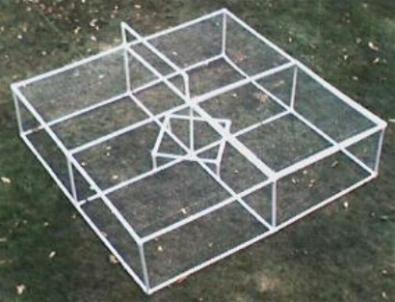


First of all, the plans don't really say what that smaller square in the middle is supposed to be. Supposedly it's a "feeder support," but it's completely useless for the feeders and waterers I use, so I just omitted it. I shrunk the dimensions from 10' X 10' to 8' X 8', giving me approximately half the area of Salatin's pens. For the time being, batches of 50 broilers are more manageable than 90 broilers, so that's fine. I wanted the height to be more than 2' to accomodate turkeys as well as chickens. It turned out that 26" was the most cost effective, because that's what was left in a 10' pipe after cutting out two 47" sections. So the turkeys get an extra 2" of headroom.

The instructions say not to glue any joints, but I found that it was absolutely necessary to glue them. Just be sure that everything is set up properly, first. I also found that simply gluing the hinges and latches was not enough given the amount of stress on them, so I further attached them with small screws (I just noticed on re-reading the instructions that it says to do that as needed. I'm observant).

I used 4' poultry fence to cover it. First I wrapped around the sides, bending the excess in on the top and bottom. Once that was secure, I covered the top and door. Be sure you do the gluing before putting the fence on, because it's a pain afterwards.

My watering system is the same as Salatin's, with an automatic bell waterer attached to a five gallon bucket resevoir. The chicken wire roof alone is not strong enough to support a full bucket, so I angled a 1X6 board across a corner next to the tarp peak for support. I used wire to attach the bucket to the peak so that it won't fall off during moves. The tarp goes over both the peak and the bucket, to protect the water from debris that could clog the tubing.

The pen is light enough to be moved by one person, but with the waterer installed and a full bucket, too heavy to blow away. I still stake down the edges with guy lines, just in case some unusual wind comes through.

I'll probably continue to make small modifications, but I intend to use this plan for the rest of the pasture pens that I make. Somewhere, I should still have the notes I scrawled to myself about quantities, prices, and lengths. If I find it, I'll post more detailed instructions.

Saturday, April 05, 2008

Perimeter Fencing

For our pastures and garden, we have woven wire fencing, with wooden corner assemblies and T-posts in between. Actually, I still have one last length of fencing to put up before the main pasture is completely fenced. Woven wire won't work for the rest of our perimeter fencing, though. The pond pasture is low enough that you hit water about two feet down. The rest of the perimeter is in the forest, where the ground is very rocky and it's impossible to go in a straight line because there are trees in the way. Also, if a tree or branch falls on a section of woven wire, that can mean that the whole section needs to be re-stretched.

My next thought was to use livestock panels. They have the extreme disadvantage of being very expensive, but they have numerous advantages. They can be bent around trees, they only need T-posts to hold them up, they can be used as gates, damaged sections can be replaced without affecting the rest of the fence, and they can be taken up and moved to another property if necessary. Granted, that last one requires renting or hiring a truck that's capable of hauling 16-foot long fence sections, but it is doable.

However, livestock panels are far beyond our fencing budget, so I've had to think further. The next possibilty I thought of was heavy duty electric netting, which is meant to stay in one place for months or years. This would be less than half the cost of the panels, with most of the advantages. An extra advantage is that these fences can be hauled in a normal pickup truck, so there would be no need to use specialized hauling. The only disadvantage is that if the power fails, the fence fails. However, that's already an issue with the movable fences we already use.

Thinking further, there's also the option of using T-posts and multiple strands of electric wire (actually, I would use Intelli-Twine). My initial calculations show that this option would be approximately an eighth of the cost of the netting. The disadvantages are that it is no longer movable (less of an issue with such a low cost), and it is more complicated to design and more work to implement.

After looking at all the options, I think that I will use the last option for most of the remaining perimeter. However, the sections near the creek are prone to flooding, so I think that in those areas I want to use the netting. That way I can remove them each winter and whenever flooding is an issue. Also, in the coming years I plan to rent additional pasture, so I'll want at least some reasonably portable fencing. I'll probably also use the netting for any internal fencing, since I'll want to be able to change the size of paddocks to fit the grazing requirements.

Friday, April 04, 2008

Pastures and Greedy Goats

The grass on the pastures is growing just fast enough to keep the goats fed. I have to move them every day, even with the huge paddocks created by using both permanent fences and the movable fences. That size of paddock lasts the better part of a week in summer. Still, they're keeping fed.

I nearly had a jailbreak today, though. I needed to get the goats from the garden to their new paddock near the water tank. In between those two places are the compost piles and assorted equipment that I don't want the dog and goats to be messing with. The only way I could do this was to set up the movable fences as a big lane, and then after they were in move part of the section to block off the compost pile. It all went according to plan at first, with the goats following me to the far end of the paddock (I was carrying hay, so it was no surprise). I thought for sure they would stay eating the hay while I set up the other end, but I guess they thought I still had food for them. They wandered back over to me after I'd opened up the end of the paddock, but before I could get it set back up properly. It took some agility, but I managed to scare most of them away so that I could get the fence set up. Bubba and Balto were the only ones to get out (it figures that the males would wander), but I knew I could catch both of them easily. Actually, as soon as Bubba realized that he was on the wrong side of the fence from his does, he found his way back in as quickly as he could. He's going to be really upset in a few days when I separate him for good. Balto of couse was no problem to catch, because he was too busy sniffing the compost pile to get too far.