Saturday, October 27, 2007

Goat Management Software

When we had goats in Arizona, I bought the Goat Breeder's Notebook software to keep track of all of the information. It's been sitting on my computer all this time, so I decided to try using it with my current goats. Oh, my. I can't believe I never noticed before how unintuitive and downright buggy this software is. I spent a fair bit of time putting in goat-related expenses, saved them all, and then none of them showed up in a report! And if you mark an animal as dead, you cannot undo it short of restoring an earlier version of the database. Yet there's no warning that it is a permanent action.

In disgust, I decided to search for some slightly more professional software. Most of what I found was either really low-level, or very expensive, but Ranch Manager: Goat Edition looked like a nice combination of quality software for a decent price. So I requested a trial version and have spent the evening playing with it. The trial version is the full program with a 30 day limit, so if I decide to buy it I'll already have all of my information entered.

So far, it has been reasonably intuitive to use, and there are some very nice features. One of the best things is that you can define different locations on your land (pastures, pens, barns, etc) and can keep track of where any given goat is at any time. The really cool part is as soon as a buck is in the same location as a doe or group of does, the software automatically calculates the earliest due dates for the does. You can also draw maps of your locations, and then add hyperlinks in the maps to the individual records.

I do have a few nitpicks. For the map thing, it would be really nice if you could upload maps as well as draw them. In the individual goat records, the photo uploader always starts in the same spot, one of the data folders for the software, so it takes a good five clicks to navigate to my image folder. It would be sanity-saving if it would remember the last folder it opened and start there instead, the way most programs do.

I've got another 29 days to play with this software, and I'm going to throw everything I can think of at it. If I'm still reasonably happy with it at the end of the trial, I'll probably buy it. This company also has special discounts if you buy more than one species' software together, which would be really nice if I had cattle, sheep, or horses. Too bad they don't have a poultry management edition.

Friday, October 26, 2007

Goat Breeding

Well, I broke down and let Bubba in with the girls tonight. See, I had dismantled his pen so that I could use the panel in the great deworming roundup, and had never put it back together. He's on a tie-out for grazing, so it wasn't a huge priority. But tonight after dusk I heard coyotes up on the ridge, and I didn't want to leave poor Bubba unprotected all night. It was too dark to put the panel back on his pen, so he had to go in with the girls and Balto. It's only about three weeks earlier than I'd planned to start breeding, and honestly, since he's young and unproven, it's probably best to start as early as possible anyhow. So kidding season should start in late March at the earliest.

Bubba was more interested in the new grass than the does. Balto thought that he smelled very interesting. He didn't spend that much time sniffing a new doe when she was first introduced. Bantini (this year's kid) ran up to sniff noses with Bubba when he first came in, but the rest of the herd pretty much ignored him.

Since at this point Bantini is the only doe I don't intend to breed this year, I won't be splitting the herd. She's nowhere near large enough to go into heat yet, so it should be fine.

Thursday, October 25, 2007

Nest Box Free Eggs

At least one of the hens has made a habit of roosting in the nest box instead of in the house, so it was starting to get filthy in there. I dumped it out and put fresh hay in it, but I also decided to leave it out of their yard for a while so that the offending hen could make a habit of sleeping elsewhere. In the meantime, the hens can lay their eggs in the grass.

It was kind of funny, because all of the eggs were together today. It looks like one hen chose a spot and made a nest, and the rest waited in line for their turn to use the same spot. That probably would have been funny to watch. I guess they've just gotten used to taking turns in the nest box.

Wednesday, October 24, 2007

Rendezvous Over a Sagging Fence

There's been a lot of rain over the last several days, so the step-in posts for the electric goat fence loosened a bit. One section of fence sagged enough that R6 Nieuw got out. I'll have to mark her as bred, since she spent as long as eighteen hours loose with Bubba. March 22 is a little bit earlier than I wanted to start kidding, but it's not too bad.

Thursday, October 18, 2007

Rodeo

Today we caught the last of the goats that needed to be dosed with dewormers. Paul and I spent a good hour chasing, cornering, roping, and tackling the recalcitrant goats. They're all done now, but we get to do it again in two weeks. And again a month later, and every month after that. *sigh* I really need to build/buy some working equipment to make this easier. Even a neck crook would probably help.

The good news is that none of these wild goats are showing any symptoms of brain worms. The bad news is that we lost another one, the bottle-baby we bought a few months ago. Also, Tally, the friendliest goat left, definitely has neurological damage. It's too soon to tell if all of the worms have been flushed from her body, but she doesn't seem to have gotten much worse in the last week. So the three tamest goats are the only ones that have been afflicted so far. As we wrestled with the wildest, meanest-tempered doe in the herd (that would be R10, Goshen), I remarked that we'll probably end up with her daughters as our foundation stock. Well, as long as they're healthy and hardy, I don't care about the temperament too much. It's not like they're dairy goats that need to be handled daily.

Tuesday, October 09, 2007

Brain Worm

Monday morning, I found Swellendam lying on the ground, unable to get up, and twitching her legs. I managed to get a vet out to look at her that afternoon. I had tried searching the internet for her symptoms, but the closest thing she matched was enterotoxemia, which didn't make much sense. I don't feed grain, and the goats had been eating pretty much the same forage as ever. Doctor Sparling took one look at her and diagnosed brain worms, which he said came from deer. He recommended fenbendazole (Safe-Guard), but said that her chances of recovery were very low. I had figured as much, since she was pretty far gone. He was unable to tell me the name of the parasite, which I'd never seen mentioned before, so I did some research after I got home.

Paralaphostrongylus tenuis

Called meningeal worm, brain worm, and deer worm, P. tenuis normally completes its life cycle in white-tailed deer. The adult parasite lives in the brains of deer, where it lays its eggs. The eggs travel through the blood to the lungs, where they hatch into larva. The larva travel to the throat, where they are swallowed and passed in the feces of the deer. Here's where things get a little bit strange. The first-stage larva in the feces are not infective until they are consumed by terrestrial snails or slugs. The larva transform into infective third-stage larva within the gastropods, with warm weather allowing them to change more quickly. Then, when a white-tailed deer ingests an infected gastropod while browsing, the larva travel to the brain and mature into adults, starting the cycle over again. The parasites generally cause no harm to white-tailed deer.

Other ruminants can be susceptible to brain worm if they eat infected snails or slugs. However, once the larva migrate into the brain, they are unable to mature into adults. Thus, they swim around in the brain and spinal cord and cause increasing neurological damage. In some cases they will travel from the spinal cord into the skin, causing itching so intense that the animal will chew holes in its hide. The camelids (llamas and alpacas) seem to be more susceptible than goats and sheep.

Since the parasite requires both deer and gastropods to complete its life cycle, only areas with high concentrations of white-tailed deer and a humid climate are at risk. There is some research showing that the instances of the disease peak three to four months after each peak gastropod season. In the Ohio River Valley, the observed peaks of disease are September/October and January/February. This corresponds to the peaks of gastropod prevalence: spring and fall.

Diagnosis

There is no way to definitively diagnose brain worm in a living animal. The only way to know for sure is to find the larva in the nervous symptom. The symptoms include lameness or weakness, paralysis, circling, blindness, and other signs of neurological distress. Some animals may recover without intervention, but even if the brain worms are destroyed, the neurological damage remains.

Treatment

There really isn't a lot of research yet on treatment for acute cases. The most common regimen seems to be dewormers to kill the larva (although there is no reliable information on which, if any, of the dewormers will cross the blood/brain barrier), steroids to reduce the inflammation while the dewormers work, and supportive care.

Prevention

Since the parasite requires gastropods as intermediate hosts, one method of prevention consists of keeping the livestock away from moist areas and woodlands. However, goats much prefer browsing in woodlands and brushy areas to grazing in pastures, and pasture grazing puts goats at much greater risk for stomach worms.

Another possibility for small farms is to put up deer-proof fencing around the property. This is of course extremely expensive, and it wouldn't prevent infected gastropods from entering. Some people spray poisons designed to kill snails and slugs to prevent the disease.

Probably the most common method of prevention is deworming every month, so that the brain worm larva never make it to the nervous system. However, there is no dewormer that is specifically for P. tenuis, so they use the standard dewormers. Deworming on such a frequent basis rapidly leads to resistant strains of parasites, many of which are a greater threat to goats than the brain worm itself.

For now, I will be deworming every month with fenbendazole, but this is only a temporary solution. I can't afford to lose anymore goats right now, but I do want to develop a management system that will not require the use of chemical dewormers on a frequent basis.

Possible Natural Prevention Strategies

The most obvious strategy (to me anyway) would be to choose breeding stock that are naturally resistant to this and other parasites and diseases. I understand that this is how the Kiko breed of goats was developed: a large number of goats were kept with no intervention, and the ones that survived, bred. As a sole strategy, this only works if you have a very large starting breeding pool and don't mind losing a large percentage of the early generations. However, in combination with other management strategies, I think that breeding for animals that require less intervention is a good long term strategy.

There are some natural dewormers out there, although as far as I know there has been no in-depth research as to their effectiveness. Some people swear by diatomaceous earth (DE), which is used as a natural way to kill many kinds of insects/arachnids. The sharp edges of the DE cut open the carapace of the insect, and it dries out and dies. I don't quite understand how DE kills parasites in the moist environment of the digestive track. I suppose that it might kill the larva in the feces once they are exposed to air, which would prevent reinfection. If this is the case, it would not prevent brain worms since they are only passed by infected deer.

There are also herbal dewormers, which often contain wormwood. Again, there is little to no research on the efficacy of these products. However, since the standard chemical dewormers work on brain worms, it's possible that if herbal dewormers work at all, they probably would work on brain worms as well.

Another strategy would be to use natural methods to control the gastropod population. There's a saying, "There's no such thing as a surfeit of snails, only a dearth of ducks." I think that turning ducks into a paddock to clean up the snail and slug population could be a very effective way to control brain worm in livestock. Especially if paddocks are kept small, so that gastropods from neighboring paddocks won't have a chance to migrate in before the animals are moved again.

I had planned to introduce Muscovy ducks next year anyway, to help control the fly population. I'll just add in some mallard-derived breeds as well to help with the gastropods. The original plan was to have the Muscovies follow the goats, but now obviously the Duck Brigade would have to precede the goats into any paddock. It would probably also be a good idea to keep a few of them with the goats as well. I know this will open up new hazards, such as coccidiosis, to the goats. I'll just have to see how it works out in practice.

So, to sum up, this fall I will deworm my goats with fenbendazole monthly until February. As soon as the weather begins to warm up in the spring, I will introduce several breeds of ducks into the paddocks to eat up all the snails and slugs. Under this system, there will still be some risk of brain worm, but it should be greatly mitigated. The long term plan is to select for resistance to all diseases and parasites. I'll probably also introduce some Kiko bloodlines into my herd to help speed that process up.

Poor Swellendam didn't make it, but at least now I know about a significant risk in my area, and can take steps to prevent further problems. RIP Swellendam; you were a good goat.

Sources:
Meningeal Worm, by Susan Shoenian

Parelaphostrongylus tenuis in the Ohio River Valley and Parasitology in Llamas and Alpacas, by Cliff Monahan

Prevention of Meningeal Worm Infection

Monday, October 08, 2007

Chicken Sale

I sold half of my laying flock today, because I only have room to keep twelve of them through the winter. My dad taught me how to tell which ones have started laying (feel how far apart the pelvic bones are), so I was able to set aside the ones that were already laying. I was honest about this with the buyer.

Despite selling eleven pullets, today was a net loss because I had to call the vet for one of the goats. More on that in the next post.

Sunday, September 30, 2007

Meet the Herd

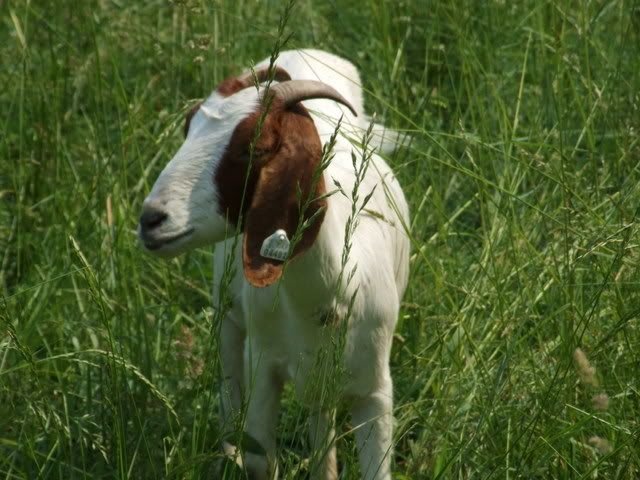
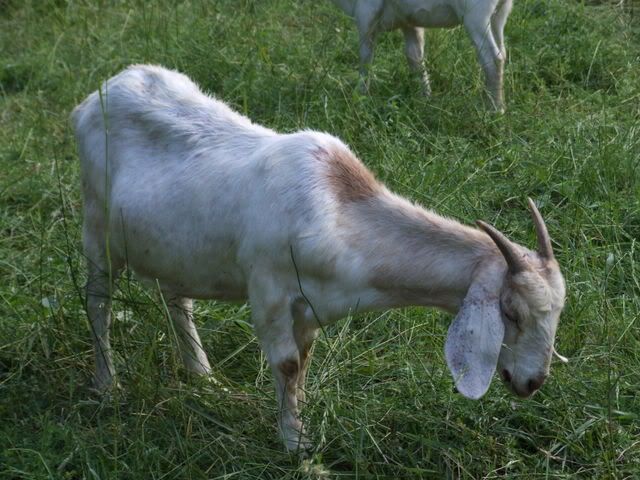
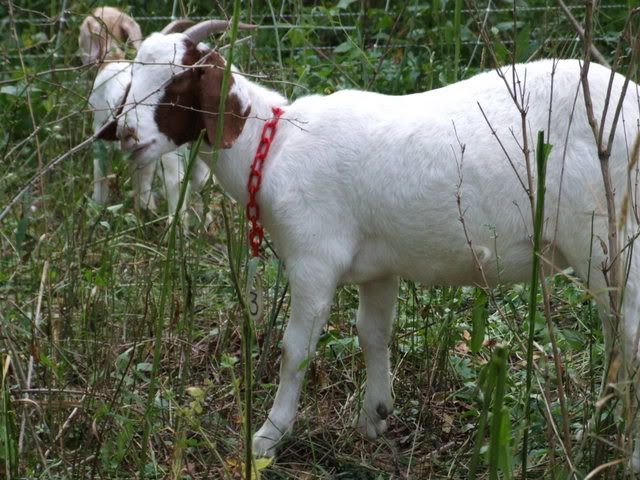
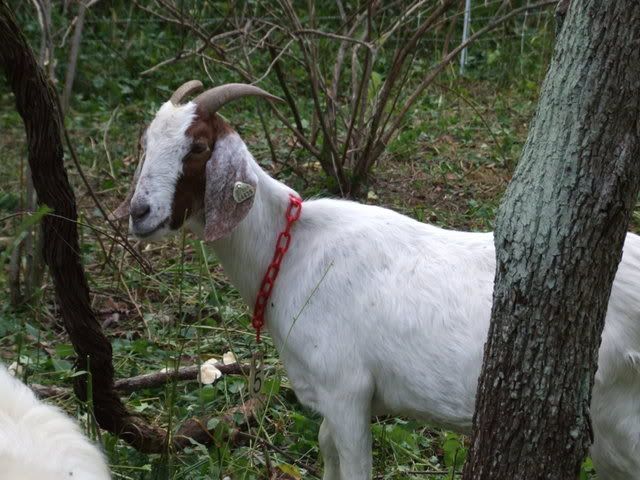
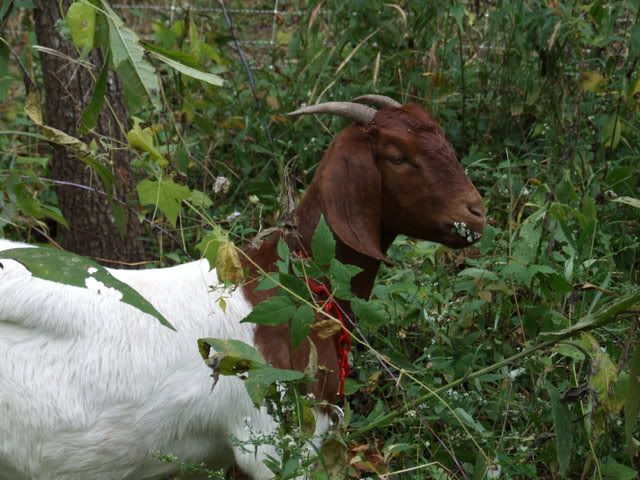
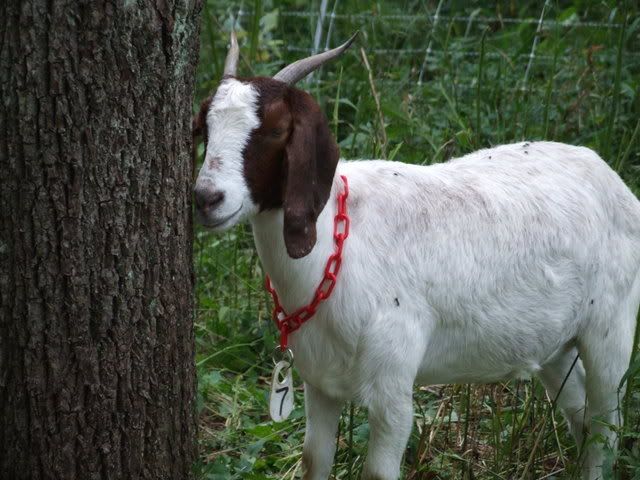
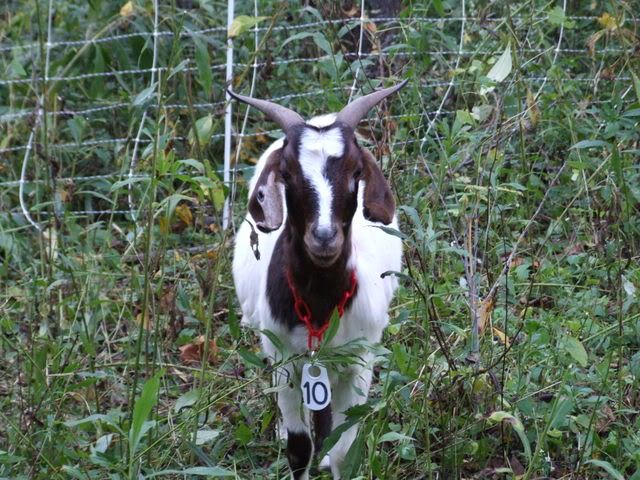
Here are our breeding does. Paul came up with the names, which are all related to the Boers in South Africa.

R1 Natalia "Tally"

R2 Swellendam

R3 Stella

R5 Ciskei

R6 Nieuw

R7 Transkei

R8 Bophuthatswana "Swana"

R9 Lyden

R10 Goshen

Wednesday, September 26, 2007

Preparing for Goat Breeding

This is our buck, Bubba. He's only seven months old, so he's nowhere near his adult size yet.


October 31 is the final kidding date for the goats we bought this summer. At that point, we'll have had them for five months, so any goats that haven't kidded by then, won't. I'll be splitting them into two herds this winter. The first will be all of the adult does except for any that kid in the next month. The second will be the kids and any of the does that kid in October. On November 15, Bubba will be turned into the breeding herd, which could be as small as one doe or as large as nine. He'll stay with them until February 1, giving us a kidding season of April 15 to June 30.

I would also like to get a Nubian doe this fall to breed for milk in the spring. I had no luck finding a currently milking doe this year, so at this point I've given that up as a lost cause. Poor Paul will have to wait another year for fresh goat's milk.

Friday, September 21, 2007

No Turkeys for Thanksgiving

I've been weighing the turkeys every week to chart their progress, and the cold weather last week really took a toll on them. They're now a full week behind schedule, so I've decided to only offer them for Christmas. I don't think there's any point in trying to sell 6-8 lb turkeys.

I've added additional protein to their diet, in the form of roasted soybeans and earthworms, so hopefully they'll start to catch up to their projected weight. I've also decided to delay putting them on pasture for one week to allow them to grow.

Speaking of pasture, I need to get started building their pasture pen. Wood and I don't get along, so I've decided to build a pvc pen with a wooden base for strength and weight. There are a few plans available online, but none of them quite meet my requirements, so I'll probably just design my own. The projected size is 8'X 8', which is a bit more manageable than Salatin's 10' X 12' pens. Next year, I'll be able to re-use the pen for broilers, and should be able to fit about 50 of them in it.

Wednesday, September 19, 2007

First Egg!

One of the Rhode Island Red pullets has laid her first egg. She even managed to put it in the nest box, which made me happy because it's a rather unusual design. I just cut a hole in the side of a large Rubbermaid container and lined it with hay. Since we already had the container, it was much cheaper and easier than trying to build something.

We used the egg to make pancakes, and they were delicious. So richly flavored.

Tuesday, September 04, 2007

The Haystack Grows

There's been a long string of good weather, so I've been frantically cutting hay. I got most of it up on the haystack today, and then decided to actually measure the dimensions rather than estimate them. It's a lot bigger than I thought! There's now just over a ton of hay on the stack, where just last week I thought I only had about 800 lbs. I have nearly a third of the hay that I need, and I haven't even finished the front pasture. After that, there's still the pond pasture, which is about 3/4 of an acre, and the overgrown grain field, which is another acre. As long as I'm able to keep cutting, there's no reason for me to need to buy any hay this winter. That is a wonderful thought.

Hay Progress:
2080 lbs/6750 lbs

Wednesday, August 29, 2007

Early Birds!

Wow, it's a good thing I got everything ready for the turkeys yesterday. I expected them to arrive in Steubenville tonight, but they were at the Adena post office this morning. They all made the trip alive, and none of them look sickly. The hatchery put in an extra one for free (which they've done every time I've ordered from them), so I have seventeen poults in the brooder.

I think I've found the solution to my protein source problem, or actually I remembered the solution. Journey to Forever has an article on how to create high-protein feed out of the air (scroll down). I just need to breed some maggots to feed to the turkeys as a supplement. High protein feed plus cutting down the fly population: a win-win situation.

Tuesday, August 28, 2007

Preparing for Turkeys

Today I finished the last of the preparations for the turkeys, which should arrive tomorrow night. The brooder has fresh bedding, the waterers have been thoroughly cleaned, and the chick feeders are clean and filled with feed.

Speaking of feed, my plan was to take my custom broiler feed (which is about 18% protein) and just add fishmeal to bring it up to 26% for the turkey poults. The only kink in this plan is that the feed store doesn't carry fishmeal, and they looked at me like I was insane when I asked for it. They were supposed to get back to me about if it would be possible to order it, and how much it would cost, but they never did and I haven't had a chance to follow up on it. I've had absolutely no luck finding an internet source, either, unless I want to buy wholesale from the fisheries. Yeah, not so much. At 76% protein, fish meal would have been very useful with these fast growing turkeys.

Apparently, dried earthworms are also 76% protein by weight, so I'll remember that in the future. I don't think I have enough earthworms to spare right now to make enough to make a difference, but I can start harvesting, drying, and storing them for next year's turkeys. In the absence of both fish meal and worm meal, I had to go with roasted soybeans, which only have 37% protein. I had wanted to find something other than soy, since that was already the main protein source in my broiler feed. It will take 8 parts of roasted soybeans to 11 parts of the broiler feed to get 26% protein.

Saturday, August 25, 2007

The Conclusion of the Chicken Marathon

Well, it took two all-day sessions with Paul helping me, but we got all of the broilers processed. Just in time, for the turkey poults arrive next Wednesday. Now that I'm done with the broilers for the year, here is what I learned:

1. It's absolutely imperative to actually get the birds out on pasture, the earlier the better.

2. Bedding was a huge hidden cost that I forgot to take into account when I figured my costs. It takes two bales of shavings (costing $5-$7 each, depending on quality) to cover the floor of the brooder. Those two bales would have easily been enough for the two week minimum that the chicks need to spend in the brooder, however, as the chickens grew they produced more and more waste, and thus needed more and more bedding. Next year I will already have the broiler pen (since I absolutely have to get it built for the turkeys), so it won't be a problem. In the future, I will require myself to have additional field pens completed before the chicks are ordered.

3. They grow incredibly fast, and the next size of feeders and waterers need to be ready to be put into use at mininum notice. This year, I was always scrambling to keep up with the chicks' increasing appetites.

4. Now that I've personally slaughtered 45 chickens, I have a pretty good handle on how to do it. Next time I need to force myself to get them all slaughtered in a timely manner, so that I don't have to keep feeding them for months past the typical 8 weeks. I've also realized that since we have very little space to work, a scalder is useless without an automatic picker. It does no good to scald several chickens at once when there's only room for one person to pluck them. So we'll have to keep doing everything by hand until we can cough up the $600 to buy a basic scalder/picker set (or until we find used ones that we can afford). Until we have that, I don't think it will be possible to raise more than one pen of chickens (75-90) at a time.

5. Cornish cross chickens really can't stand high heat once they're more than about a month old. Most of our 30 losses were due to really hot days where they just keeled over. Getting them out on pasture should help with that.

Hopefully I'm now past the steep part of the learning curve, and next year will run more smoothly.

Tuesday, August 14, 2007

Hay Calculations

I've spent much of the last few months learning how to make hay by hand, starting with a scythe. I've gotten good enough that I think I can harvest the bulk of the hay that my goats will need for the winter. It was hard finding an estimate of how much hay goats will eat, but the number I found was 5 lbs/goat/day. At 15 goats for 90 days, that works out to 6750 lbs of hay.

It was even more difficult to find a formula to estimate the weight of a given volume of loose hay. Finally, I found a Canadian site which said that there were 60 kg/m3. That works out to 3.75 lbs/ft3. Assuming that I did all of the calculations correctly, I need 1800 cubic feet of loose hay.

The weather has been dry this week, so I've been cutting hay every day. This will be the first time cutting the entire pasture by myself (last time the goats helped). I think it's quite likely that I'll have enough hay just from this cutting, but there should be another cutting before winter to give me some surplus.

Friday, August 10, 2007

Jewish Pickles

Up until yesterday, I had no idea that cucumbers could be preserved in a salt brine just like kimchee, but apparently that's the old Jewish way of making dill pickles. So I'll be trying out this recipe with our smaller cucumbers. I'm fascinated with all kinds of fermentation, so this is right up my alley. Plus, if it works, it's so much easier than vinegar pickling!

The large cucumbers are still slated to become dill spears in a vinegar brine.

Processed today:

Jewish Dill Pickles, using all of the small cucumbers (forgot to weigh them).

Thursday, August 09, 2007

More harvest

Harvested today:

Radishes, 6 ounces. These are pretty tough and woody, so they won't be any good for eating raw. They might be okay grated into a soup or something similar.

Potatoes, 3 lbs. Most are pretty small, including a few the size of a large pea, so we'll see how they taste. They're Yukon Gold variety, which is a baking potato.

String beans, assorted, 1 lb. Green, wax, and burgandy beans. These will probably just be cooked up for a side dish one day.

Processed today:
Salsa verde, 3 cups, using 1-1/2 lbs of tomatillos from the house garden.

Wednesday, August 08, 2007

Cucurbita Explosion

Harvested today:

Pickling cucumbers, just under five pounds. The amazing thing is that there were only a few cukezillas in the batch; most of them were a decent size. These are slated to be dill pickles, either whole or spears (depending on size).

Zucchini, two and a half pounds. The bad thing is that they are only two squashes. Zukezilla!

Acorn squash, one at one and a half pounds.

Unknown squash (turns out it's a scallop squash), one at three-eighths of a pound.

I had planned to slaughter a batch of chickens tomorrow, but now I think I'll be pickling instead. The cucumber situation is becoming serious.

Also, we have a ton of mustard greens that I was too busy washing and putting away to weigh. However, the freezer still has nearly all of last year's mustard greens still stored, so it's not like we need anymore. They are apparently good for trading, though, since Paul traded a gallon bag of mustard greens for a hat full of homegrown tomatoes. Our tomatoes are still small and green, so they were a nice treat.

Monday, August 06, 2007

Gobble Gobble

After waffling for a few months, we decided to raise turkeys this year. The poults will be hatched on August 28, and they'll be 12 weeks old just before Thanksgiving. They should be 15-20 lbs dressed weight by then, or maybe a bit less. The minimum order from the hatchery is 15 (we bought 16 because that put us in a lower price bracket), so we'll need to find buyers for most of them. Even if there were nothing else in our freezer, we couldn't fit 16 turkeys in there.

So, if anyone wants a homegrown, pasture-raised turkey for Thanksgiving or Christmas, let us know.